Congressman Jo Bonner to Headline Mobile GOP Gathering
First-term U.S. Rep. Jo Bonner was announced as guest speaker for Mobile's Grand Old Party at a midtown restaurant, with free admission for members and a $10 charge for the general public.
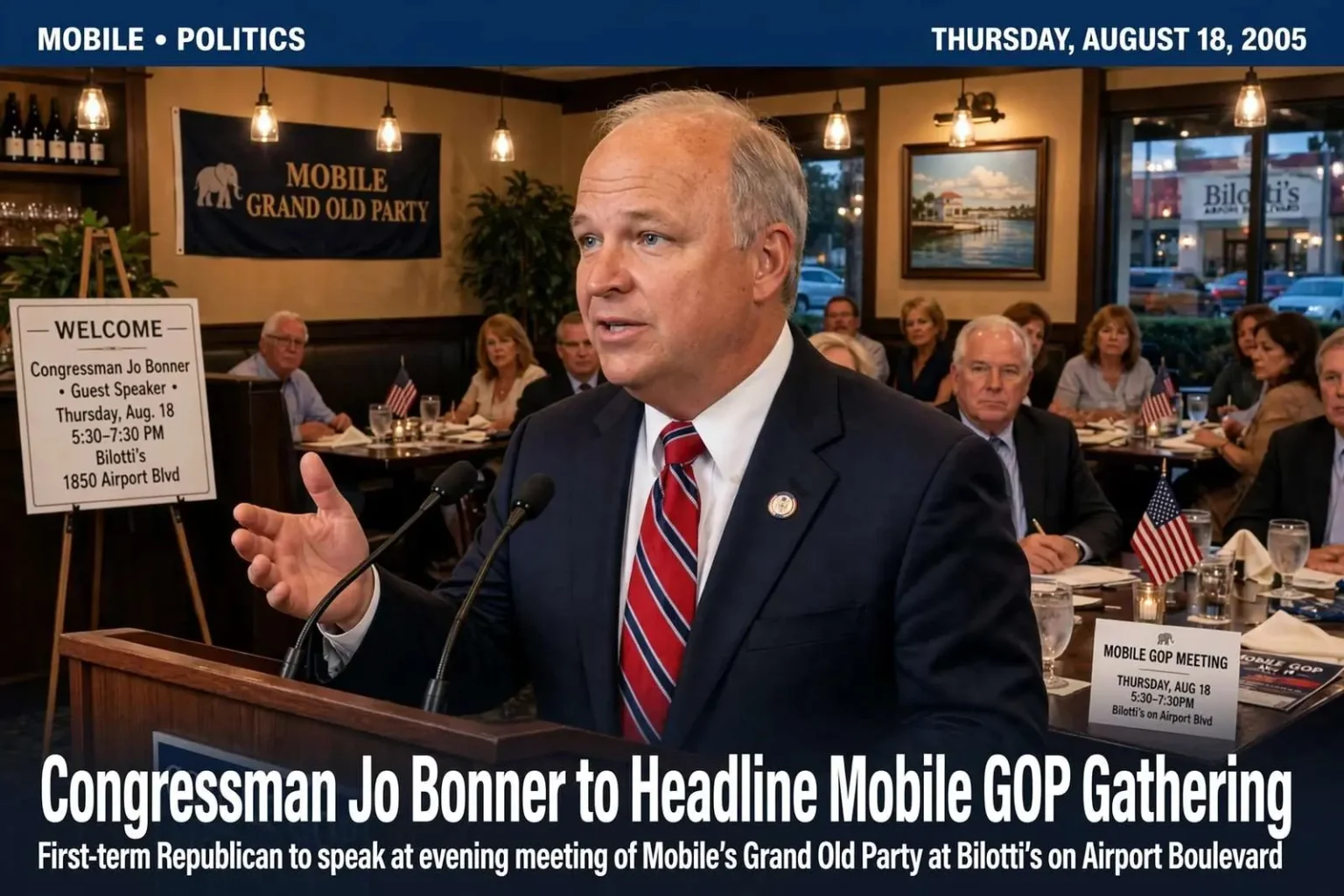
Mobile’s Republican activists prepared to hear from their congressman, as U.S. Rep. Jo Bonner was announced as the guest speaker for an evening meeting of Mobile’s Grand Old Party at a midtown restaurant. The gathering was set for Thursday, Aug. 18, from 5:30 to 7:30 p.m. at Bilotti’s on Airport Boulevard, according to GOP spokesman Shane McBryde. For a party organization that meets month after month without much fanfare, the visit of the district’s sitting congressman counted as a headline event, and organizers expected a full room of the volunteers, donors and neighborhood-level operatives who form the base of Republican politics in Mobile County.
Bonner was at the time a first-term Republican in the U.S. House of Representatives, having won the seat representing Alabama’s First Congressional District. The district is anchored in Mobile and Baldwin counties and stretches north along the Tombigbee River, taking in a broad swath of southwest Alabama’s timber country, small towns and growing suburban corridors. It is a geographically demanding seat — part port city, part beachside boomtown, part rural piney woods — and members have traditionally built their careers on being visible in all three at once.
Before winning the office in his own right, Bonner had spent years as a congressional aide, learning the institution from the inside and building the relationships that later carried him into the seat. That staff-to-member path is a familiar one in Alabama delegations, and it shaped the way Bonner approached the job: an emphasis on constituent service, on returning home constantly, and on tending the network of local party organizations that had helped put him there. His appearance before the local party organization was exactly the kind of routine constituency work that keeps a member of Congress connected to the volunteers who turn out his voters — the precinct workers, the Lincoln Day dinner regulars, the people who staff headquarters in a fall campaign.
The district and the party that anchors it
The First District has been reliably Republican for decades, and that fact shapes how local politics actually operates. In much of the country, a congressional incumbent spends the fall arguing with a general election opponent. In southwest Alabama, general elections have rarely been competitive, which paradoxically makes local party meetings more consequential rather than less. With the real contest settled in a Republican primary, the arguments that matter tend to happen inside the party organization, among the people who show up to meetings on a Thursday evening. Candidates court those rooms early, officeholders feed them information, and the activists who attend form the first audience for any announcement a congressman or local official wants to make.
That dynamic gives groups like Mobile’s Grand Old Party an outsized role relative to their size. A speech that would draw little attention in a swing district becomes, in Mobile, a chance for a member of Congress to speak candidly to the people who will renominate him. The same arithmetic applies down the ballot, to county commission seats, judicial races and legislative contests, all of which in the First District are typically decided among Republicans before November ever arrives.
Party officials framing the event emphasized both its social and its practical side. Meetings of this kind double as recruiting opportunities, and an appearance by the district’s congressman gives first-time visitors a reason to walk through the door. Light appetizers were to be served, with a cash bar, and the format was expected to follow the organization’s usual pattern: remarks from the featured speaker, time for questions, and conversation among members before and after the program.
Meeting details
The logistics were straightforward. The speaker was U.S. Rep. Jo Bonner, R-Ala. The time was 5:30 to 7:30 p.m., Thursday, Aug. 18. The place was Bilotti’s, 1850 Airport Blvd., near the Loop. Admission was free for MGOP members, with a $10 charge for non-members — a charge that was waived for anyone who joined the organization that night. Annual dues were set at $25 per person or $40 per couple. Organizers noted that additional parking was available across Airport Boulevard, south of the restaurant, a practical detail for an event expected to draw more attendees than a typical meeting. Anyone wanting more information was asked to contact Susanne Simmons at 461-2606.
The dues structure told its own story about the intended audience. At $25 a year, membership was priced for participation rather than for donors — a level within reach of retirees on fixed incomes, young families and anyone curious about becoming involved. Waiving the admission charge for anyone who joined at the door was a straightforward recruiting device: the evening’s headline attraction effectively covered the cost of trying the organization out. Groups that price themselves as social clubs with a political purpose tend to grow; groups that price themselves as donor networks tend to shrink to the people already committed.
What MGOP was
Mobile’s Grand Old Party, known by the shorthand MGOP, functioned as an affiliate of the Mobile County Republican Executive Committee, the official party body for the county. The distinction matters in Alabama, where county executive committees are the formal units of party organization — they certify candidates, seat precinct officers and carry the party’s legal authority — while affiliated social groups do the quieter work of keeping activists engaged between elections.
Groups of that kind serve as the social and fundraising arm of a county party. They hold regular dinners, bring in officeholders as speakers, recruit volunteers and provide a low-barrier entry point for people who want to get involved but are not ready to run for a party office or chair a precinct. For newcomers, an MGOP meeting is a place to learn who is who in Mobile Republican politics; for officeholders, it is a reliable audience and, frequently, a source of the volunteers who staff phone banks and poll-watching rosters each fall. The relationship between the executive committee and its affiliated groups runs on that division of labor, and an evening with the congressman in front of a midtown crowd was the arrangement working as designed.
Mobile County’s Republican machinery has long been among the most organized in south Alabama, reflecting the county’s steady shift from its Democratic roots of the mid-twentieth century into a reliably Republican stronghold in state and federal races. Organizations like MGOP helped manage that realignment at the neighborhood level, giving the party a permanent presence in the parts of the county — midtown, West Mobile, the growing corridors toward Theodore and Semmes — where precinct-level organization decides turnout.
Politics in a busy season
The meeting was announced during one of the most crowded political summers Mobile had seen in years. The city’s nonpartisan mayoral election was set for Aug. 23, five days after the Bonner gathering, with four major candidates competing to succeed Mayor Mike Dow. Among them were former state Sen. Ann Bedsole, former City Councilwoman Bess Rich and City Councilman John Peavy, all of whom had sought office as Republicans, and Mobile County Commissioner Sam Jones, a Democrat. Although the city election carried no party labels — Mobile’s mayoral races are officially nonpartisan — party organizations on both sides were unavoidably part of the atmosphere in which it was fought.
A Republican gathering held on the eve of a mayoral vote was, whatever its formal agenda, also a room full of people about to go to the polls. Candidates in the mayor’s race had spent the summer courting the same civic networks that fill party meetings: neighborhood associations, business groups, church congregations and the volunteer circles that move from one campaign to the next. The congressional visit gave those networks one more reason to gather, and few in the room would have doubted that the mayoral contest was a topic of hallway conversation before and after the program.
Dow’s impending departure after a long tenure had opened one of the city’s most consequential offices, and the field that formed to replace him mixed City Hall veterans with fresh faces. Bedsole brought a resume reaching back through the Legislature; Rich carried a reputation for challenging the city’s fiscal assumptions from her council seat; Peavy offered continuity with the council’s work; Jones arrived with the county commission’s perspective and the Democratic label. Which of them the city would choose remained unsettled, but the audience Bonner faced that Thursday evening would help decide it.
Airport Boulevard and the Loop
The venue placed the meeting in the heart of midtown Mobile. Bilotti’s sat at 1850 Airport Blvd., near the Loop — the intersection where Government Street, Airport Boulevard and Dauphin Street converge. The Loop takes its name from the turnaround that once served the city’s streetcar line, and it remains one of Mobile’s most recognizable landmarks, a commercial crossroads that generations of Mobilians have used as a reference point for giving directions. Restaurants and shops around the junction have long been gathering places for civic groups precisely because the location is central to so many of the city’s neighborhoods.
For a party organization looking for a central, easily reached location, an Airport Boulevard restaurant near the Loop was about as convenient as the city allowed. The corridor runs east toward downtown and west toward the growing suburbs, and the surrounding blocks sit within a short drive of both Spring Hill and the tidal communities along the bay. Organizers’ note about overflow parking across Airport Boulevard reflected the practical arithmetic of a big crowd at a popular midtown restaurant.
By the time the evening ended, the organization had heard from its congressman, signed up new members at the door, and positioned itself — deliberately or not — in the middle of a mayoral week. For Mobile Republicans, that combination of routine and consequence was the point: in a one-party district, the Thursday-night meeting is where the politics actually happens.