Government Plaza Roof Repair Could Cost Mobile County a Quarter-Million More
Mobile County commissioners are weighing a $235,000 cost increase to the Government Plaza roof repair after contractors found faulty materials and fire damage.
The long-running effort to repair the roof at Mobile’s Government Plaza has hit another snag, with county officials now considering a change order that would add roughly $235,000 to the project’s cost. The proposal drew pushback from all three county commissioners when it was presented, given the roof project was already budgeted at $3.2 million.
A change order is the formal mechanism by which a public construction project’s scope or price is adjusted after the contract is signed, and commissions routinely scrutinize them because each one moves the project further from the figure taxpayers were originally told. A request of this size — roughly 7 percent on top of an existing $3.2 million budget — is large enough that it typically requires justification in detail before a board will approve it.
What crews found under the old roof
According to Mobile County facilities manager Tyler Martin, the additional expense stems from a series of unexpected discoveries made as work has progressed. Roofing crews found that the original contractor who installed the roof used substandard coupling materials that are prone to leaking, requiring replacement with a more durable material throughout the building’s atrium.
Couplings on the exterior portion of the atrium will instead be welded in place, according to Martin. Welded connections eliminate the failure point that plagues mechanical couplings, which can loosen over decades of thermal expansion and contraction — a particular concern on a Gulf Coast roof that endures intense summer heat, driving rain and the occasional tropical system.
Hidden conditions of this kind are the classic source of cost growth in roof replacement work. A decades-old roof cannot be fully evaluated until crews strip it back, and when the original installation falls short of what the drawings specified, the repair contractor must correct work it did not perform — work that was never in its bid.
Martin described the roughly quarter-million-dollar estimate as a worst-case figure, though it remains the number currently on the table for commissioners to evaluate. Worst-case framing gives the board room for the final number to come in lower, but it also means the county must budget for the ceiling, not the hope, when it authorizes the additional spending.
Beyond the material issues, the project has also been complicated by two separate roof fires that broke out since construction began, adding further delays and expense to an already prolonged repair effort. Construction fires on roofing projects — typically linked to torch-applied membranes or hot work on the roof — are a recognized hazard in the industry, and each incident here meant emergency response, damage assessment and resequencing of the work already underway.
The extension request
Compounding the cost concerns, the contractor, Team-Craft Roofing, is also requesting an 89-day extension to the project timeline. That request drew a pointed question from one commissioner, who asked why the company should receive extra time over delays tied to fires that occurred during its own work on the site.
Martin pushed back on the framing, saying he didn’t view the extension as a reward for the contractor but rather a practical response to an evolving situation. His position reflects the way construction schedules actually work: once the discovered conditions multiplied the work in the atrium and fires interrupted the sequence, the original completion date became unreachable regardless of whose fault each individual setback was.
Extensions in public contracts are typically evaluated against the contract’s delay provisions, which distinguish between excusable delays — events outside the contractor’s control — and delays attributable to the contractor’s own performance. Where a project grows through change orders, the added work itself justifies added time, which is why cost increases and schedule extensions often arrive together as a package for a board to weigh.
The distinction matters financially as well. If the county rejected the extension and the contractor missed a deadline through no fault of its own, the company could later claim damages for the delay. Working through the change-order process keeps the adjustments documented and, in principle, keeps the county’s exposure contained to the negotiated amounts.
The commission’s deliberation
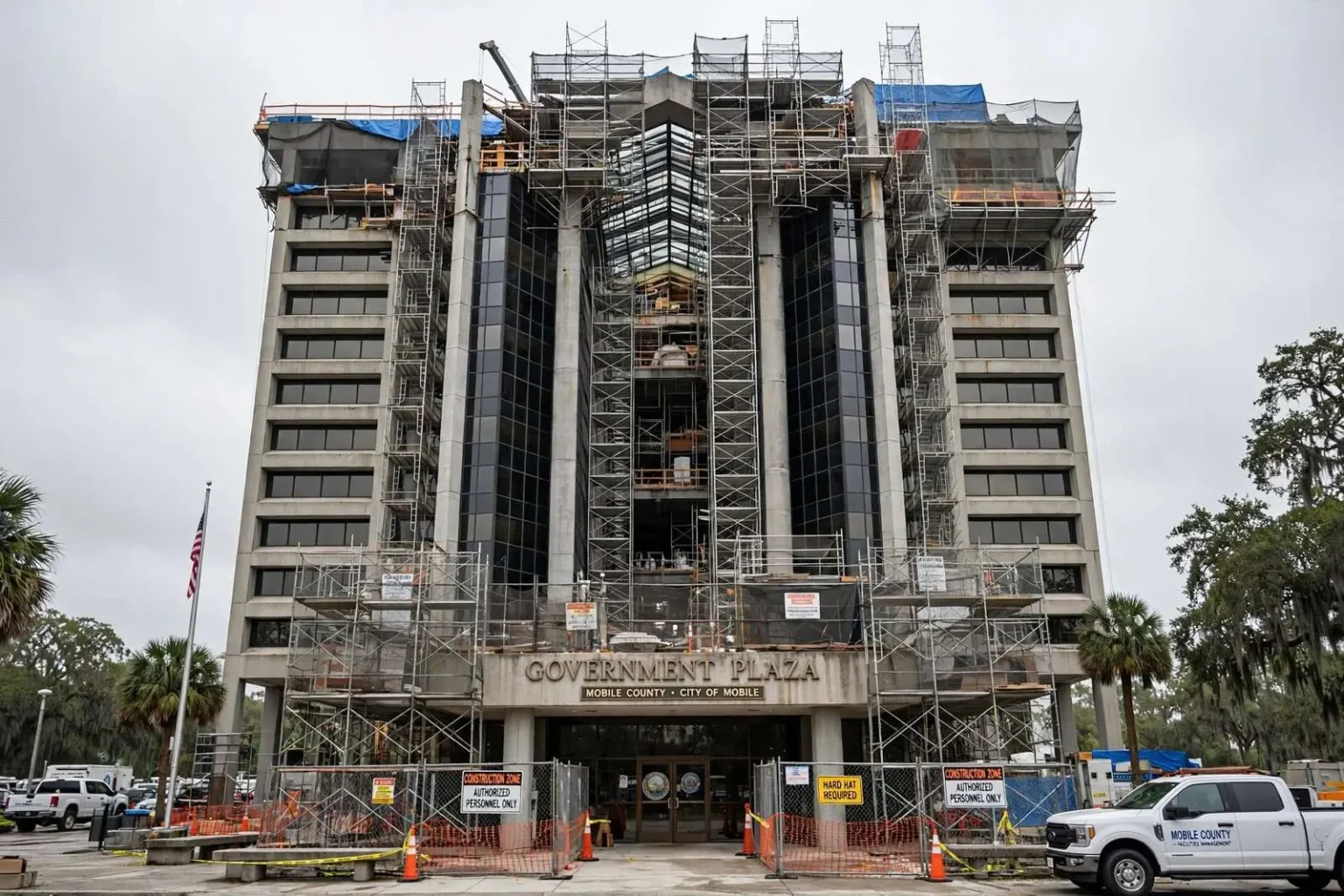
Commission President Connie Hudson said she needed additional time to evaluate the proposed change order before making a decision, effectively putting the matter on hold until at least the following week. In the meantime, she asked that the scaffolding currently in place throughout the building remain up until the board reaches its decision, preserving access to the areas where the disputed work is centered.
The scaffolding has been a visible feature of Government Plaza during the roof work, running through the atrium space that serves as the building’s central public area. Keeping it in place until the change order is resolved avoids the cost of dismantling and re-erecting it if the board approves the additional work, and it keeps crews positioned to proceed quickly if the answer is yes.
Government Plaza, the high-rise shared by Mobile County and the City of Mobile, opened in the mid-1990s as the region’s signature government building, housing commission chambers, municipal offices and courtrooms. A building of that size and public importance cannot simply shut down for a roof replacement, which is why the work has proceeded in phases around the daily business of two governments.
The atrium at the center of the current problems is the building’s most distinctive feature, a tall open volume that draws natural light into the lower floors. Repairing a roof over that space is structurally and logistically harder than a flat roof over a standard floor plate, and the couplings at issue span both interior and exterior portions of the atrium’s covering.
How the cost has grown
The roof project’s $3.2 million budget already represented a major facilities investment for the county, and the proposed change order would bring the total toward $3.45 million if approved as presented. Each increment in a public building project passes through the commission’s agenda, which is why residents following the item have watched the figures move in public meetings rather than in a single award announcement.
Facilities officials face a balancing act in presenting numbers like these. Understating the final cost erodes board confidence when the next change order arrives; overstating it ties up money the county may not need. Martin’s worst-case framing of the $235,000 is an attempt to give the commission the full picture before it commits.
The county’s alternatives are limited once a roof is opened. Abandoning the repair mid-project would leave the building worse off than when work began, and delaying the atrium corrections would leave known leaking risks in place above occupied offices. Boards in this position generally approve the additional work while pressing for documentation of why the original installation failed — a record that can matter if the county pursues recovery from anyone else later.
What commissioners will weigh
When the item returns to the agenda, the board’s questions will center on three things: whether the $235,000 estimate can be narrowed, what portion of the 89-day extension the contractor is entitled to under the contract, and whether the fire-related delays shift any of the responsibility back to the roofing company. The answers determine not just this week’s vote but the county’s leverage for the remainder of the project.
The all-three-commissioner pushback at presentation was a signal that the board intends to scrutinize rather than rubber-stamp the request. Public works change orders of this size routinely draw that level of attention, particularly on a project that has already stretched on and accumulated incidents that were not in anyone’s plan.
For county employees and the public who use Government Plaza daily, the practical stakes are modest but real: scaffolding through the atrium, phased work overhead, and a schedule that now extends months beyond the original plan. The sooner the board resolves the change order and the extension, the sooner the project can settle into a predictable finish.
Roof failures of this kind also serve as a reminder for other Gulf Coast governments managing aging buildings. Installation shortcuts that save money in the year a roof goes on can cost multiples later, and the correction falls to a new generation of officials who had no role in the original decision. The Government Plaza project — delayed, fired upon twice by accident, and now growing — is the region’s most visible object lesson in that arithmetic.
The commission’s decision, expected when the board next meets, will set the project’s final budget trajectory and its completion date. Until then, the scaffolding stands, the atrium couplings wait, and the county’s most expensive roof continues to be the most closely watched construction site in Mobile’s government quarter.
The change-order review will also become part of how the county evaluates future bids. Contractors and facilities staff alike know that a project marked by disputes and surprises makes the next procurement harder, and a clearly documented record — what was found, what it cost, and why — is the county’s best protection when the Government Plaza roof eventually needs attention again decades from now.