Weekend Guide: Battle of Mobile Bay 150th Anniversary Reenactment
Fort Gaines and Fort Morgan host a sesquicentennial reenactment of the Battle of Mobile Bay, with tickets, shuttles, ferries and a full weekend schedule.
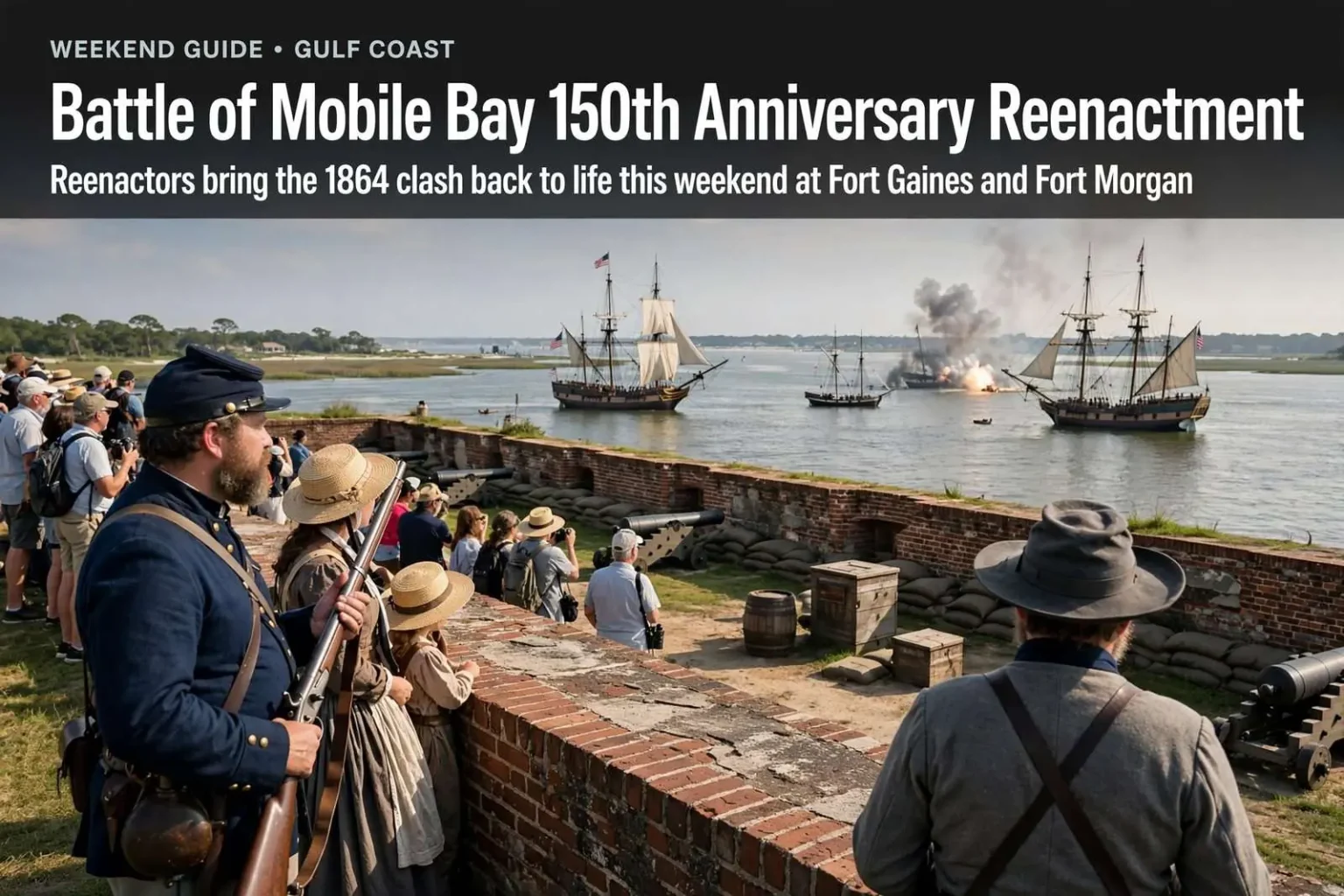
History buffs and families along the Gulf Coast have a rare chance this weekend to watch the Battle of Mobile Bay come back to life, as Fort Gaines on Dauphin Island and Fort Morgan near Gulf Shores mark the 150th anniversary of the Civil War clash with a large-scale reenactment. Organizers have built a family-friendly weekend around living history on both land and water, with activities split between the two forts that guard the entrance to Mobile Bay. Admission is handled separately at each site, and attendance on both sides of the channel is expected to be heavy.
Matthew Capps, executive director of the Dauphin Island Park and Beach Board, said organizers pulled in re-enactors from across the country for the sesquicentennial commemoration. The milestone marks a century and a half since August 1864, when a Union fleet under Rear Adm. David G. Farragut fought its way past the mines — then called torpedoes — guarding the bay entrance and overwhelmed a smaller Confederate squadron under Adm. Franklin Buchanan. The victory sealed off Mobile as one of the last major ports still open to the Confederacy and tightened the Union blockade that had squeezed Southern trade for three years. The battle also produced one of the most quoted commands in American naval history, attributed to Farragut as his flagship pressed forward through the minefield: “Damn the torpedoes, full speed ahead.”
The centerpiece of this weekend’s commemoration will be a naval engagement featuring 14 vessels, including two schooners and a yawl, standing in for the fleets that fought for control of the bay in 1864. The ships will not be open for public tours, but visitors can view them anchored near the east end of Dauphin Island throughout the day Friday ahead of the battle reenactment. Viewing from shore is free, though visitors should plan around the island’s limited parking near the east end.
Admission and Tickets
Admission is handled separately at each fort, and all tickets must be purchased on-site, since online sales are not being offered. At Fort Morgan, a one-day ticket runs $10 for visitors six and older, with a three-day pass priced at $20. Families of four can get a one-day ticket for $30 or a three-day pass for $65. Fort Gaines charges $4 for children ages 5 through 12 and $6 for those 13 and up. Visitors planning to attend events at both forts should budget for both admissions, and the three-day options at Fort Morgan offer savings for anyone making a full weekend of it.
Because crowds are expected, arriving early in the day is the practical choice at both sites. The forts sit on opposite sides of the Mobile Bay ship channel, and the drive between them around the bay runs well over an hour, so most visitors will want to pick one side per day and plan their schedules around that fort’s programming.
Getting to Fort Morgan
Getting to Fort Morgan requires a bit of planning. Because of state and county rules, parking and admission fees are sold separately, and visitors will need to catch a shuttle run by the Baldwin Rural Area Transportation System from two Gulf Shores pickup points, Pelican Place and Faulkner State Community College, for $4 per person each way. Shuttle service runs Friday from 4 to 9 p.m., Saturday from 7:30 a.m. to 9 p.m., and Sunday from 9 a.m. to 2 p.m. Visitors should build the shuttle connection into their plans, since parking at the fort itself is restricted during the event.
There is one way to skip the shuttle entirely. Visitors who instead take one of two ferries running between the forts can park directly on-site at Fort Morgan. The Mobile Bay Ferry connects Dauphin Island’s east end with the Fort Morgan peninsula, a roughly 30-minute crossing that carries cars and passengers across the mouth of the bay — the same waters the 1864 fleets contested. During a busy reenactment weekend, ferry lines can be long, and early boarding is the safer bet for families working around a fixed schedule of battle demonstrations.
The shuttle arrangement reflects the realities of the Fort Morgan peninsula, a narrow strip of land at the end of State Highway 180 that has limited road capacity and little room for event parking. Splitting parking from admission keeps traffic moving through Gulf Shores and along the peninsula, but it does mean visitors should bring cash for the shuttle and allow extra time on both ends of the day.
What to Bring — and What to Leave Behind
Organizers are urging attendees to dress for a full day outdoors, with sunscreen, hats, sunglasses, comfortable shoes and plenty of water recommended. August on the Gulf Coast brings heat indexes well into the 90s, and the grounds at both forts offer limited shade, particularly around the open ramparts where the best battle views are found. Parents may want to bring ear protection for young children given how loud the battle recreation can get when cannons and muskets fire in volleys.
Coolers and pets are not permitted on the grounds. Boaters hoping to watch from the water will need to stay outside a 450- to 500-foot perimeter set up around the naval battle, and the east end boat launch on Dauphin Island will be closed the Thursday before the event. Boaters planning a water vantage point should check their fuel and gear ahead of time, since the closure takes the closest public ramp out of service for the day before the weekend begins.
Weekend Schedule Highlights
At Fort Gaines, Saturday’s schedule includes the naval battle reenactment at 1 p.m. and a presentation on Civil War photographer Mathew Brady at 2:30 p.m. Brady’s studio produced many of the images that fixed the war in the public mind, and the talk offers a look at how photography of the era actually worked, from heavy glass plates to long exposures that made battlefield action nearly impossible to capture. Sunday brings a period church service at 10 a.m. followed by a talk on Confederate commander Col. Charles Anderson at 10:30 a.m. Anderson commanded the garrison at Fort Gaines in the summer of 1864 and surrendered the fort after a siege that lasted less than three days.
Additional programming is planned at both forts throughout the weekend for visitors wanting a deeper look at the campaign that closed one of the Confederacy’s last major ports. Typical living history offerings at events like this include infantry drill demonstrations, period campsites where re-enactors cook and sleep as soldiers did, and artillery crews explaining the drill behind each cannon shot. Schedules at each fort may shift with weather, and visitors should check posted programs when they arrive to line up the demonstrations they most want to see.
The Forts and the Fight of 1864
The two fortifications anchoring the weekend were built a generation before the war as part of the Third System of coastal defenses, a chain of masonry forts stretching along the Atlantic and Gulf coasts. Fort Morgan, completed in 1834 on the Mobile Point peninsula, mounted some of the heaviest armament on the Gulf. Fort Gaines, finished on the eastern tip of Dauphin Island in 1861, guarded the channel’s other side. Between them, Confederate engineers stretched a line of floating mines across the channel and stationed the ironclad CSS Tennessee and a small squadron behind the line.
On the morning of Aug. 5, 1864, Farragut’s fleet of 14 wooden ships and four monitors steamed into the channel. The monitor USS Tecumseh struck a mine and sank within minutes, taking most of her crew down with her, and the fleet momentarily wavered in the narrow passage. Farragut’s order to press ahead carried the day: the fleet ran past the forts, rammed and captured the Tennessee after a hard fight, and within weeks both forts had surrendered. Mobile itself held out until the war’s final months, but the bay was closed, and the Union blockade that had strangled Southern commerce became airtight on the Gulf.
Why the Sesquicentennial Matters Locally
For Dauphin Island and the surrounding coastal communities, the 150th anniversary is both a commemoration and an economic event. Reenactment weekends of this scale draw visitors who fill restaurants, vacation rentals and bait shops from Bayou La Batre to Gulf Shores, and the town of Dauphin Island — a community of roughly 1,300 residents connected to the mainland by a single bridge — typically sees its peak-season crowds compressed into an even busier weekend. Town officials on both sides of the bay generally encourage visitors to arrive with full tanks of gas and patience, since two-lane roads carry nearly all of the traffic.
The sesquicentennial also arrives as Alabama’s Civil War sites continue to draw heritage tourists year-round. Fort Morgan is a state historic site operated by the Alabama Historical Commission, and Fort Gaines is maintained by the Dauphin Island Park and Beach Board, the same organization that runs the island’s public beach and campground. Both forts host school groups, living history days and special events throughout the year, but a reenactment on this scale — with naval vessels involved — comes along rarely, which is why organizers spent months coordinating the maritime side of the program.
Planning Your Visit
Families coming from Mobile can reach Dauphin Island via the Dauphin Island Bridge on State Highway 193, a drive of roughly 45 minutes from downtown, while Fort Morgan lies at the end of State Highway 180 about 22 miles west of downtown Gulf Shores. Visitors from across the region, from Pascagoula to Pensacola, should expect heavy traffic on the coastal highways Saturday morning and again after the 1 p.m. battle demonstration concludes. Bringing water, snacks and a full tank of fuel remains the standard advice for any Dauphin Island trip, and it applies double for an event weekend.
The weekend’s program closes one of the most significant chapters in Gulf Coast history. The Battle of Mobile Bay was, in the words often used by historians, the event that made the Union blockade complete on the Gulf, and the forts that witnessed it still stand within sight of the ship channel that Farragut’s fleet crossed. For one weekend, visitors can stand on those same ramparts and watch the sails and cannon smoke return to the bay.