Edwards, Gore and a Border Fence: Mobile Democrats and Republicans Size Up 2008
A second round of Mobile-area figures weighed the 2008 field, from a license commissioner drawn to John Edwards and Joe Biden to a trio of Republicans backing California congressman Duncan Hunter.
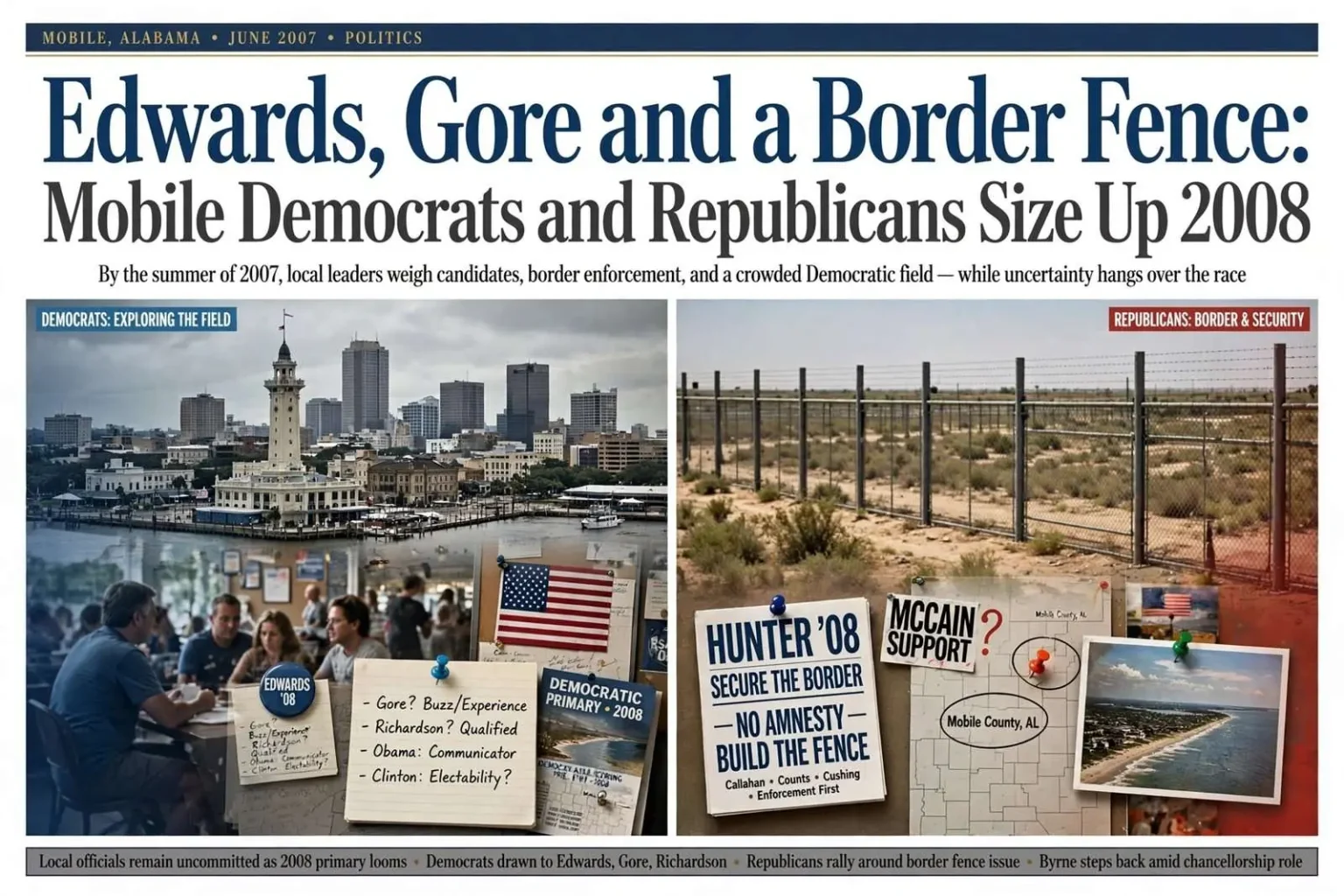
By the summer of 2007 the presidential field had grown crowded enough that supporting a candidate required a certain amount of homework. Mobile-area political figures, asked where they stood, produced answers ranging from the studiously noncommittal to the enthusiastically specific — and the spread of those answers says a great deal about how Alabama’s Gulf Coast was reading a race that had not yet taken its shape.
The unavailable and the uncommitted
Jack Edwards, the former congressman whose name still carried real weight in Mobile, said simply that he had no involvement and did not know when he would turn his attention to the presidential race. Edwards, who represented southwest Alabama in Washington for decades before retiring from the House, remained a fixture of the region’s Republican establishment, and his neutrality carried its own weight in local politics.
State Sen. Bradley Byrne offered a more interesting kind of demurral. He had been supporting John McCain, he said, but did not know whether he could continue to be so politically active in his present position. That position was chancellor-in-waiting of Alabama’s two-year college system, a post whose political neutrality was about to become a matter of some importance to him. The two-year college system was then emerging from a period of intense scrutiny, and the chancellorship required stepping cleanly away from partisan work — a constraint that would define Byrne’s public life for the next stretch of years.
Charles Dodson, the former Mobile County circuit judge, was not supporting anyone and had not made up his mind. Mobile City Councilman Fred Richardson thought it was too early to decide. Circuit Judge John Lockett said he was watching and learning, and confessed to being intrigued by New Mexico Gov. Bill Richardson, adding the observation that the joy of the early stages is that you can still find someone you truly agree with, before the process forces you to settle for one of the three or four survivors.
A Mobile attorney, asked whom he liked, said it was far too early, and offered the mordant suggestion that one almost wished Lyndon LaRouche were still around — a joke that captured the wistfulness of political watchers who find primary seasons more entertaining than general elections.
The Democrats who had a candidate
Donald Briskman, a Mobile attorney, had not saddled up to a particular horse but thought the Democratic field outstanding. Gore was creating a lot of buzz. Bill Richardson might be the most qualified. Obama, he allowed, was a terrific communicator. Briskman’s ambivalence reflected a genuine feature of that moment: the Democratic field was widely considered the party’s strongest in a generation, and even engaged observers were comfortable browsing.
Carol Norris, the Mobile County license commissioner, was drawn to John Edwards for his intelligence, warmth and positions, and also to Sen. Joe Biden, whom she hoped might land in someone’s Cabinet. She felt a kinship with Biden, she said, because she too had a way of stating things that caused consternation, generally by speaking with what she cheerfully described as blunt force trauma.
The most detailed analysis came from Vivian Beckerle, the Democrats’ unsuccessful 2006 congressional nominee, who was fluctuating between Edwards and Clinton and floated a prediction: an Edwards-Clinton ticket. Edwards, she reasoned, was a son of the South steadily building momentum, and would be persuasive in Alabama in a way Clinton could not be in a conservative state. Clinton could pull feminists, the party’s more liberal wing and those who simply wanted to see more of Bill.
Her critique of the Clinton campaign was sharper than her praise. Clinton, she argued, may have peaked early by rushing to compete with Obama’s timing, violating an important rule: never let your opponent tell you when and what to do. Her high profile had placed her in the line of fire. Edwards, by contrast, was flying under the radar. If detractors would get past the story about his haircut and on to the substance, Beckerle thought, he would keep gaining.
The hawks
One bloc in the survey knew exactly what it wanted. Mobile attorney Braxton Counts reported that he, former U.S. Rep. Sonny Callahan and attorney Dan Cushing were supporting Congressman Duncan Hunter of California. Their reasons were unambiguous. Hunter was a hawk. He opposed amnesty for illegal immigrants. He supported a border fence running from California to Texas.
Hunter never became a factor in the Republican race, withdrawing after minimal support in the early contests. But the enthusiasm of a former Mobile congressman and two prominent local attorneys for a candidate running explicitly on border enforcement is worth noting, because immigration was then splitting the Republican coalition and would help sink John McCain’s standing with conservatives before it eventually helped him win the nomination anyway.
The shape of the moment
Taken together, the responses map a political community in genuine suspense. The Democrats present were divided among Edwards, Clinton, Richardson and a Gore candidacy that never came. The Republicans were split between an immigration hardliner, a wounded McCain and a general sense of waiting. Almost nobody named the two people who would actually win their parties’ nominations.
In June 2007, that was not a failure of insight. It was simply an accurate reading of a race that had not happened yet. Obama was then running second in most national polls among Democrats, and McCain’s campaign was widely described in press accounts as broke and adrift — assessments that proved premature on both counts within months.
The episode also illustrated something durable about Alabama politics: the state’s party figures do not simply inherit national preferences, and in the year before a presidential primary, local endorsements remain a market of individual judgment. The former congressman staying out of it, the chancellor-in-waiting forced to stay out of it, the license commissioner drawn to blunt speakers, the group of hawks rallying around a long-shot border fence — each reflected the particular temper of the Gulf Coast in that summer.
History, of course, moved on without waiting for any of them. Gore never ran. Edwards collapsed. Biden fell early only to return years later as vice president. Obama and McCain, barely named in the survey, met in the general election and carried their contest into Alabama in November as a formality, the state long since locked into the Republican column.
But the snapshot retains its value precisely because it was taken before the outcome was knowable. It shows a political class doing what political classes do in the summer before a primary: hedging, browsing, amusing themselves, and occasionally committing early to a candidate on the strength of a single issue. Reading it now, with the ending known, the real story is how ordinary the uncertainty looked from the inside — and how completely the year would upend every early assumption within eighteen months.
The context behind the survey matters as well. In 2007, Alabama’s presidential primary had not yet been moved to its now-familiar early February date; the state voted later in the cycle, which meant local figures had little structural incentive to lock in early. Candidates barnstorming the region still had to build relationships county by county, and Mobile County — with its mix of downtown establishment money, west Mobile suburban growth and a sizable bloc of Democratic-leaning voters inside the city limits — remained a place where even modest expressions of support were worth tracking.
Byrne’s dilemma, in particular, was a sign of the times. His move toward the two-year college chancellorship came as the system faced a far-reaching state and federal investigation into its finances and governance, and the office he would eventually hold demanded visible independence from both political parties. That a sitting state senator and McCain backer had to publicly reconsider his own activism said less about McCain’s prospects than about how high the neutrality bar had been raised for the post he was preparing to accept.
For Mobile’s Democrats, meanwhile, the 2007 survey captured a party still searching for footing in a state where it had grown increasingly regional. Norris and Beckerle were among the most visible local Democratic officeholders and candidates of their era, and their preferences — the personal, almost aesthetic case for Edwards and Biden, the tactical case for an Edwards-Clinton pairing — reflected a party weighing electability against enthusiasm in a place where enthusiasm alone rarely carries a general election.
The Republicans’ Hunter bloc, likewise, was less about a single candidate than about a single issue. A decade before border funding became a defining national argument, a former congressman, a party activist and two attorneys in Mobile had already organized their primary politics entirely around it. That immigration would go on to reshape not just the 2008 cycle but the following decade of Republican politics made their early, unembarrassed single-issue commitment one of the most prescient entries in the entire survey.
What the summer of 2007 shows, in the end, is the gap between how campaigns look at street level and how they end at the ballot box. Mobile’s political figures were, by and large, playing the race they could see — a cluttered, personality-driven contest still months from its first real tests. The lesson has aged well: in presidential politics, the only thing harder than predicting a nominee is remembering why anyone preferred someone else once the field has cleared.