From a Morehouse Busboy to a Caddy Master at Spring Hill: More First Jobs
A legislator who bussed tables on the Atlanta graveyard shift, a minister who ran the caddy shack at Spring Hill College and a judge who picked cotton at $2.50 a hundredweight recalled how they started.
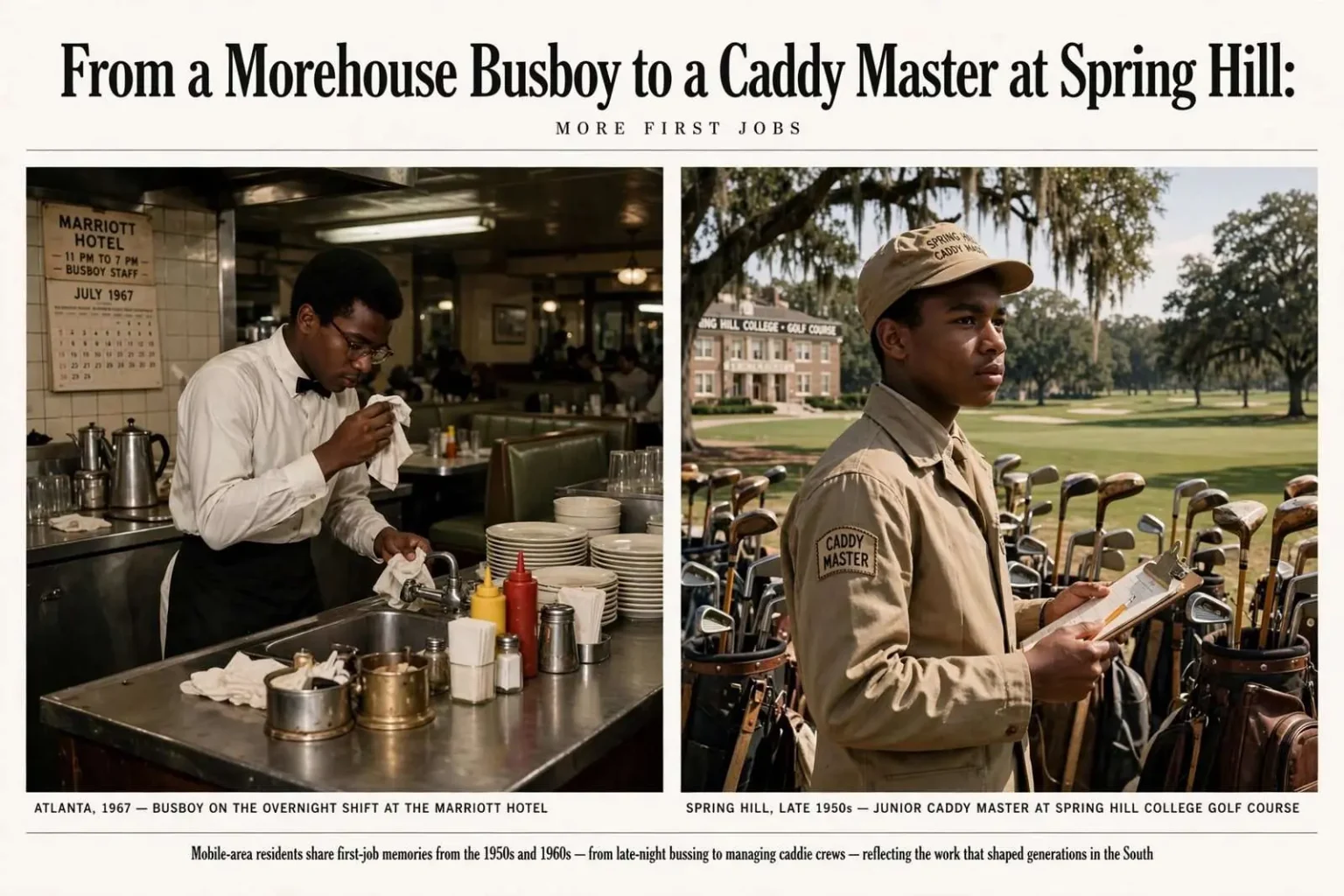
MOBILE — The stories kept coming. Asked about the first job that ever paid them, more Mobile-area figures answered with accounts that ranged from the comic to the quietly historic — and that together sketch a picture of what work looked like in the South before most of us were born. The graveyard shift at the Marriott State Rep. Joseph Mitchell began with a paper route in Georgia — 198 papers thrown from canvas bags tied to a bicycle, paid in cash, no taxes. His first job with a tax deduction came in 1967, when he was a student at Morehouse College: busboy on the overnight shift at an all-night restaurant in the Marriott Hotel in downtown Atlanta, 11 p.m. to 7 a.m. He bussed and washed dishes, mopped the kitchen, reset the dining room from day service to morning service and back again, and occasionally escorted, in his phrase, “inebriated and free-flowing” hotel patrons to the concierge. Between four and five in the morning, when the room emptied, he refilled the salt, pepper, sugar, mustard and ketchup and wiped down the brass. Pay was minimum wage plus a share of whatever cash the waitresses chose to pass along. On a good night, a busboy might clear fifteen or twenty dollars in dimes and quarters. Busboys competed on speed, because a fast table turn meant a waitress could work more customers.
Lessons From the Marriott
Mitchell listed what he learned in his first two weeks with the precision of a man who has told the story before: that most of the china at the Marriott was made in Japan and would shatter if dropped six feet onto a tile floor; that being on good terms with the cooks beat being on good terms with the boss; that even when the boss was wrong, he was still the boss; and “that being called ‘boy’ didn’t mean I was one.” He went on to work his way through Morehouse mopping floors, setting pins in the college’s two-lane bowling alley, teaching gymnastics at Spelman and running a used-magazine stand, before joining the Atlanta Fire Department full time during his senior year and beginning the public safety career that would eventually bring him to Alabama. Mitchell’s recollection captures the texture of Black working life in Atlanta in the late 1960s, where students at historically Black colleges built résumés that ran the gamut from food service to emergency response, all while studying for the degrees that would define their professional lives.
The Caddy Master at Spring Hill
Other first jobs came from the country club set. A longtime caddy master at the Spring Hill College golf course recalled that his first paying job was at the Spring Hill course itself, where he started as a junior caddy at age 12 in the late 1950s. By the time he was 16, he had worked his way up to caddy master, responsible for assigning the day’s caddies to golfers, settling disputes and making sure the bags were ready for the next group. The work paid modestly but came with perks that mattered to a kid growing up in midcentury Mobile, including access to a swimming pool the club maintained for caddies and the occasional free meal in the kitchen after a long day on the course. He later moved into other work, but the lessons he learned at Spring Hill — about how to deal with difficult people, how to read a room, how to show up on time — stayed with him for the rest of his career.
Other First Jobs Worth Remembering
Other entries in the running series produced equally vivid memories. A retired schoolteacher remembered her first job as a Saturday helper at her uncle’s barbershop in Prichard, where she swept up hair and learned the names of every regular who came through the door. A lawyer recalled the summer he spent painting houses with his older brother in Toulminville, learning how to mix colors and how to negotiate with customers who wanted more than the contract specified. A retired judge told of his first job as a caddy at a private club on the Eastern Shore, where the lessons in tact and discretion he learned on the course served him well in court decades later. A hospice nurse remembered the summer she worked the night shift at a convenience store on the Airport Boulevard, where she learned to deal calmly with people who were drunk, scared or both. Each of these stories, told briefly, captured something essential about what work looked like in the South for people who came of age in the 1950s, 1960s and early 1970s.
What the First Jobs Reveal
Read together, the stories describe a Mobile that was more industrial, more segregated and more locally rooted than the city of today. Most of the first jobs described in the series were found within a few miles of where the workers grew up, and most of the employers were small, family-owned operations that depended on personal relationships rather than formal résumés. The young men and women who worked those jobs learned skills — how to handle customers, how to manage money, how to show up on time — that served them for the rest of their careers, even when the jobs themselves did not. Several of the participants noted that they had not fully appreciated what their first jobs taught them until they were well into their professional lives and looking back on how they had gotten there.
Why These Memories Endure
The first installment of the series ran in late May and generated an outpouring of additional submissions, with readers eager to share their own memories of early work. Some of those memories were happy: the pride of a first paycheck, the satisfaction of mastering a new skill, the camaraderie of coworkers who became lifelong friends. Others were harder: the exhaustion of long shifts, the unfairness of a bad boss, the realization that the work was not what the worker had hoped it would be. Almost all of them were detailed, with specific names, dates and places that made the memories feel immediate and real. That kind of specificity, the editor noted, was the whole point of the series: to capture what work actually looked like in the South, not as it was remembered in sanitized form but as it was lived.
The Mobile That Produced These Stories
Many of the first jobs described in the series were tied to industries that have since shrunk or disappeared from the Mobile area. The shipyards, the paper mills, the small family-owned grocery stores, the neighborhood barbershops and the locally owned service stations that employed so many of the participants have largely given way to larger national chains, regional employers and a service economy that looks very different from the one that produced the contributors’ first paychecks. Mobile today is a more diverse, more globalized economy than it was in the 1960s, but it is also a city in which fewer teenagers work summer jobs and in which the path from first paycheck to professional career is less direct. The series captured a particular moment in the city’s working life, and the contributors made clear in their submissions that they saw those first jobs as foundational to everything that came after.
What Comes Next in the Series
The editor noted that additional installments would continue to feature first-job stories from Mobile-area residents, with a particular interest in hearing from people whose early work experience is not represented in the first two installments. The series is part of a broader effort by the publication to document the working life of south Alabama, an effort that has included features on longtime Mobile businesses, oral histories with retirees and profiles of unusual occupations. The first-jobs series has been among the more popular recent projects, and the response suggests that readers are eager for more stories about the kinds of work that built the Mobile area. Future installments will continue to mine the memories of older residents whose working lives stretched across decades of change in the regional economy.
What makes these memories especially vivid is how often they involve specific, named people and places. The first jobs described in the series are not abstractions; they happened at particular counters, on particular shifts, in particular buildings that, in many cases, are still standing. For Mobile-area readers who recognize those places, the series offers a kind of community time travel. For readers who came to Mobile more recently, it offers a reminder that the city’s current landscape is built on layers of work that often go unnoticed. Whether the contributor went on to become a lawyer, a teacher, a judge or a state representative, the first job mattered in ways that shaped everything that followed.
The Broader Lesson
The cumulative lesson of the series, several of the contributors observed, is that the value of a first job is rarely the paycheck. It is the formation of habits that will last a lifetime, the chance to learn how the working world operates, and the early encounters with adults who are not family members but who nonetheless become important figures in a young person’s life. For the contributors who went on to professional careers, those early lessons were often as important as any degree they earned later. They also reflect a Mobile that, despite the economic and demographic changes of the past half-century, has continued to give young people a chance to enter the workforce in ways that build character and resilience.