A Restless Electorate: Mobile Voters Wanted a Candidate Who Didn’t Exist
By late summer 2007, a striking number of Mobile's civic and business figures had looked over both fields and found nobody who fit. One of them said the ideal candidate was Bob Riley.
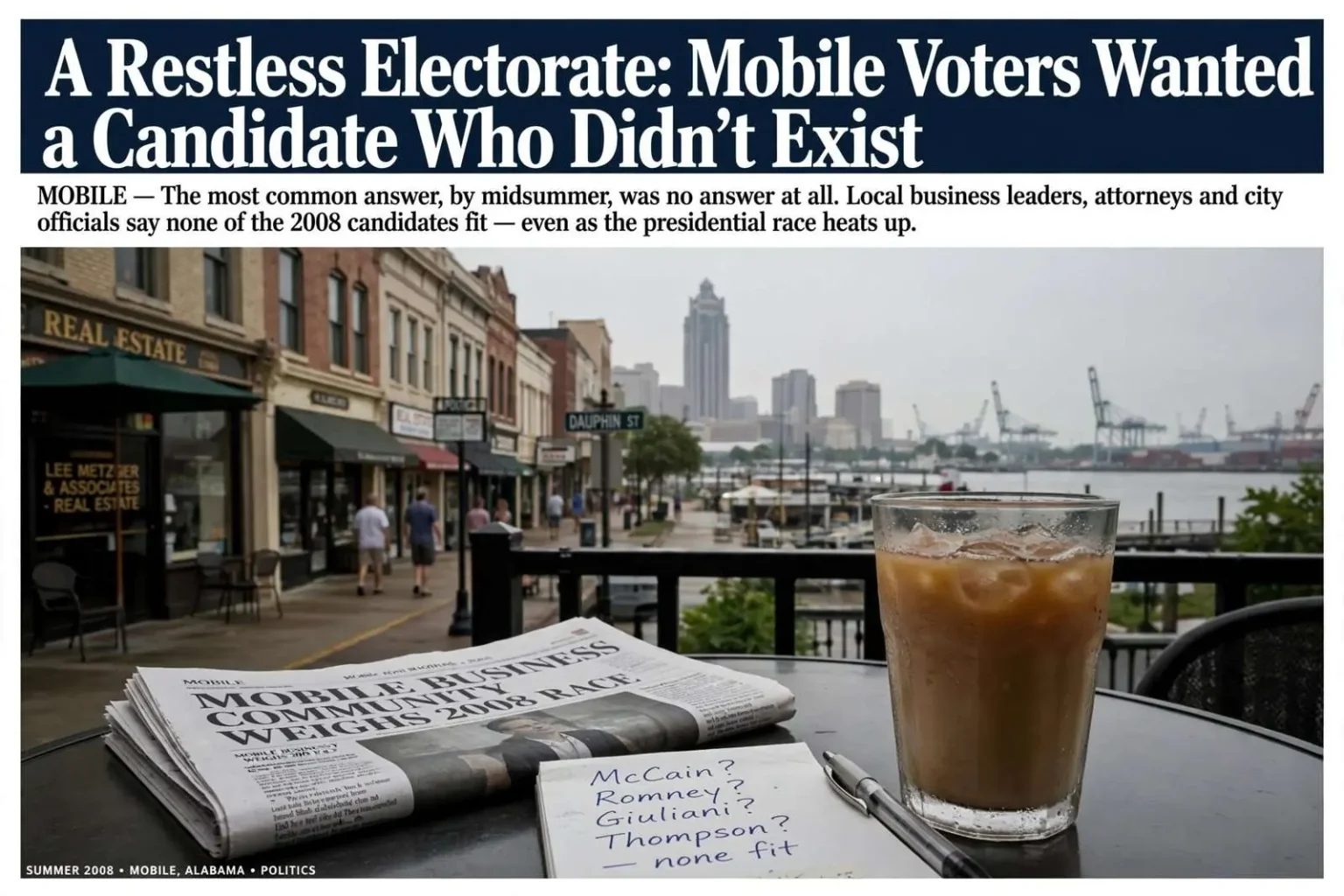
MOBILE — The most common answer, by midsummer, was no answer at all. Asked whom they supported in the 2008 presidential race, a number of Mobile’s business people, lawyers and elected officials described something closer to a shopping trip that had gone badly: they had examined the merchandise on both sides of the aisle, and nothing fit.
The season that produced those answers was an unusual one even by presidential-year standards. An open seat with no incumbent running, a war that had worn down both parties’ bases, and a Democratic field contesting between a senator and a former first lady while the Republicans rotated through a cast of senators, a governor, a former mayor and a former actor-turned-senator — the combination left voters shopping rather than committing. By the height of summer, with the conventions still ahead, plenty of Mobile’s professional class had browsed both racks and bought nothing.
‘None of the current suspects ring my chimes’
Local real estate executive Lee Metzger had recently heard the commentator Chris Matthews handicap the field for a national gathering of Realtors in Washington. After a few days of turning the presentation over, Metzger concluded that the Republican platform remained the better fit for his family. Then came the hard part. “The problem then becomes, which candidate?” he said. “To this point none of the current suspects — McCain, Romney, Giuliani, Thompson — ring my chimes.”
Metzger’s list named the four figures then leading the Republican conversation: John McCain, the Arizona senator and war hero whose Straight Talk Express had sputtered and revived; Mitt Romney, the former Massachusetts governor running as a businessman-turned-turnaround artist; Rudy Giuliani, the former New York mayor whose national standing had been forged in the aftermath of September 11; and Fred Thompson, the Tennessee senator turned actor whose late-entering candidacy traded on his screen presence and conservative credentials. Each had a constituency; none, in Metzger’s telling, had him.
If Republicans failed to find someone with broad appeal and a moderate position on Iraq, he warned, the party could find itself watching Bill Clinton pick out the china for state dinners. The quip compressed the Democratic scenario then in play — Hillary Clinton’s campaign and the return of a former president to the White House residence — into the one image a real estate man would use. Metzger volunteered a name that was not on any ballot. “I know this sounds odd, but I think Bob Riley has demonstrated the most effective leadership of any politician I have observed in the last five years,” he said of Alabama’s governor. “Just think where Alabama was five years ago when he took office, and look at us today. I am not suggesting Riley as a candidate for President, but we could probably do a lot worse.”
The tribute reflected Riley’s standing in his home region at the time. The governor, a former congressman whose district included much of south Alabama, had built a record of economic development recruitment, highway investment and — after his 2006 re-election — the education and taxation initiatives that had made him a national name in Republican circles. To a Mobile businessman watching the state’s fortunes climb, the idea that Alabama could produce presidential timber was not absurd, merely unavailable; Riley was not a candidate, and no one in the field had filled the space his name occupied in Metzger’s imagination.
Mobile attorney Jim Frost described the same problem in more analytical terms. “My impression is that if you could take certain candidates and combine them you would have a complete candidate, but that none of them has a complete skill set at this point,” he said. Electability, he added, was something he wanted to evaluate more closely before putting his money anywhere. “Have I dodged the question sufficiently?”
The councilman’s list
Mobile City Councilman John Williams went down the Republican roster with a reservation attached to each name, working through the field the way a councilman works through a budget item — weighing strengths against liabilities and declining to commit until the numbers were in. His answers tracked the same pattern running through the rest of the sample: admiration for qualities scattered across the candidates, and no conviction that any single man combined them.
That hesitation was not unique to one city or one party. Across the country in the summer of 2008, pollsters found the same restlessness: historic levels of voter dissatisfaction with the direction of the country, a Republican brand weighed down by an unpopular war and an unpopular president, and a Democratic contest between Hillary Clinton and Barack Obama that had already consumed more than a year of campaigning. Money was being raised and primaries were being scheduled, but plenty of voters — including the business and professional class of a city like Mobile — had not yet chosen a horse.
On the Democratic side, the choice Mobile’s voters faced was between two candidates whose differences were largely generational and stylistic. Clinton offered experience and a familiar political machine; Obama offered a movement candidacy and an argument about change that had already reshaped turnout in primaries across the country. Either nominee would carry historic significance, and either would present Alabama’s heavily Republican electorate with a clear contrast in November.
For Mobile’s business community, the stakes sat in familiar categories: energy policy for the port city’s chemical and shipping interests, hurricane recovery and insurance for a Gulf Coast still rebuilding from recent storms, and federal spending priorities that touched the region’s shipbuilding and aerospace employers. Those interests did not map neatly onto either party’s field, which was part of why the interview sample produced so much hedging.
What the hedging meant
The pattern in Mobile’s answers described a broader truth about that campaign: the candidates were known, but not yet known well. McCain’s nomination was still locked in a competitive primary fight; Romney was spending his personal fortune to stay in it; Giuliani had bet his entire strategy on the January contests in Florida; Thompson had entered late and was being measured against the campaign he had talked about for months before running. Voters who liked pieces of each candidate were being asked, months before the first ballot, to pick one — and were declining.
The other half of the hesitation was the Democratic field’s strength. A party that could field a sitting senator with a war record, a governor with executive experience and private-sector credentials, a national hero-mayor and a former senator-turned-actor was, on paper, deep. Against a Democratic side that would ultimately nominate a candidate of historic resonance, the Republican shopper’s dilemma was real: the merchandise was better than it looked in the mirror of a tough news cycle, but the mirror was what voters were looking into.
How the question resolved is now history. McCain secured the nomination, chose Alaska Gov. Sarah Palin as his running mate, and carried Alabama decisively in November even as Barack Obama won the presidency nationally. The hedging Mobile’s business class expressed in midsummer dissolved in the autumn campaign, as it usually does — but the episode remains a small, telling record of how an engaged Southern city’s civic leadership actually weighed a wide-open presidential field: candidate by candidate, quality by quality, with no enthusiasm sufficient to carry a name.
Mobile’s place in the conversation
The interviews themselves said something about Mobile. The city’s civic conversation has long run through its real estate executives, attorneys and council members — a business-forward establishment that measures politics by results rather than party loyalty. Metzger’s instinct to grade national candidates against Alabama’s own governor, and Frost’s insistence on evaluating electability before spending money, both reflected that habit: judge the performance, not the pedigree.
That frame also explains the restlessness. Alabama’s voters were not deciding between abstractions; they were comparing résumés with the same scrutiny they applied to a development deal or a city contract. A field with four plausible Republicans and two formidable Democrats gave them a buyer’s market and, for a season, a paralysis of choice. The most common answer in midsummer Mobile — no answer — was the honest one, and the general election answered it for them.
The episode is also a reminder of how much quieter presidential politics was in Alabama’s off-years compared with its current-cycle noise. In 2008, a Mobile businessman could be asked over coffee whom he supported and answer honestly that no one had earned his confidence yet — a candor that primary season, with its flood of advertising and its compressed calendar, would soon make obsolete. The city’s civic leadership weighed the field the way it weighed everything else, in public and with reasons attached, and then let the campaign itself do the persuading. The record of that summer remains a snapshot of an electorate in motion: engaged enough to grade every candidate, undecided enough to admit it, and Southern enough to keep the final judgment private until the ballots counted.
For Mobile specifically, the summer of hedging previewed a campaign that would keep the Gulf Coast on the national map: energy prices that summer reached record highs, hurricane season loomed over a coastline still recovering from earlier storms, and the port’s economy sat at the intersection of nearly every issue the nominees would debate. The voters who had not yet chosen were not disengaged — they were watching the very forces that would define the general election gather, and waiting to see which candidate would speak to them.