A Conservative Push for ‘None of the Above’ on Alabama’s 2008 Primary Ballot
Former Public Service Commissioner Jim Zeigler floated a slate of uncommitted delegates for Alabama's Feb. 5 primary, calling it a lawful way for disappointed conservatives to vote for none of the above.
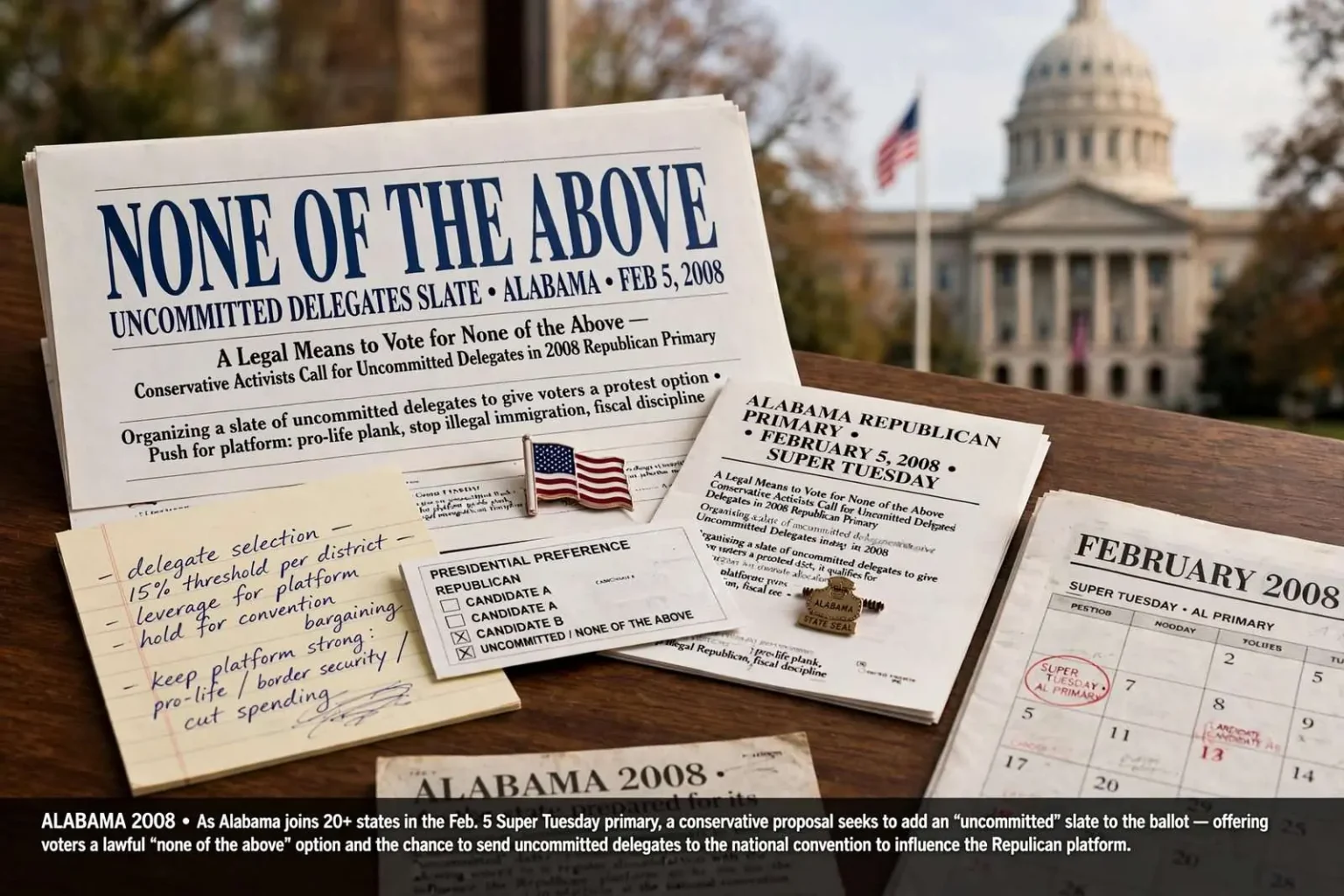
As Alabama prepared to vote earlier in a presidential nominating contest than it ever had before, one veteran conservative in the state proposed an unusual answer to a field that many on the right found underwhelming: a slate of delegates pledged to nobody at all.
Jim Zeigler, a former member of the Alabama Public Service Commission and a familiar figure in the state’s conservative politics, said he was considering organizing a slate of uncommitted delegates to run in the Feb. 5 primary. The idea, he explained, was to give voters a lawful mechanism to register dissatisfaction without settling for a candidate none of them wanted.
Zeigler’s proposal turned Alabama’s ballot mechanics into a protest instrument. Rather than asking conservatives to choose among candidates they did not believe in, he proposed they choose instead for a slate that stood for nothing — yet everything: the right to withhold commitment until the field improved.
‘A Legal Means to Vote for None of the Above’
“Conservative activists have been disappointed with the candidates and campaigns thus far,” Zeigler said. “There is no Ronald Reagan in the field.”
The comparison to Reagan was the shorthand of the moment. For a generation of Alabama conservatives, the 1980 campaign represented the standard — a candidate who united the party’s economic, social and national-security wings and carried the South. By the summer of 2007, in Zeigler’s telling, the field offered factions without a unifier.
Feb. 5, he argued, was “much too early for voters to be asked to commit themselves.”
“If we organize a slate of uncommitted delegates, we will promote it as a legal means to vote for ‘none of the above,'” he said.
The mechanics, as Zeigler laid them out, were straightforward. If “Uncommitted” drew 15 percent or more of the vote statewide or in any single congressional district, the slate would win delegate seats. If it drew a plurality, it could win enough delegates to control the state’s delegation outright.
Alabama’s Republican delegate selection rewarded broad geographic strength, and a fifteen-percent floor could be crossed in a single congressional district even when the statewide field crowded the top. That made the uncommitted gambit arithmetically plausible: a disciplined bloc of protest voters concentrated anywhere could send someone to the national convention with a bargaining mandate.
Because Alabama traditionally falls near the front of the roll call of states at a national convention, he said, an uncommitted delegation would arrive in a position to bargain.
“We could start a movement toward any candidate we later decided to support,” Zeigler said. “We could also fight any attempt to water down the pro-life plank and the plank to stop illegal immigration.”
That last sentence revealed the plan’s second purpose. The uncommitted slate was not only a hedge against the field; it was a preservation mechanism for the platform. A bloc of delegates with no candidate could still vote on the platform itself — and could block, from inside the convention, any softening of the two planks Zeigler’s wing of the party counted as non-negotiable.
A strong uncommitted showing, he added, would send an unmistakable message that conservative voters wanted “strong specific plans to cut wasteful spending, stop the exportation of industries and jobs to other countries, and stop illegal immigration.”
The three demands cut across the movement’s usual lanes: fiscal discipline, economic nationalism and immigration enforcement, assembled into a program Zeigler wanted stated in specific plans rather than rhetoric. His proposal treated the convention as a place where those demands could be drafted into the party’s official text even if no candidate carried them.
A Field That Had Not Settled
Zeigler’s frustration was not his alone. Across Mobile and the surrounding counties, political figures approached for their views on the presidential race described a contest that had not yet found its shape.
Braxton Kittrell, the former presiding judge of Mobile County Circuit Court, said he had no candidate, though “if I had to pull the trigger right now it would be” U.S. Sen. John McCain.
Huntsville attorney G. Sage Lyons Jr. said he was part of a group working to draft former Sen. Fred Thompson of Tennessee. “He is a long time friend and a brilliant man,” Lyons said. “If he does not run I am stumped.”
The Thompson draft movement was the cycle’s waiting-room candidate — a familiar face from the Senate and television whose late entry was courted precisely because the announced field inspired so little conviction. Lyons’ phrase, “if he does not run I am stumped,” captured the posture of many conservatives: not opposed to the field, simply unpersuaded by it.
Former U.S. Attorney Billy Kimbrough was still choosing among Democrats: “It’s between Clinton, Obama and Richardson.”
Former state legislator Mary Zoghby begged off entirely, saying she was consumed with the 50th anniversary celebrations of the Boys & Girls Clubs of South Alabama and would evaluate the candidates later in the year.
Retired Marine Corps Maj. Gen. Gary Cooper, one of Mobile’s most prominent civic figures, said simply, “I have not made a decision yet.”
Local teachers’ union leader Wade Perry was among the few who committed: “I’m with Edwards, at this point.”
One Mobile executive, weighing the Republican field, said, “Of the three front runners, I like Romney. My first choice would be Fred Thompson. I think Newt would be a great president, but conventional wisdom says he can’t be elected.”
The candor of that last remark — electability as the filter between preference and vote — described the whole season. The field had enough names to inspire every faction and not enough certainty for anyone to commit. Thompson stirred the wistful, Gingrich the impressed-but-cautious, Romney the front-runner’s tepid respect, McCain the grudging first choice of a man who would rather not choose. The uncommitted-slate idea was simply that mood, given a place on the ballot.
Zoghby’s deferral is worth noting as well: a former legislator declining to engage with the race at all, absorbed instead in the golden anniversary of a hometown institution, illustrated how far the presidential campaign sat from everyday Alabama life in the summer before the vote. The calendar would change that within months.
What Was at Stake in February
The urgency behind all of this was the calendar. Alabama had joined more than 20 states in moving its presidential primary to Feb. 5, 2008, a coast-to-coast voting day that came to be known as Super Tuesday.
For a state long accustomed to voting after the nominations were effectively settled, the change promised genuine influence — but it also demanded that voters make up their minds while the fields in both parties were still unwieldy. Alabama’s delegation, arriving early in the convention’s roll call, would matter in a way the state’s late-spring ballots never had.
The move carried risks on both sides. Candidates would have to campaign in a state they could previously take for granted, and Alabama’s political class would have to form judgments before the picture resolved. Zeigler’s slate was, in effect, an adaptation to that compression: if the calendar forced a decision, he would build a lawful way to defer it — and convert the deferral itself into leverage.
Zeigler’s uncommitted slate never materialized as a serious force, and Alabama’s February primary went ahead with the candidates on the ballot. Republicans here gave their contest to McCain; Democrats chose Barack Obama.
The outcome validated the calendar’s promise — Alabama’s votes counted, in both parties, at a moment when the nominations still hung in the balance — and it retired the protest mechanism before it was ever tested. McCain’s win gave the state’s Republican delegates a candidate to bind to, and Obama’s victory gave its Democrats a place in the close contest that followed through the spring. The uncommitted idea passed from proposal to footnote, remembered by the people who had discussed it rather than the voters who might have used it.
Zeigler himself remained a fixture in Alabama politics for years afterward, winning election as state auditor in 2014. But the impulse he described in the summer of 2007 — a conservative electorate uneasy with the choices in front of it and searching for a way to say so at the ballot box — proved to be a durable feature of the cycle, and of several that followed.
In that sense, the episode’s real subject was not the 2008 field but the voter’s position in it. Super Tuesday gave Alabama its first real say in a presidential nomination, and with the say came the discomfort of being asked to use it early. Zeigler’s answer — organize the dissatisfaction, put it on the ballot, and let it bargain at the convention — never took. The discomfort it addressed never quite left.