University of South Alabama Mobile
Senate Confirms Mobile’s Angus Cooper II for Another Term on Alabama Trustees Board
The maritime executive and Cooper/T. Smith chairman was among three trustees reconfirmed by the Alabama Senate to terms running through 2015 on the University of Alabama board.
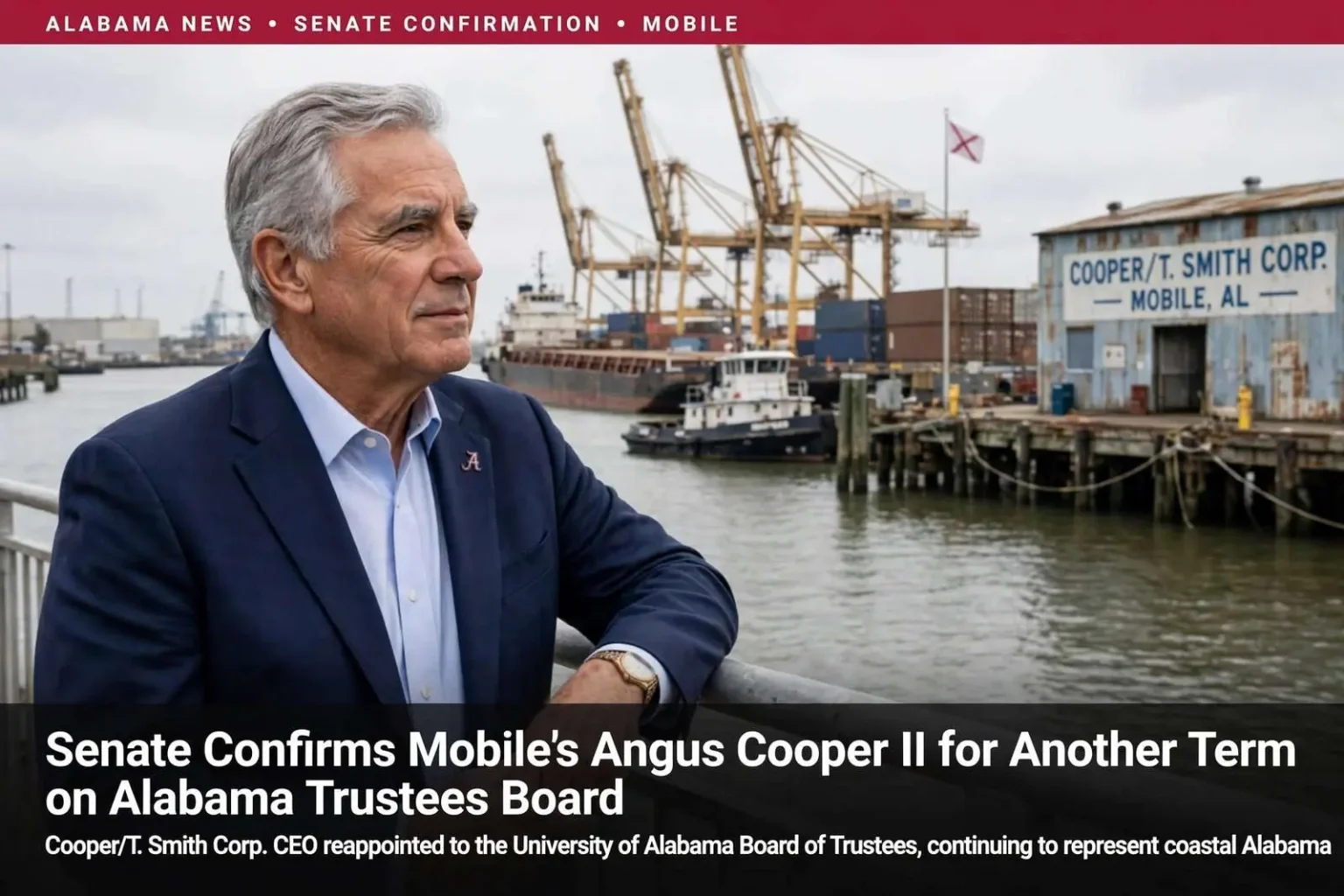
The Alabama Senate this week confirmed the reappointment of three members of the University of Alabama Board of Trustees to new terms, among them Angus R. Cooper II of Mobile. Cooper, a maritime executive who has spent his career on the Mobile waterfront, will serve through 2015 under the new term, continuing a tenure that gives coastal Alabama a voice in the governance of the state’s flagship university system.
Cooper is chairman and chief executive officer of Cooper/T. Smith Corp., a Mobile-based company whose business is the working waterfront: ship docking, mooring, warehousing and barge transfer. The firm is one of the largest stevedoring operations in the country and one of the more consequential private companies headquartered on the Alabama coast, with operations that touch nearly every phase of cargo moving across the docks of the Port of Mobile.
A graduate of the University of Alabama, Cooper was inducted into the International Maritime Hall of Fame in 2007, an honor reserved for leaders whose careers have left a lasting mark on the global maritime industry. The recognition placed the Mobile executive alongside shipping and port figures from around the world and underscored the reach of a company that began with Gulf Coast stevedoring work and grew into an international operation.
What the board does
The Board of Trustees governs three institutions: the University of Alabama in Tuscaloosa, the University of Alabama at Birmingham and the University of Alabama in Huntsville. Its members set tuition, approve budgets and capital projects, and select the chancellor and the presidents of the three campuses, making the board the final authority over the system’s academic and financial direction.
Trustees serve long terms and are confirmed by the Alabama Senate, which makes the board one of the more durable centers of influence in state government — less visible than the Legislature, but with authority over an enterprise that employs tens of thousands of people and educates a substantial share of the state’s professional class. Turnover on the board is rare, and members who earn reappointment can shape policy across multiple governors and legislative sessions.
The scale of what the board oversees is easy to underestimate. The University of Alabama in Tuscaloosa, founded in 1831, is the state’s flagship campus and its oldest public university. The University of Alabama at Birmingham has grown into one of the South’s leading research and medical institutions, anchoring a hospital and health system that ranks among Alabama’s largest employers. The University of Alabama in Huntsville sits at the center of a research corridor tied to NASA’s Marshall Space Flight Center and the defense and aerospace industry of the Tennessee Valley.
The board itself traces its roots to the early nineteenth century, when the Legislature created the university and empowered a governing board to oversee it. That structure has evolved into the modern system board, which now balances the needs of a flagship research campus, a major academic medical center and a doctoral research university spread across three cities.
With the Senate’s action this week, Cooper and two other trustees whose terms were up were returned to service. The confirmation of a full slate at once is typical of how the Senate handles trustee appointments, moving them through in a single group once nominees clear the appointed- trustee process that precedes legislative confirmation.
Mobile’s seat at the table
For Mobile, the value of Cooper’s continued service is straightforward. The Port of Mobile and the shipbuilding and maritime industries that surround it depend on engineering and business graduates, and on research relationships with the state’s universities. A trustee whose company works the docks every day is a trustee who understands what the coast needs from a university system headquartered several hours to the north.
It is worth noting the geography. The University of South Alabama in Mobile has its own separate board of trustees and is not governed by the University of Alabama system, which means Mobile’s largest public university operates independently of the body Cooper serves. His role instead gives the port city a voice in the system that trains much of the state’s engineering, business, nursing and legal talent — graduates who end up working in shipyards, logistics offices, hospitals and courthouses across south Alabama.
Cooper/T. Smith has been part of the Mobile waterfront for generations, growing from local stevedoring roots into an international company. Its core services — ship docking, mooring, warehousing and barge transfer — are the unglamorous but essential work that keeps cargo moving between oceangoing vessels and the rail and highway networks that carry freight inland. Along the Mobile River, where the Alabama State Port Authority operates public terminals and private stevedores handle much of the rest, firms like Cooper/T. Smith form the backbone of a port complex that ranks among the largest deepwater ports on the Gulf of Mexico.
The port’s reach has grown steadily over the years, with heavy industrial investment along the riverfront, a shipbuilding sector that has expanded dramatically on the Mobile River, and rising volumes of containerized and breakbulk cargo. Each of those developments draws on graduates of the university system — civil and industrial engineers, logistics managers, accountants and skilled workers trained on campuses the Board of Trustees governs. When trustees decide what programs to expand or what facilities to build, the port economy downstream has a direct stake in the outcome.
Cooper’s reappointment also preserves institutional memory at a time when the system faces familiar pressures: state budget cycles that swing with the economy, competition for research funding and the rising cost of attendance. A trustee who has run a labor- and logistics-intensive business for decades brings a private-sector view of workforce needs that complements the academic perspective of the board’s other members.
Coastal Alabama’s business community has long argued that the region’s universities should be closely attuned to maritime industry needs, from marine engineering to international trade. Cooper’s seat on the board is one of the most direct connections between that community and the state’s higher education establishment, and his continued service keeps the link intact for years to come.
What it means for the region
Trustee service in Alabama is a long game. Board members hold lengthy terms, and the Senate confirmation requirement means the body answers to the state as a whole rather than to any single region. For south Alabama, having a trustee with daily working knowledge of the port economy helps keep Gulf Coast priorities — workforce training, engineering programs, marine-related research — on the agenda in Tuscaloosa, Birmingham and Huntsville.
The board’s routine decisions matter to local families as much as its high-profile ones. Tuition rates set by trustees determine what a semester costs for thousands of students from Mobile and Baldwin counties. Capital projects approved by the board — dormitories, laboratories, classrooms and medical facilities — shape where students live and learn and where graduates will find work afterward. The selection of campus presidents and the system chancellor sets the tone for how the three universities respond to the state’s changing workforce demands.
Cooper’s own path illustrates the connection between the university system and the coast. He studied at the University of Alabama before building his career in the maritime industry, and his company’s growth paralleled the rise of the Port of Mobile into a national shipping hub. The International Maritime Hall of Fame induction in 2007 recognized a lifetime in an industry that most Americans rarely see up close but that moves the bulk of the nation’s trade through ports like Mobile.
The stevedoring business itself is a demanding one. Ship docking and mooring require crews available around the clock, in weather fair and foul, to secure vessels as large as a city block. Warehousing and barge transfer tie the waterfront to the interior, moving cargo between ocean ships and the shallow-draft barges that ply the inland river system. It is an industry that demands precision, safety and deep local knowledge — qualities its longtime practitioners argue are not so different from what good university governance requires.
For Mobile’s civic leadership, the confirmation is a small but meaningful piece of the city’s standing in state affairs. Mobile has historically had to make its case for attention from a state government centered in Montgomery and a university system centered in Tuscaloosa. Seats like Cooper’s, held by residents with deep roots in the port city, are part of how the region maintains its voice.
With his new term now running toward 2015, Cooper will continue representing coastal Alabama’s interests on a board whose reach extends from football Saturdays in Tuscaloosa to hospital corridors in Birmingham and research laboratories in Huntsville. For a city whose economy still rises and falls with the tide of ships on the Mobile River, that seat at the table remains a quietly valuable asset.