Shelby Announces $4.76 Million for Mobile’s State Docks Intermodal Project
U.S. Sen. Richard Shelby announced a $4.76 million federal award to the Alabama State Port Authority in Mobile for the State Docks intermodal facility, the second installment of a $20 million authorization.
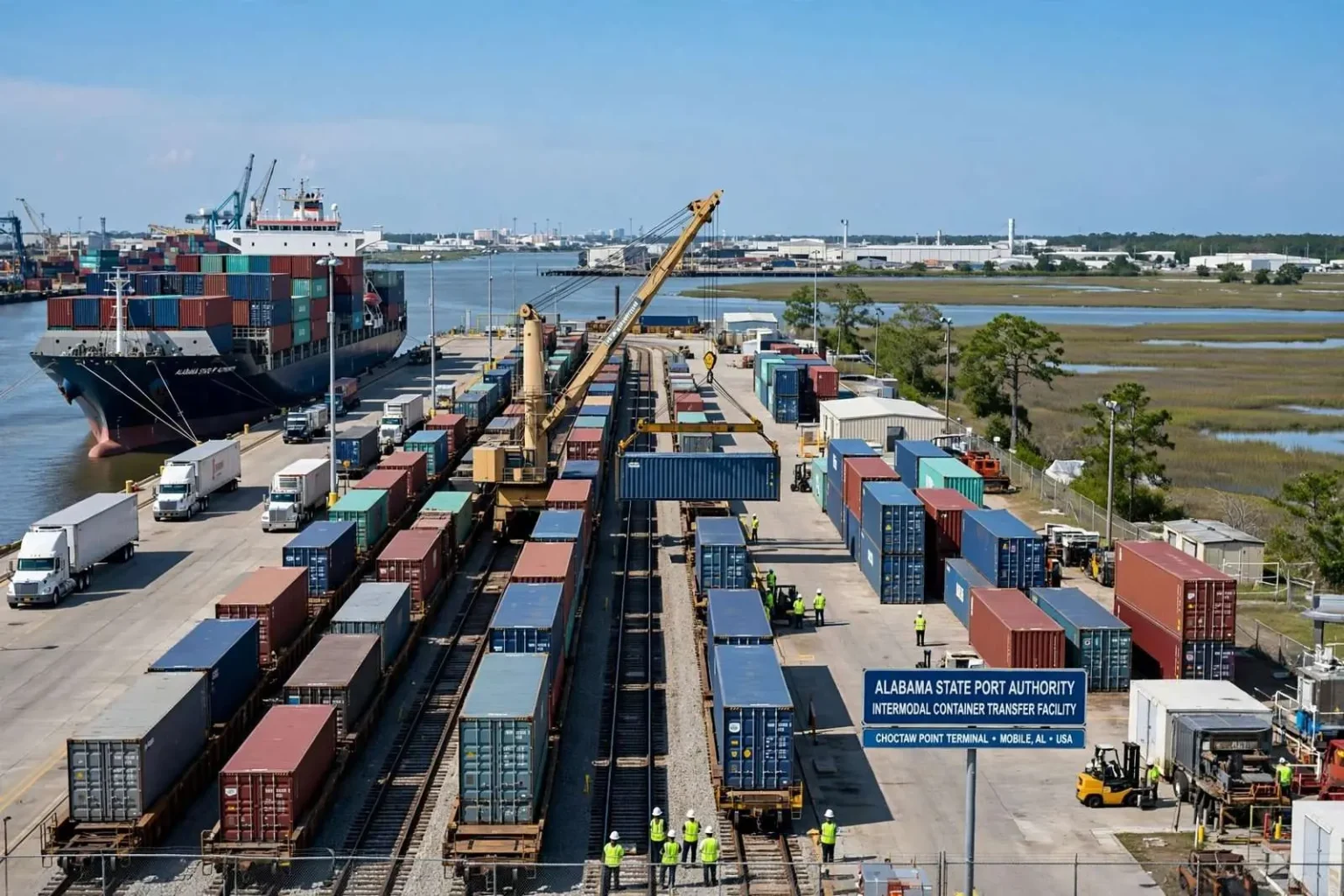
U.S. Sen. Richard Shelby, R-Alabama, announced that the U.S. Department of Transportation had awarded $4.76 million to the Alabama State Port Authority in Mobile for the Alabama State Docks Intermodal Facility Project. The money represented final approval of the second installment of a $20 million authorization included in the four-year federal transportation plan for that fiscal year.
“These funds will allow Alabama to modernize and expand its current dockside facilities to ready the docks for increased traffic and freight cargo,” Shelby said.
An intermodal facility is the piece of infrastructure that lets cargo move between ships, trains and trucks without being unpacked and repacked — the connective tissue of a modern port. For Mobile, which sits at the intersection of deep water, a Class I rail network and the interstate system, that capability was central to the port’s ambitions.
The geography has always been the argument. Mobile Harbor sits roughly 30 miles up Mobile Bay from the Gulf of Mexico, giving ocean-going vessels deep water well inland, while rail lines running to the docks connect the waterfront to the Midwest, the Southeast and the Texas markets beyond. Interstate 10 crosses the city east to west and Interstate 65 runs north toward Montgomery and points beyond, so freight arriving on the waterfront can in principle reach a vast share of the country’s population within a day’s drive.
What makes or breaks that advantage is the transfer itself. A container that comes off a ship, waits on the dock, is lifted onto a chassis and hauled to a warehouse to be reloaded onto a truck adds cost at every step. An intermodal container transfer facility is designed to cut those steps out, moving containers directly between vessel and railcar, and the $20 million authorization was aimed squarely at building that capability on the Mobile waterfront.
State Docks Director Jimmy Lyons explained the funding rhythm, which was less a single check than a series of them. “Each year about one-quarter of the amount has to be appropriated and go through the approval process,” Lyons said. “We have the ’08 portion working through the appropriation process now — a little over $5 million. The last portion would have to be appropriated in next year’s budget. Then we would hope that Congress would pass another multi-year authorization bill.”
The distinction Lyons drew — between an authorization, which sets a ceiling, and an appropriation, which actually releases money — is the difference between a promise and a payment, and it explains why port projects of this kind unfold over years rather than months. Congress can authorize $20 million for a project in a transportation bill, but each annual appropriation must still clear the committee process, and each carries its own review before the Department of Transportation signs off and the dollars move.
For the Port Authority, that meant budgeting around a funding stream that arrived in quarters, with the port’s own planning, engineering and matching obligations running on a parallel track. Port directors in that era routinely described multi-year federal projects in exactly those terms: the authorization gave them the confidence to design and phase the work, while the appropriations determined the pace of construction.
More Money in the Pipeline
Shelby said he had also secured $5.173 million for the Alabama State Docks in the fiscal year 2008 Transportation, Housing and Urban Development appropriations bill. That legislation had been approved by the Senate and was headed to a conference committee with the House of Representatives, where the two chambers’ versions of the spending bill would be reconciled before final passage.
“The Alabama State Docks has the potential to become one of our nation’s most economically viable ports due to its proximity to emerging trade routes in the Gulf of Mexico,” Shelby said.
The two announcements, taken together, showed the layered approach that port expansion required. The intermodal authorization addressed the long-term physical plant — the tracks, transfer equipment and terminal layout that determine how fast cargo can move. The appropriations earmark addressed nearer-term dockside needs, and both ran through the same senator’s hands.
A Port in the Middle of a Build-Out
The announcement came during one of the most active periods of expansion in the port’s history. The Alabama State Port Authority had recently opened a new container terminal at Choctaw Point, and the region was absorbing a wave of industrial investment — the ThyssenKrupp steel complex in north Mobile County, the growth of Austal’s shipyard on the Mobile River, and a steady increase in steel, coal and forest products moving across the docks.
All of that traffic depended on the ability to get cargo off the water and onto rail and highway efficiently. Congestion at the interchange between ship, train and truck is what turns a deep-water port into a bottleneck, and intermodal investment is the standard remedy.
The ThyssenKrupp project alone, then among the largest industrial investments in the United States, promised to run slabs and coils through the Port of Mobile for export, adding heavy cargo to a waterfront already handling coal exports, forest products and container traffic. Austal’s expansion on the river brought its own logistics demands. Each new industrial customer tightened the case for dockside capacity that could absorb growth without delays rippling back up the supply chain.
The container terminal at Choctaw Point marked a turning point of its own. Mobile had long been a bulk and breakbulk port — coal, timber, plywood, poultry, steel — and its entry into serious container operations positioned it to compete with Gulf rivals for the liner services calling at New Orleans, Houston and the Florida ports. A container terminal without fast rail transfer, however, cedes much of its advantage, which is why the intermodal project and the terminal were treated in port circles as two halves of the same strategy.
Shelby’s position made the money possible. As a senior member and, at various points, chairman or ranking member of the Senate Appropriations subcommittee with jurisdiction over transportation, he was in a position to direct federal dollars to Alabama projects with a consistency few states enjoyed. Over his long tenure, that leverage reshaped the Mobile waterfront, the University of Alabama system and the state’s highway network.
In Alabama, that arrangement was understood as the practical price of being a small state in a Senate organized by seniority. Projects that other regions financed through their own megascale budgets arrived in Mobile as a sequence of earmarks, each one negotiated through the appropriations process, each one dependent on Shelby’s seat at the table. Port officials learned to work the rhythm — requesting multi-year authorizations, then returning each year for the installments that turned them into construction.
The intermodal container transfer facility that grew out of this era of funding eventually opened near the Choctaw Point terminal, allowing containers to move directly between ships and rail. The port has continued to expand in the years since, with channel deepening and widening projects intended to accommodate the larger vessels that began transiting an enlarged Panama Canal.
The wider ships changed the arithmetic again. Vessels that once called at the biggest East and West Coast ports began reaching the Gulf, and ports up and down the coast invested in channel depth, crane height and rail access to compete for them. Mobile’s deepening project, which lowered the harbor channel to allow fully laden larger ships to call, was the eventual successor to the infrastructure arguments being made in the intermodal fight — the same logic applied a decade later at a much larger scale.
For Mobile, the logic has not changed since the day Shelby made the announcement: the docks are the region’s largest single economic asset, and their value depends on how quickly and cheaply freight can be moved off a ship and onto its way inland. The tens of thousands of jobs tied directly and indirectly to the port — longshore labor, trucking, rail, warehousing and the industrial plants that feed it cargo — all trace back to the same basic equation the $4.76 million installment was written to improve.
What the intermodal facility promised, in the end, was margin. A port that can turn cargo a day faster, or move a container from ship to train without touching a warehouse, wins cargo that would otherwise sail past. That was the case Lyons and Shelby made together, in the careful language of authorizations and appropriations, and it is the case that every subsequent expansion of the Mobile waterfront has continued to make.
Port officials at the time framed the investments in precisely those terms when they appeared before civic groups across the region: every improvement to the transfer network protected existing traffic and created the conditions for new traffic. A coal contract, a steel account or a shipping line choosing among Gulf ports looked not just at the depth of the water but at the whole journey a box would take after it landed, and Mobile’s answer to that question was being built one appropriation at a time.