A Mobile Seat on the University of Alabama Board Comes Open, and a Quiet Fight Begins
Oliver Delchamps Jr.'s move to emeritus status leaves a first congressional district seat on the University of Alabama board open, and the Senate may have the last word.
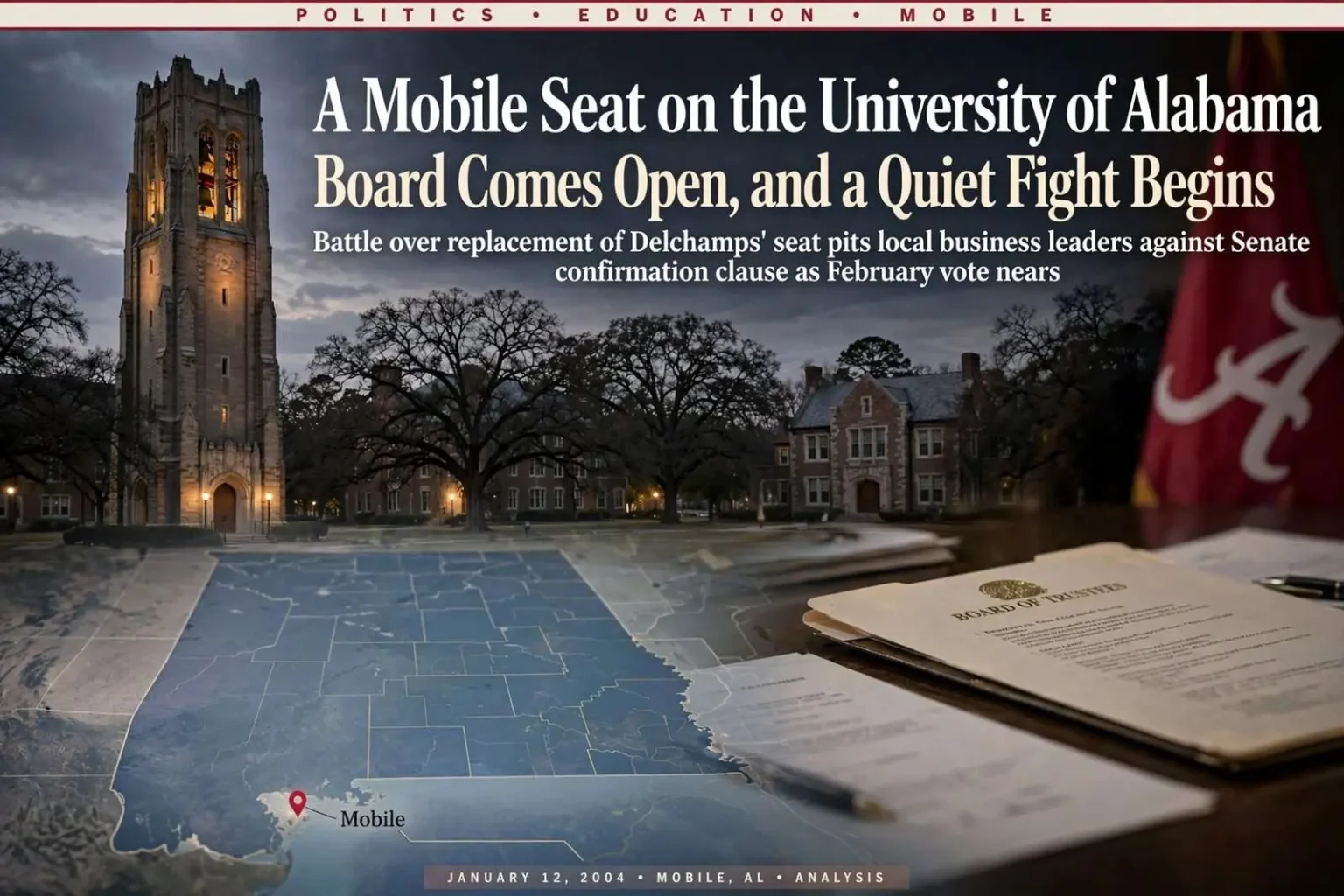
A battle may be brewing over the replacement of a Mobile man on the University of Alabama Board of Trustees — a contest that will be settled by secret ballot, but not necessarily by the board alone.
With his 70th birthday, Oliver Delchamps Jr. became a trustee emeritus, creating a vacancy in one of the two board seats reserved for residents of Alabama’s First Congressional District. Delchamps, 71, took emeritus status in September 2003, ending a tenure that had given Mobile two seats on the board that governs the state’s flagship university system.
Mobile shipping executive Angus R. Cooper II of Cooper T. Smith holds the other first district seat. The board is tentatively scheduled to elect Delchamps’ successor when it meets in February.
Delchamps said he would observe an unwritten board rule discouraging an outgoing trustee from politicking on behalf of a successor — a constraint that kept the retiring trustee’s considerable local standing out of the contest, even if his views on the candidates were no secret to his colleagues.
The Contenders
The frontrunners are believed to be Harris V. Morrissette, 45, a business executive with Marshall Biscuit Co. in Mobile, and Riley Boykin Smith, 55, who directed the state conservation department under former Gov. Don Siegelman and is a principal in Tensaw Land and Timber Co. Both men declined to comment.
Mobile commercial real estate executive Marietta Urquhart, 49, also has support — though she went out of her way to praise a rival.
“Harris is a most viable candidate,” Urquhart said. “He’s worked for the university on various boards and he’s served on an advisory board for the business school. He’s been a committed supporter of the University of Alabama for many years. He would make an excellent trustee, and I don’t mind saying that because it’s the truth. He really loves that school.”
Elliot B. Maisel, 49, chairman of Gulf Distributing Companies in Mobile, is also a contender and was invited to meet with the board to discuss the opening — an invitation that itself signaled serious consideration. Local businesswoman Buffy Donlon has been mentioned as well.
Morrissette, a former president of the Student Government Association during his undergraduate years in Tuscaloosa, is said to enjoy good favor on the board. His long ties to the university gave him a biography that read naturally in a trustees’ meeting.
Smith has the backing of, among others, his brother-in-law Wallace Malone, the influential former chief executive of SouthTrust Bank, which was acquired by Wachovia a few months ago. Malone does not sit on the university’s board — but in a selection decided by his peers’ secret ballots, an endorsement from a banker of his stature carried weight in boardrooms across the state.
The candidates represented the depth of Mobile’s civic bench. Morrissette’s years at Marshall Biscuit, one of the city’s long-standing food manufacturers, and his history in Tuscaloosa’s student government made him a trustee candidate in the classic mold. Smith’s résumé — a state cabinet post under Siegelman and leadership of a timber company with landholdings across south Alabama — mixed government experience with the rural landowning class that has historically fed the board’s membership. Maisel’s Gulf Distributing put him at the center of the beverage business, and Urquhart’s commercial real estate practice gave her a daily view of the property market a growing campus touches. Donlon’s name circulating among the others reflected the range of figures the board was willing to hear from before the February vote.
The Senate’s Role, and the Politics of It
Here the process becomes interesting. The board’s bylaws call for trustees to elect their own colleagues, but they also require confirmation by the Alabama Senate — and they appear to grant the Senate authority to do more than say no.
Section 2 of the bylaws reads in part: “If the Senate should reject the name of any Trustee, it shall thereupon elect Trustees in the stead of those rejected.”
That clause turns a routine confirmation into a potential capture point. The board nominates; the Senate can reject — and then seat its own choice in place of the board’s. For a chamber dominated by Democrats who were closely allied with the Siegelman camp, the provision meant a Mobile seat on the flagship system’s board could, at least on paper, be filled from Montgomery.
State Sen. E.B. McClain, D-Birmingham, chairs the confirmation committee that would receive the board’s nominee. A rejection and substitution would still require a vote of the full Senate — the committee alone could not install a replacement.
State Sen. Lowell Barron, D-Fyffe, the leading power in the chamber and the dispenser of committee chairmanships, is said to enjoy a warm relationship with Smith but to be uncomfortable with the idea of the Senate rejecting the board’s choice for its own body. Barron’s posture mattered because he could make or break any floor maneuver, and his instinct to respect the board’s autonomy set a ceiling on how far the Senate’s leverage could actually be pushed.
A source close to the board said the trustees were confident their preference would prevail on the Senate floor, if not in a particular committee.
Complicating matters further is the perception of Morrissette as a staunch Republican.
“If one of those women is close to being a Democrat or an Ann Bedsole-type of Republican, they would go for that nominee,” one Senate source said of the confirmation committee — referring to Urquhart and Donlon and to the former Mobile state senator whose brand of pragmatic, business-minded Republicanism had played acceptably across party lines.
The partisan math was doing quiet work. A Democratic Senate weighing a perceived Republican nominee against a candidate with Siegelman-era credentials — Smith — could find reasons, once it started looking, to prefer the latter. Whether it would exercise that preference through the bylaws’ substitution clause was the open question.
The Board and Its Reach
Elected trustees serve six-year terms and may not serve more than three consecutive full terms — the limit that had just moved Delchamps into emeritus status at 70, the board’s customary age of transition.
The board is charged with “the entire management and control over the activities, affairs, operations, business, and property of The University of Alabama System.” That mandate covers three campuses — Tuscaloosa, Birmingham and Huntsville — with budgets, construction programs, athletic contracts and presidential appointments all flowing through the boardroom. A trustee’s vote can touch everything from a hospital expansion at UAB to the hiring of a football coach in Tuscaloosa. For the First Congressional District’s two trustees, the work extends to the system’s Gulf Coast footprint as well, where enrollment growth and campus services answer to the same boardroom decisions made hundreds of miles away.
Current trustees include John J. McMahon Jr., president pro tempore; Angus Cooper; Paul W. Bryant Jr.; Vanessa Leonard; Peter L. Lowe; John H. England Jr.; Sidney L. McDonald; Joseph C. Espy III; Finis E. St. John IV; Andria S. Hurst; John Russell Thomas; Olin B. King; and James W. Wilson III.
Other Mobile-area trustees emeriti, besides Delchamps, include retired attorney Massey Bedsole and Jack Edwards, the former congressman who practices law in Mobile and lobbies in Washington. The emeritus bench gave the region a pool of experienced voices on university affairs even after active service ended.
What Mobile Had at Stake
For Mobile, the stakes are simple enough. Two seats on the board of the state’s flagship university system are reserved for this end of Alabama, and how they are filled determines whether the region speaks with influence in Tuscaloosa or merely with a vote.
Mobile’s presence on the board has historically carried practical consequences: attention to Gulf Coast campus needs, sensitivity to the port city’s economy in business decisions, and a seat at the table when system priorities are set. Losing one of the two seats to a nominee aligned with Montgomery’s Democratic leadership — rather than to a Mobile businessman accountable to local institutions — would shift that balance.
The February meeting would resolve the first half of the question: whom the trustees chose in their secret ballot. The Senate confirmation, scheduled to follow, would resolve the second — and the bylaws’ substitution clause hung over both stages, a reminder that in Alabama even a university board seat could be a contested piece of statewide politics.
Whoever won, the process itself said something about how the university system is governed. Few institutions of its size are run by a self-electing board whose members must then clear a legislature that can, under its own bylaws, replace them. The Delchamps vacancy made Mobile the latest arena for that arrangement — a city’s business leadership, a retiring trustee’s quiet example, a governor’s allies in the Senate, and a clause on paper, all converging on a single district seat in February.