Tea Party Leader Says Mobile’s Budget Hole Began at City Hall, Not at the Cash Register
A Mobile tea party organizer argued the city's $18.5 million shortfall was the product of optimistic budget assumptions, and urged the council to exhaust cost cuts and asset sales before raising the sales tax.
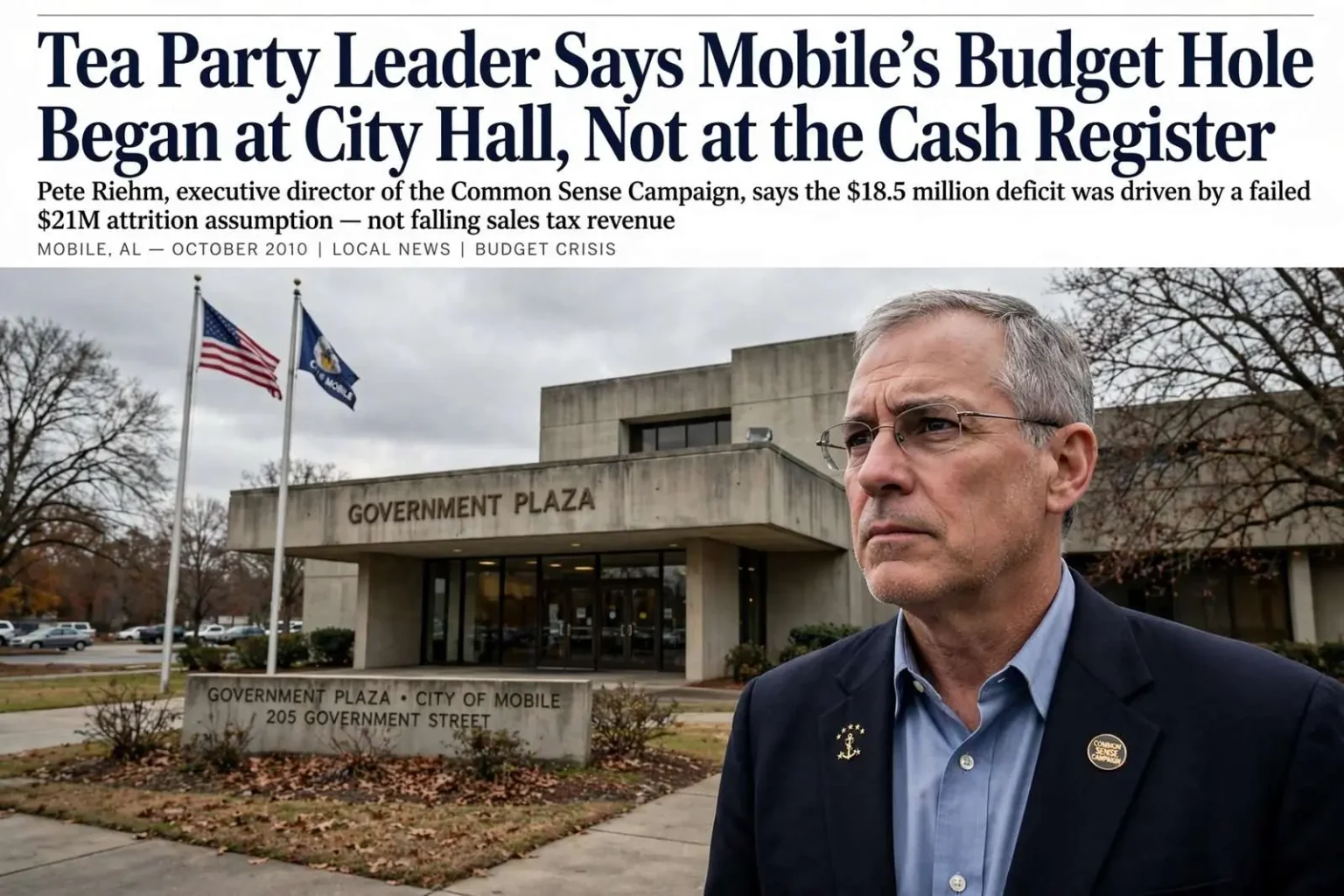
As Mobile officials wrestled with an $18.5 million hole in the current year’s budget, a leader of the region’s fast-growing tea party movement argued that the crisis at Government Plaza was not a revenue problem at all, but the predictable result of a spending plan built on assumptions that never had much chance of holding up.
Pete Riehm, executive director of the Common Sense Campaign and a retired U.S. Navy commander who works as a commercial real estate executive in Mobile, said in a commentary published this week that the same question animating conservative activists at the national level applied squarely to City Hall: what should government be doing, and how much money does it actually need to do it?
Riehm’s organization had become one of the most visible faces of the tea party wave along the Gulf Coast, drawing participants from Mobile and Baldwin counties who turned out to fiscal-aid meetings, budget hearings and candidate forums in growing numbers. What distinguished the group’s argument in the Mobile budget fight was that it was aimed less at Washington than at the city’s own ledger — and it came from someone who understood local real estate and municipal finance from the private side.
Mobile’s city government operates under a strong-mayor, seven-member council form in which the administration drafts the budget and the council amends and adopts it. The budget debate that year unfolded in the shadow of the worst national recession in a generation, with sales tax collections — the city’s dominant revenue source — falling short across the country and forcing cities from Birmingham to Baton Rouge into similar triage. Mobile’s $18.5 million shortfall put it squarely in that national company, and the fight over how to close it turned the council chambers at Government Plaza into the region’s most closely watched civic theater.
The $21 Million Assumption
Riehm’s central complaint concerned the personnel savings written into the fiscal 2010 budget. The city had counted on roughly $21 million in voluntary attrition — savings from retirements, transfers and unfilled positions — to bring salary costs down without layoffs. Councilwoman Connie Hudson challenged that figure when the budget was adopted, Riehm noted, and the administration insisted it was realistic. Only about $8 million of that attrition had materialized, he wrote. That left the remainder to be found through involuntary means: layoffs, furloughs or pay reductions.
The gap between assumption and reality was the single largest arithmetic error in the budget, and it defined everything that followed. Attrition-based savings depend on ordinary retirements and ordinary turnover, and those slow to a crawl in a bad economy: workers who might otherwise have retired stay on, and employees in nearby government or private jobs hold the positions they have. Budgeting $21 million of savings from a process the city did not control meant budgeting a number the city could only hope for, not count on.
Riehm’s objection was one of logic. If the city had genuinely believed it could deliver the same services with $21 million less in payroll through retirements, he asked, why was it now describing $13 million in layoffs as an intolerable blow to public safety? Both propositions, he argued, could not be true at once. Either the payroll could absorb a $21 million reduction without damage, in which case the same reduction accomplished through involuntary means should be manageable with planning; or it could not, in which case the original attrition assumption was never credible and the deficit had been baked in from the day the budget passed.
He credited a caller to a local talk radio program with framing the contradiction most plainly, and said the city owed residents an answer rather than a warning. In his view, the administration had spent the fiscal year alternating between two irreconcilable claims — first that the city could run leaner without consequence, then that any further reduction would devastate police and fire — and had never squared the two in public.
Why Start With Police and Fire?
After the council declined to approve a one-cent increase in the municipal sales tax — a step that would have raised the city’s share by a quarter — the administration began outlining reductions to police and fire protection. Riehm called that sequence backward and, in his sharper phrasing, a form of pressure applied to residents who had not fallen in line.
The council’s rejection of the penny increase reflected the political math of the moment. A full cent on Mobile’s sales tax would have been among the largest single tax increases in the city’s history, landing on every retail transaction in the city limits during a recession, and a council majority had balked at putting it forward. But Riehm argued that turning immediately to public safety cuts converted a budgeting disagreement into a hostage negotiation: residents who refused new taxes would be made to feel the consequences in the services they valued most.
Before touching public safety, he argued, the city should have looked hard at three categories of spending:
Roughly $4 million in performance contracts with outside organizations, none of which delivered core municipal services. Mobile, like many cities, funds a network of civic, cultural and development organizations under contracts that promise measurable results; to a budget critic, that money was discretionary in a way police payrolls are not.
Shortened hours or seasonal closures at parks and museums, an approach used by cities across the country to preserve front-line services while absorbing visible but manageable reductions in amenities.
Municipal assets that routinely lost money, including the civic center, the golf course and the botanical gardens. Each had a constituency, and each had a genuine public value, but each also cost the general fund year after year in a moment when every dollar was being counted against police and fire protection.
Riehm was careful to say he valued those amenities and did not want them abolished. His point was one of sequence. Given a choice, he wrote, most residents would sooner shutter the civic center for a while than close a police precinct — and if the city could not say that out loud, he argued, it had not actually prioritized anything. The test he proposed was blunt: rank every line item by what residents would protect first, and cut from the bottom up. Parks hours, museum schedules and money-losing facilities sat near the bottom of that ranking in his view; police and fire sat at the top, and the city’s early moves had it upside down.
Revenue Ideas Beyond Taxes
On the income side of the ledger, Riehm said the public had heard almost exclusively about higher taxes and fees. He asked why the city had not moved to sell non-performing assets, renegotiate contracts to at least break even, or pursue what he called creative sources of money.
The example he offered was the Chastang landfill in north Mobile County, where captured methane and other landfill gases could be sold. Landfill gas has become a genuine commodity: operators across the country capture the methane produced by decomposing waste and sell it for energy generation, and the federal environmental rules that required large landfills to control their gas emissions created a market for exactly that capture. Private firms had competed for that business for years, he wrote, and estimates of the potential return to the city ranged from $400,000 to $1 million a year. The idea, he said, had drawn little attention downtown.
At the low end, the landfill gas estimate would not have closed the $18.5 million gap by itself; at the high end, it could have offset a meaningful slice of the layoff total. But Riehm’s larger argument was about inventory: a city the size of Mobile held land, buildings, contracts and franchises that a private market would value, and a government facing a structural deficit should know what those assets were worth before asking residents for another dime.
A Deficit Foreseen
Riehm also questioned why a budget adopted in the middle of the worst economic stretch in living memory had projected a roughly $10 million, or 9 percent, increase in sales tax collections. Paired with the attrition assumption that did not pan out, he said, the arithmetic of the $18.5 million deficit was not mysterious. Prudent officials, he argued, should have seen it coming a year earlier — though raising it then, he added pointedly, might have complicated an otherwise quiet municipal election season.
The 9 percent growth assumption was the budget’s second fragile pillar. Sales taxes track consumer spending, and consumer spending in 2009 and 2010 was contracting across the Gulf Coast as port traffic slowed, construction stalled and household budgets shrank. Assuming double-digit-style growth in that environment was, in Riehm’s telling, less a forecast than a wish — and once the attrition savings and the revenue growth both failed, the combined miss produced the deficit the city was confronting.
He closed by citing local budget watcher Tilmon Brown, who had calculated that Mobile residents were paying more than double for city services what a population of the same size paid in 1966, and asked whether taxpayers were getting twice the value. For scale, Mobile’s total budget in fiscal 1993 — general fund, capital, convention center and strategic plan combined — called for about $125 million in revenue against roughly $123 million in spending, with the general fund alone at about $100 million. Seventeen years later, the city’s spending plan had grown by roughly two-thirds, outpacing inflation’s modest pace and the city’s barely changed population.
Riehm’s prescription was not a specific number but a process: an exhaustive public review of every option, driven by residents pressing their council representatives. He wanted the contracts, the assets, the amenities and the payroll all on one table at the same time, with residents watching — not a series of unilateral announcements from the administration. “Good self-government starts at home,” he wrote, and in his framing the budget crisis was less a test of the city’s finances than a test of whether Mobile’s residents would demand the full accounting the crisis made necessary.