Mobile Legislators Opened Their Homes for a Montgomery Congressional Hopeful as the Primary Neared
Four Mobile-area state legislators hosted a reception for a Montgomery Republican running in the 2nd Congressional District, while the Romney campaign eyed a Senior Bowl weekend stop ahead of an early coastal primary.
Late January 2008 found the Mobile area’s political calendar unusually crowded. Alabama’s presidential primary had been pulled forward to Feb. 5, joining the massive multistate Super Tuesday contest, and in Mobile and Baldwin counties the date collided directly with Mardi Gras Day. Because the two coastal counties effectively shut down for parades, election officials moved their balloting even earlier — to Jan. 30 — with ballots sealed and counted the following week alongside the rest of the state. Campaigns of every size adjusted accordingly, compressing their coastal schedules into a single frantic week.
A Montgomery Republican Courts Mobile Money
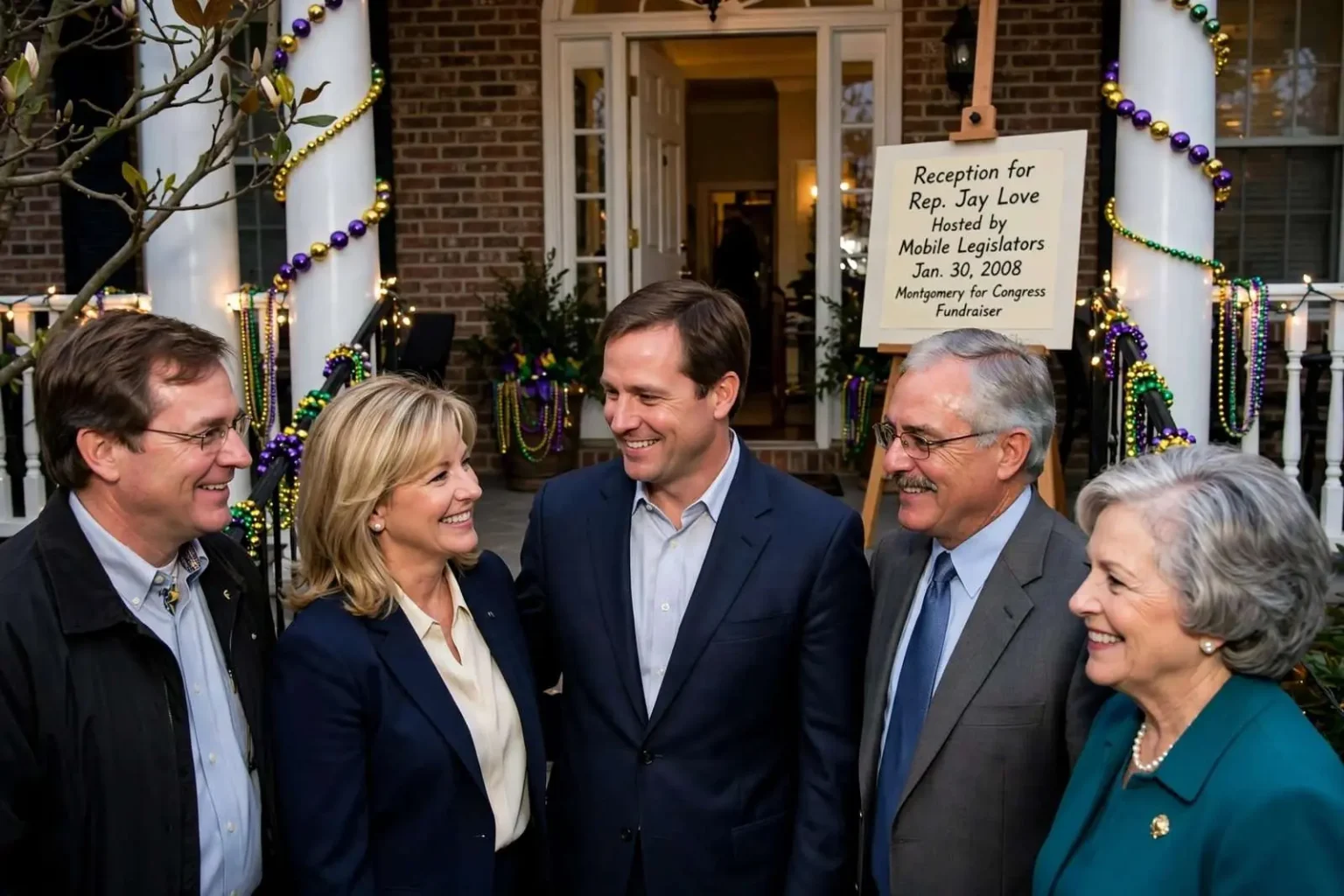
At the legislative level, four Mobile state legislators, their spouses and a roster of area supporters prepared to host a reception for state Rep. Jay Love of Montgomery, who was seeking the Republican nomination in Alabama’s 2nd Congressional District. The event was set for Wednesday, Jan. 30, at the home of state Rep. Jamie Ison and her husband, Jay. Among the hosts were state Rep. Jim Barton and his wife, Kim; state Rep. Chad Fincher and his wife, Carisse; and state Rep. Victor Gaston and his wife, Jean, along with a long list of Mobile business and civic figures. Admission was $500 per couple or $250 for an individual — standard pricing for a congressional fundraiser, but a notable ask for a district that does not include Mobile.
Love, then the minority whip in the Alabama House, was running for a seat that had been in the hands of U.S. Rep. Terry Everett of Rehobeth since 1993. Everett had announced he would not seek re-election, opening the first genuinely competitive race in the district in a generation. State Sen. Harri Anne Smith of Slocomb had already declared her candidacy, and Montgomery Mayor Bobby Bright, an independent, was publicly weighing a bid without tipping his hand on which party he might ultimately align with. The field would take shape over the following months, but in late January the contest was still an open lane.
The geography of the district made the Mobile fundraiser notable. Alabama’s 2nd District covers the Wiregrass and much of southeast Alabama — Dothan, Enterprise, Troy and the surrounding farm country — rather than the coast. Love had no natural coastal constituency, yet there he was, headlining an event hosted by half of Mobile’s legislative delegation. It was a reminder that Mobile had become a reliable source of Republican money for candidates well beyond its own congressional lines, and that the state’s county legislative delegations functioned as fundraising networks as much as governing bodies. A candidate who could draw Ison, Barton, Fincher and Gaston as co-hosts was signaling to Montgomery donors and Birmingham party leaders alike that Mobile’s establishment had taken his candidacy seriously.
For the legislators themselves, the calculus ran both ways. Hosting a fundraiser for a rising House colleague built goodwill inside the Statehouse that could pay off in budget fights and leadership votes for years. And for a delegation whose members regularly sponsored Mardi Gras galas and civic fundraisers for one another, adding a congressional race to the January social circuit required little new machinery — the same donor lists, the same living rooms, the same network of business figures who underwrote politics across south Alabama.
Romney Looks at Senior Bowl Saturday
At the presidential level, Mitt Romney’s campaign was hoping to schedule an event in Mobile on Senior Bowl Saturday, according to a Romney campaign aide. One of the candidate’s sons, Josh or Ben, was mentioned as a possible headliner in his father’s stead, a common tactic for campaigns trying to cover more ground in the closing days before a multistate vote.
The choice of date was shrewd. The Senior Bowl, the college all-star game played at Ladd-Peebles Stadium each January, drew NFL scouts, national media and a large local crowd to Mobile every year. For a campaign trying to make an impression in the days before an unusually early coastal vote, it was the single busiest weekend on the calendar — a guaranteed audience of engaged local voters and out-of-town press gathered in one place, with none of the scheduling competition a ordinary weeknight would have brought.
Presidential politics had rarely rewarded Alabama candidates or voters with much attention. The state’s primaries historically fell late in the nomination calendar, long after the races had been decided, and Alabama voters were accustomed to watching other states pick the nominees. The 2008 cycle changed that calculus for both parties, and the campaigns noticed: visits, phone banks and advertising arrived in Alabama at volumes the state had not seen in a modern nomination fight.
‘America Is Listening’
State officials were doing their part to drive turnout. Alabama Secretary of State Beth Chapman urged Alabamians to vote, arguing that for the first time the rest of the country would actually be paying attention to what the state’s voters decided. Her pitch reflected a genuine shift. Alabama had historically voted late enough in the primary calendar that its results were symbolic at best. By joining more than 20 states on the Feb. 5 ballot, the state had bought itself relevance — and campaigns responded accordingly, with candidate visits, organized phone banks and television advertising that Alabama voters had rarely encountered in a nomination fight.
Chapman’s framing captured the moment for many state politicians. Alabama’s primary had long been an afterthought, a line item on a calendar that the national parties had little reason to court. Moving to Feb. 5 turned the state into one voice among a hundred million on a single night, and for once the conventional wisdom held that a Southern, socially conservative electorate could actually tip a contested nomination rather than merely ratify one that was already decided. Whether or not that proved true, the sense of mattered-once relevance was real, and secretaries of state across the South made the same argument their own voters.
The Coastal Wrinkle
The Mobile and Baldwin exception remained the oddity of the cycle. Because Feb. 5 fell on Mardi Gras Day, and because the two counties effectively shut down for parades, balls and family obligations that consume the day, election officials moved balloting to Jan. 30. The votes would be cast first and counted last, sealed and held until the rest of the state finished voting on Super Tuesday, alongside every other state in the national contest.
For campaign staffs, that meant the coast had its own compressed deadline. Anything a candidate intended to say to Mobile and Baldwin voters had to be said by the end of January, days before the national conversation even reached its peak. Direct mail had to land earlier, phone banks had to start earlier, and any candidate visit had to squeeze into the same narrow stretch of calendar as the parties and parades that dominated the season.
The reception at the Ison home, the Romney event under discussion and the secretary of state’s appeals all landed in the same window — and then the parades began. For a few days, Mobile’s dual identity as a political jurisdiction and the home of the oldest carnival celebration in America occupied the same space, with campaign operatives checking parade schedules the way they normally checked polling data.
The January 2008 episode also previewed dynamics that would define Alabama politics for years afterward. The Mobile legislative delegation’s role as a fundraising gateway for statewide and congressional candidates became a fixture of Republican politics in the state. The 2nd District race that Jay Love was chasing would develop into one of the nation’s most closely watched congressional contests later that year, drawing national attention and money to the Wiregrass. And the memory of the state’s single day of genuine presidential relevance — the one Feb. 5 when Alabama mattered — lingered in the arguments of both parties over how and when the state should vote in cycles that followed.
For the candidates, the lesson of the compressed coastal calendar was practical. In Mobile and Baldwin counties, a campaign could not assume the national rhythm of a Super Tuesday week applied; the coast voted first, quietly, while the rest of the state was still being courted. Any operation that treated Mardi Gras Day as just another Tuesday risked losing the two counties’ votes before the confetti settled — a fact that every subsequent campaign operating on the Alabama coast has had to take into account whenever the state’s primary calendar has threatened to brush up against Carnival season.
By the following week, the ballots were counted, the parades were over, and Alabama’s brief moment at the center of American presidential politics had passed. But the January of 2008 had shown how the state’s political machinery actually worked when it mattered: local legislators raising money for candidates from other districts, presidential campaigns building events around a football game, and election officials quietly reshaping the calendar around two centuries of Carnival tradition.