Mobile’s Political Class Sizes Up an Unsettled 2008 Presidential Field
Asked to name a favorite in the 2008 presidential race, Mobile-area officials, lawyers and civic figures answered with hedges, wish lists and a fair amount of open dissatisfaction with both parties' fields.
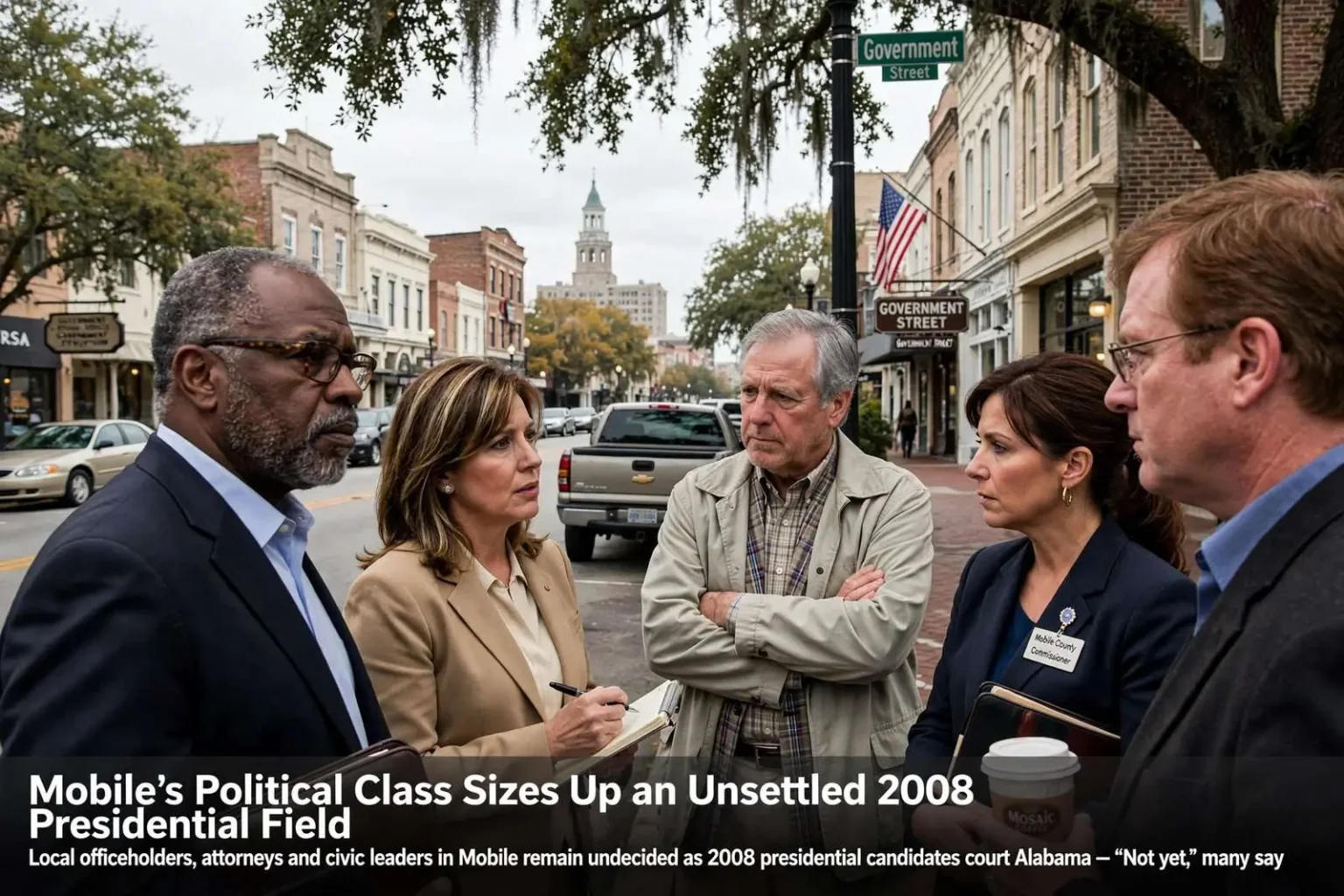
With the first votes of the 2008 presidential contest still months away, prospective nominees in both parties were already courting influential local figures across Alabama — and in Mobile, a survey of officeholders, attorneys and civic leaders found a political class that was watching closely and committing to almost nothing.
Asked which candidate had their support, a striking number of the region’s most active political figures answered with some version of “not yet.” The responses, gathered as the campaign entered its long pre-primary stretch, captured a moment when the field on both sides was unusually crowded and no obvious favorite had emerged in South Alabama.
Republicans Looking for a Standard-Bearer
Several conservatives said they were holding out for a candidate who had not entered the race.
“My first choice is Newt Gingrich, a dedicated conservative and a brilliant thinker,” said conservative activist Michael Mastro. “He has some baggage, but I believe that conservatives would gladly support him.” His second choice, he said, was former Sen. Fred Thompson of Tennessee, “another dedicated conservative and brilliant thinker” without the same history.
What he liked in both men, he said, was that they “seem to be unaffected by political correctness, and neither seems to mind stepping on toes.”
Baldwin County Realtor Starke Irvine was blunter still. “I’m not involved but I am waiting on Newt. I will support him,” he said. “Otherwise I do not think we are looking at anyone I would consider as presidential in this time of need.”
Neither Gingrich nor Thompson had announced at that point; Thompson entered the race that fall, while Gingrich ultimately declined to run.
The Gingrich-or-nobody posture reflected something real about the 2008 Republican field as Mobile’s conservative activists saw it. The declared candidates — among them Sen. John McCain of Arizona, former Massachusetts Gov. Mitt Romney and former New York Mayor Rudy Giuliani — each carried positions that gave some faction of the conservative coalition pause, and none had yet consolidated the movement wing that Gingrich’s tenure as House speaker and Thompson’s screen career made them portals to. Waiting for a candidate who had not entered the race was, for some, a way of declining to settle.
Democrats Divided Among the Front-Runners
On the Democratic side, the region’s answers ran the length of the ballot. Mobile attorney Henry Brewster made a point of backing a man who was not running at all: former Vice President Al Gore, “all the way,” he said, noting he had long admired the Nashville-born candidate whose political roots ran through Tennessee and whose 2000 campaign had carried Alabama’s neighbor states in the national argument.
Gore’s standing among some Mobile Democrats had been renewed by the advocacy work that followed his 2000 defeat — the climate campaign that would, within months of these soundings, earn him a share of the Nobel Peace Prize. That Brewster would commit to a non-candidate spoke to the same instinct the Gingrich holdouts expressed on the right: an unwillingness to choose from the declared field when a preferred alternative might still be persuaded.
Other Democratic figures in the survey spread their support among the actual front-runners — the sitting senator from New York, the young senator from Illinois whose candidacy was still converting its grassroots energy into establishment respect, and the former senator from North Carolina running a populist economic message. The split was less about ideology than about judgment: which of the three could actually win in November, and which could carry the South.
That question mattered in Alabama in a way national commentary missed. The state’s Democratic primary electorate — heavily Black in the urban centers and across the Black Belt, with a white working-class base in the industrial towns — would be one of the earliest real tests of whether the party’s new coalition could hold together under the pressures of a contested nomination. Mobile’s Democratic insiders understood that whichever candidate carried their county’s delegation into a February primary would shape the state’s superdelegate arithmetic.
The calendar that compressed everything
The reason the courtship of local figures started so early was structural: Alabama, along with a bloc of other Southern states, had moved its primary into early February, joining the nationwide delegate scramble that became known as Super Tuesday. A state that once voted late, after the nominees were effectively chosen, now voted in the first cluster — which meant campaigns had to build organizations in Alabama a full year ahead, and local endorsements had acquired a market value they had not held in a generation.
That was the context in which prospective nominees’ representatives worked the phones and visited the offices of Mobile’s officeholders, attorneys and civic leaders. An early endorsement from a county commissioner or a legislator meant a list, a network and credibility with the voters who actually turn out in Alabama primaries. And the people being courted, as the survey showed, were in no hurry to spend that currency.
Why Mobile’s Insiders Held Back
The hesitation had several layers. Some of it was arithmetic: with the field crowded and the primary a year off, an early commitment bought goodwill from one campaign while closing doors to the rest. Some of it was uncertainty about who could win — the Republican field’s front-runners each carried general-election vulnerabilities, and the Democratic field’s leading candidates had never competed in the South. And some of it was local habit: Alabama politics has always rewarded those who wait, and the state’s most durable power brokers built careers on endorsing late, when their support could decide something.
There was also a distinctly Mobile dimension. The city’s political class — the legislative delegation, the county officeholders, the downtown attorneys and the Baldwin County’s business conservatives across the bay — had learned to think in cycles, and a presidential field still fluid enough to include non-candidates like Gingrich and Gore was, to them, not yet a field worth betting on. Their answers reflected the professional’s version of indecision: watching, weighing, and keeping every campaign’s number in the phone.
The survey also caught the parties at asymmetrical moments. On the Republican side, the contest for conservative authenticity had no clear referee — no southern favorite son, no movement consensus — which left activists inventing their own standard-bearers. On the Democratic side, the front-runners were already national names with Alabama organizations beginning to stir, but the state’s Democrats knew their primary would be a single contest inside a regional one, with the Black Belt and the urban counties doing most of the deciding.
What actually happened next
The subsequent year resolved the indecisions the survey recorded — and mostly against the holdouts. Thompson entered the race that fall as the candidate the conservative movement had been waiting for, led briefly in national polls, and fizzled under the weight of an unenthusiastic campaign. Gingrich never entered. The Republican nomination went instead to McCain, the declared candidate the survey’s subjects had mostly declined to support, who rode a New Hampshire revival to the nomination and chose as his running mate a governor whose candidacy scrambled the field’s assumptions entirely.
On the Democratic side, Gore stayed out, won the Nobel, and watched from the sidelines as the party’s defining contest came down to the New York senator and the Illinois senator — a contest that stretched through the February primaries, including Alabama’s, into June. The Illinois senator won Alabama’s primary decisively, carried the Black Belt and the urban counties by margins that validated the coalition argument Mobile’s Democrats had been debating, and ultimately won the nomination and the presidency.
For Mobile’s political class, the 2008 cycle ended as a lesson in the cost of waiting. The insiders who held out for Gingrich or Thompson, or for a Gore candidacy that never came, spent their influence on candidates who did not materialize, while the campaigns they declined to court early went on to write the year’s history. The survey’s “not yet” answers capture something true about that moment — genuine uncertainty, a crowded field, a late calendar — but they also capture the professional gambler’s instinct to keep folding until the last card, and 2008 showed what that instinct costs when the cards run out.
The snapshot also documented the ecosystem through which Alabama has always absorbed national politics. Presidential campaigns in the state do not primarily run through media markets or paid organizing; they run through the local figures — legislators, commissioners, prosecutors, real estate leaders, party committeemen — whose endorsements translate into turnout infrastructure. Courtship of those figures is the state’s true primary season, and it begins long before any vote. The survey’s subjects were the people being courted, and their answers constituted the field’s first real polling in southwest Alabama.
The Republican hesitation had a geographic flavor worth noting. Baldwin County, across Mobile Bay, has been for decades the anchor of Republican strength in south Alabama — the real estate professionals, retirees and business owners whose loyalty the party could count on in November but whose primary votes had to be earned. When a Baldwin County Realtor said publicly that none of the declared candidates looked presidential, the message traveled: the movement base was unclaimed, and whichever campaign convinced the Gingrich holdouts that their standard-bearer was real would inherit that territory.
The Democratic split had its own geography. Mobile’s Democratic establishment historically balanced downtown’s business and legal community against the neighborhood organizations that dominate city primaries, and a contested national field gave both factions room to maneuver. Supporters of the different front-runners could all plausibly claim electability, and the local party — accustomed to rallying behind a single statewide slate — had no settled mechanism for dividing among three.
In the end, the value of the survey lies in what it preserved: a moment when Alabama’s presidential politics still belonged to its local gatekeepers, before the February calendar, the money race and the national organization-building made state endorsements simultaneously more necessary and less decisive. The people Mobile’s campaigns courted that year were the last generation of insiders who could answer “not yet” and mean it — and 2008 was the election that taught both parties how much that answer had come to matter.