Who Inspires Our Leaders? South Alabama Officials Named Their Political Heroes
Asked to name the political hero who shaped them, area officeholders past and present answered with presidents and prime ministers - and, more often than expected, with their own mothers and fathers.
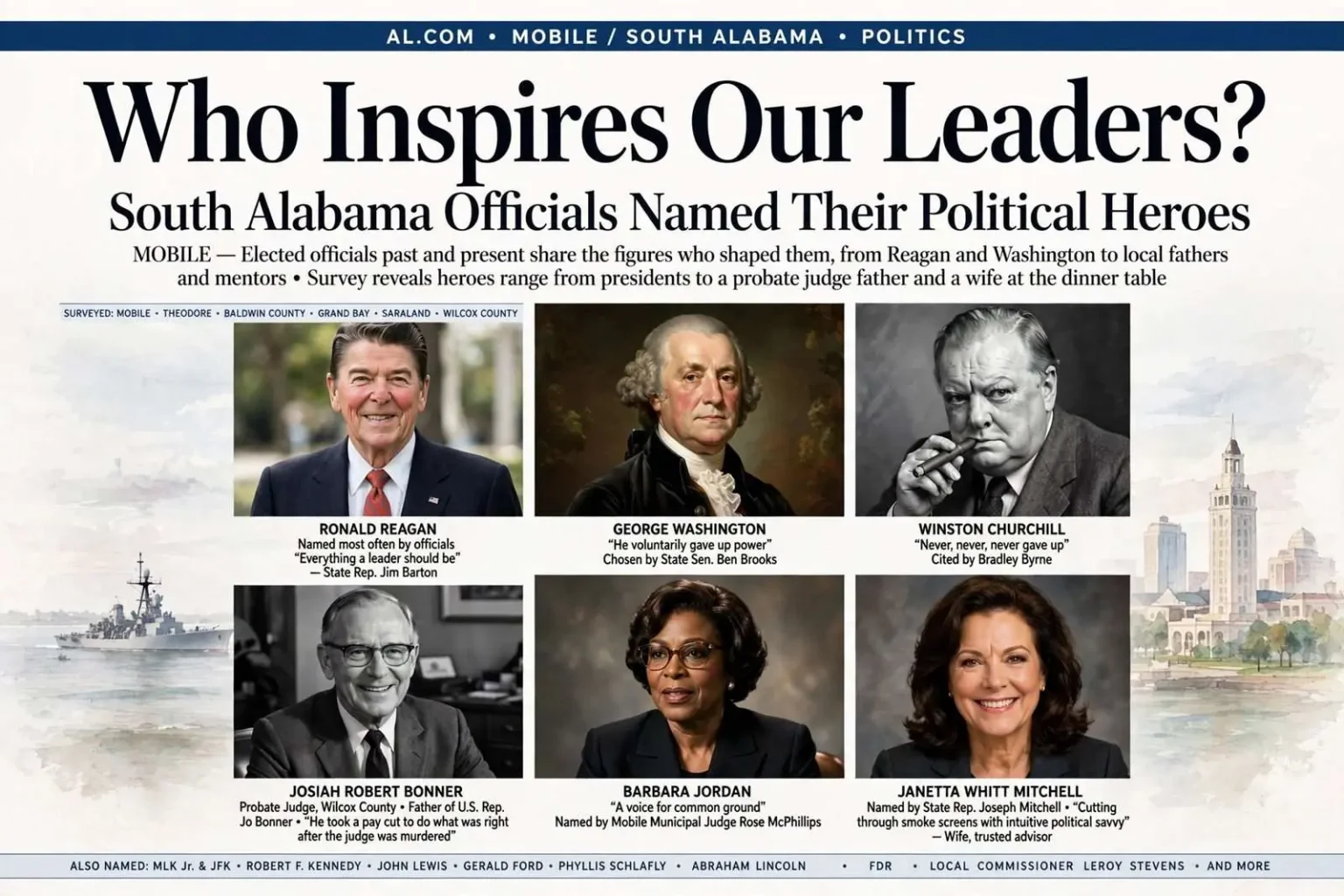
MOBILE — Ask an elected official to name a political hero and you expect a safe answer: a president, a founder, a face already carved into stone. Some of South Alabama’s officeholders obliged. A surprising number did not. Surveyed on the question, area elected officials past and present offered a roster that ran from Winston Churchill to Barbara Jordan — and, again and again, to a father.
Reagan, and the Men on the Money
Ronald Reagan was the most frequently named figure. State Rep. Jim Barton of Mobile County traced his interest in politics directly to him. “To me he was everything a leader should be,” Barton said. “In 1984 I was probably the only depressed 16-year-old at McGill-Toolen because I was not old enough to vote for Reagan!” The lament marks the era precisely: a Catholic high school student watching the 1984 landslide from the sideline, too young by two years to pull the lever he badly wanted to pull.
Mobile County District Judge Judson Wells made the case in policy terms. Reagan took office when inflation was at record levels, Wells said, and “tamed both the inflationary beast and communism. When he took office, people did not feel very good about our country or the future. When he left office, they did.” The two-part argument — economic rescue and restored national confidence — is the standard case for Reagan’s presidency, and Wells delivered it as both a judge and a veteran of the political wars of that decade.
State Sen. Ben Brooks of Theodore chose George Washington — but not for the war or the presidency. Washington earned the place, Brooks said, “because he voluntarily gave up power at the end of his second term. This single act confirmed the tradition of citizen service in our American system of government.” The choice says as much about the chooser as the chosen: a state senator picking not the commander or the executive but the man who walked away from both.
Bradley Byrne, then chancellor of the state’s two-year colleges, gave the shortest answer in the survey: “Winston Churchill. Because he never, never, never gave up.” The paraphrase of Churchill’s own wartime phrasing was an answer in miniature — a sentence that doubled as a career philosophy for a man whose public path would run from the chancellor’s office through the Mobile County school board, Congress and beyond.
Fathers, Uncles and a Wife
The most affecting answers were the closest to home. U.S. Rep. Jo Bonner named his father, Josiah Robert Bonner, appointed probate judge in Wilcox County in the late 1960s after the sitting judge was murdered. He took a significant pay cut to do it, stepping into one of Alabama’s most difficult public posts in the turbulent years after the assassination of Martin Luther King Jr.
Bonner told a story about a football field. At the county’s African-American high school, still segregated, the field “had no grass, just dirt and rocks. It had only one goal post. Every time a team kicked an extra point or a field goal, they had to switch to that end of the field.” His father pushed for grass and other improvements. “He thought it was just a glaring example of inequality… Whether it was a small thing or a large thing, he did what was right.” The image — a single goalpost shared by two teams on a dirt field — compressed the argument about equal treatment into a single image a child could keep.
State Rep. Jamie Ison of Mobile named her father, Roger Norman, president of the New Albany, Mississippi, school board in the late 1960s — “a consensus builder, a motivator and a problem solver.” A woman who would later serve on Mobile’s city council and in the Legislature credited the skills she would use in both to a small-town school board president handling desegregation-era disputes in northeast Mississippi.
Former legislator Taylor Harper of Grand Bay remembered his great-uncle Leroy Stevens, who served on the Mobile County Commission from 1942 to 1972 and chaired it for roughly 25 of those years — a three-decade tenure that made him one of the dominant figures in county government’s modern history. Including the day he stood in a sage field at what is now Dauphin and Sage and declared that this was where the new courthouse ought to go. The declaration made in a vacant field became, in time, the civic geography of west Mobile.
State Rep. Joseph Mitchell of Mobile County simply named his wife, Janetta Whitt Mitchell, crediting her with “an intuitive political savvy that cuts through smoke screens, smoky mirrors and smoky personalities.” Mitchell, a veteran of decades in the House, made the only answer in the survey that pointed not to history but to the person at his own dinner table.
King, Kennedy and the Cost of Service
State Rep. James Gordon of Mobile named Dr. Martin Luther King Jr. and President John F. Kennedy, with Georgia Rep. John Lewis as his favorite living politician. All three, he said, served “without regard for their own safety.” Serving today, Gordon added wryly, “is akin to being married to a spouse that is constantly looking for fault in all you do” — and yet King, Kennedy and Mobile’s own John LeFlore, the longtime civil rights leader and NAACP figure, faced threats and worse. “I just have to withstand lies and half-truths.”
Former state legislator Mike Box of Saraland also chose Kennedy, remembering being “swept up by the sense of excitement and hope engendered by the Camelot years.” His answer belonged to a generation that came of age under the young president’s rhetoric of service and possibility, before its abrupt end in Dallas.
Former city councilwoman Bess Rich named two: Robert F. Kennedy, whose assassination sparked her political awakening, and Margaret Chase Smith, the first woman elected to both houses of Congress. Smith’s presence on the list was notable — a Maine Republican remembered by an Alabama councilwoman for the independence and conscience that defined her Senate career, including her early, lonely stand against McCarthyism.
Across the Aisle and Across the Years
State Sen. Rusty Glover of Mobile County named Phyllis Schlafly and U.S. Sen. Jeff Sessions — pairing the conservative movement’s most influential organizer with the Alabama senator whose career defined the state’s modern Republican politics. Baldwin County legislator Joe Faust refused to choose among Reagan, Abraham Lincoln and Franklin Roosevelt, a three-way tie that spanned the party’s entire modern history.
Mobile municipal judge Rose McPhillips chose Barbara Jordan, “a voice for common ground.” Jordan, the Texas congresswoman famous for her command of the Watergate hearings and her 1976 convention keynote, has remained a touchstone for officials who value deliberation over volume.
Retired state Sen. Hap Myers picked a local man: retired Congressman Jack Edwards. “Jack’s my guy!” Myers’ choice pointed to the congressman who represented the First District for three decades and built the coastal federal footprint — from shipyard work to aerospace — that the region still trades on.
Edwards himself named Gerald Ford, recalling 1965, when five inexperienced Alabama Republicans arrived in a Washington where many northern Republicans, bitter after the Goldwater rout, “referred to us as ‘redneck racists.’” The freshman class included Edwards and the other southerners who had broken the Democrats’ long hold on the region’s congressional seats, and the reception they found was colder than the election returns had suggested.
Ford, he said, was one of the few who gave them the time of day. The future president’s habit of treating awkward freshmen as colleagues rather than curiosities left a mark that outlasted both men’s careers. Edwards and his wife, Jolane, were at the White House when Ford was sworn in after Nixon resigned — witnesses to the transfer of power that followed the only presidential resignation in American history. “Jerry was a very honorable man,” Edwards said, using the nickname that colleagues and friends had kept since Ford’s Michigan days.
Read together, the survey sketches a portrait of how South Alabama’s politicians understand their own trade. The presidents on the list — Reagan, Washington, the two Kennedys, Ford, Lincoln, Roosevelt — are honored less for ideology than for character under pressure: courage, restraint, persistence, the willingness to absorb abuse and keep serving. Churchill and Jordan and Schlafly join them as figures of conviction across party lines.
But the survey’s emotional center is not the famous names. It is the probate judge who took a pay cut after a murder, the school board president in New Albany, the county commissioner who pointed at a sage field and saw a courthouse, the wife with the eye for smoke screens, and the football field with one goal post. Those answers suggest that for many of the region’s officeholders, the first model of public service was not a monument but a relative — someone who handled small wrongs with the same seriousness as large ones, and whose example outlasted every campaign they ever ran.
The range of the answers also reflects the range of the region’s politics: a Democrat citing Reagan, a Republican citing Jordan’s common ground, a judge citing Churchill’s stubbornness, a legislator citing his wife’s instincts. Whatever the partisan divisions of the moment, the people who answered agreed on at least one thing — that political character is learned by watching, and that Alabama’s next generation of leaders is watching someone right now.