Why a Former Alabama GOP Chairman Settled on Romney
Marty Connors explained the research that led him to Mitt Romney, while other Alabama conservatives surveyed on the 2008 race fretted that no candidate in the Republican field could hold the party's base.
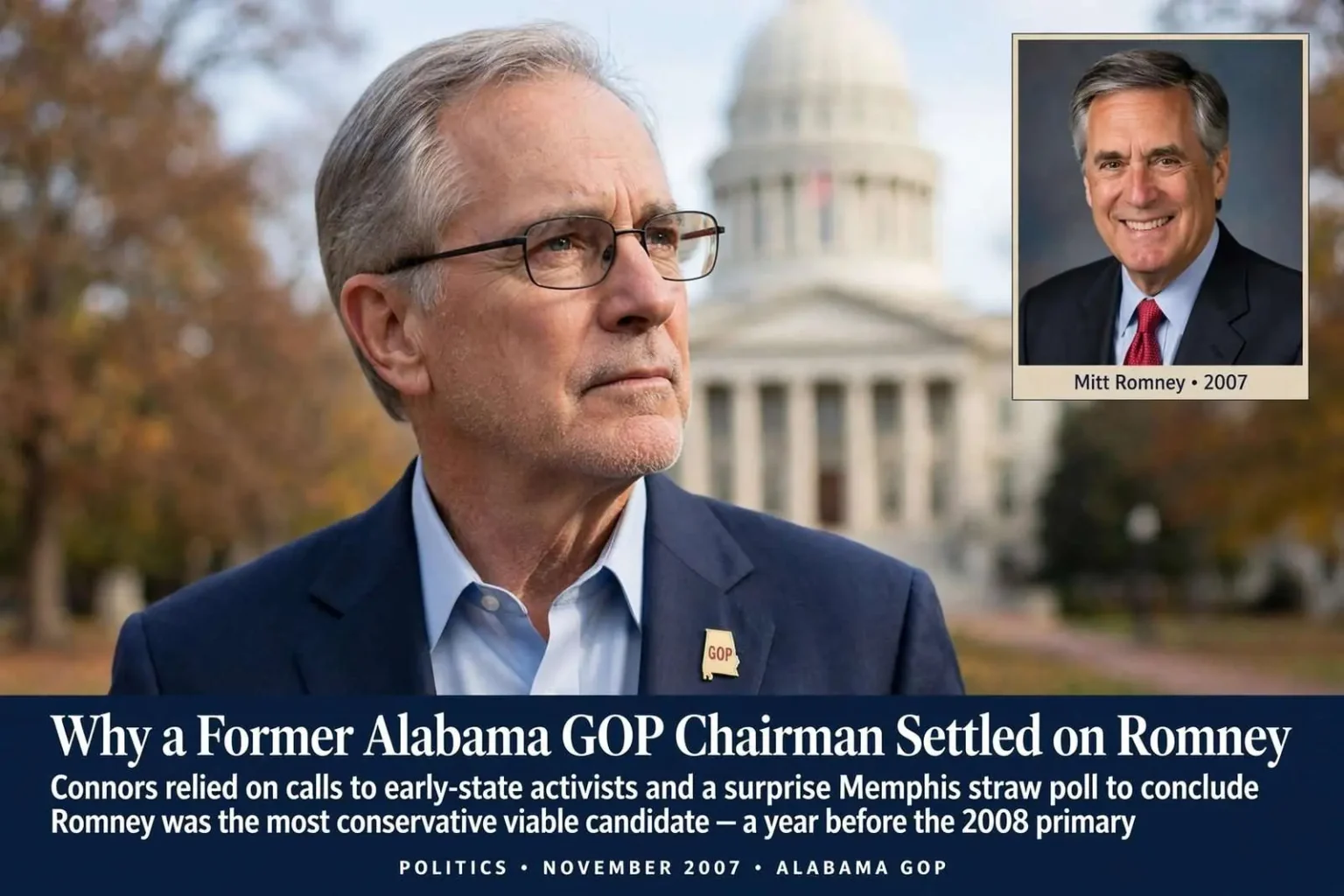
Most endorsements are arrived at by instinct and then justified afterward. Marty Connors, the former chairman of the Alabama Republican Party, described a process closer to research, and in doing so gave the clearest window available into how a Southern Republican operative was reading the 2008 field a year before the voting.
Connors had run the Alabama GOP through some of its most consequential years, a stretch in which the party consolidated its hold on state offices while fighting internal battles over taxes, judicial elections and the direction of the national party. When he talked about a presidential preference, he was therefore not a bystander but a practitioner — someone whose judgment would carry weight with county chairs, donors and the party activists who would eventually staff campaigns and turn out voters.
The method Connors started with reporting rather than ideology. A year earlier, he said, he began calling old friends across the Republican spectrum in Iowa, New Hampshire, South Carolina and Washington, and asked each of them a single question: which candidate seems to be moving in your state?
The question was shrewdly chosen. Early state activists see the field from ground level — who is drawing crowds, who is hiring staff, who the county chairs take seriously — long before polls or fundraising reports reveal much. Asking the same question in all four early and influential states amounted to a private poll of the party’s most attentive observers.
Then came the data point that changed his thinking. Mitt Romney, a governor of Massachusetts, finished second in the Southern straw poll at the Southern Republican Leadership Conference in Memphis. Second, Connors noted with some astonishment, to Bill Frist, in Frist’s own state of Tennessee.
That result sent him to a candidate-by-candidate review on the issues, and he emerged convinced that Romney was the most conservative of the viable contenders. Everything since, he said, had confirmed it.
The Memphis result rewarded that conclusion. A Massachusetts governor out-polling the home-state Senate majority leader at a Southern gathering, in front of thousands of activists from across the region, suggested Romney was finding a way to speak to the party’s conservative base that his credentials would not have predicted. Connors’s astonishment was really a measurement: the straw poll told him the field’s conventional ordering was wrong.
The case against McCain, from inside the party
Connors also explained why he had not gone the other way, and his reasoning is a useful catalog of the grievances Southern Republicans held against John McCain in 2007. He had noticed that McCain was hiring seemingly everyone in Alabama, but he balked at a list of the senator’s positions: the McCain-Feingold campaign finance law, which as state party chairman Connors had been obliged to work under; the immigration bill then before Congress; the “Gang of 14” compromise on judicial nominations and the judicial fights that followed.
Each item in that list was a genuine sore point for the party’s base. McCain-Feingold, the campaign finance overhaul co-written with Sen. Russell Feingold of Wisconsin, had restricted the soft-money fundraising that state parties had long relied on, and Connors had administered the consequences in Alabama firsthand. The immigration bill — the compromise package that had paired a path to legal status with enforcement measures — was the single issue that most reliably ignited Republican primary voters in 2007. And the Gang of 14, the bipartisan group of senators who defused the fight over judicial filibusters, was viewed by many conservatives as a surrender that let Democratic obstruction stand.
Of Rudy Giuliani he offered the classic backhanded compliment of the cycle, saying he thought Giuliani would be the best of the lot to drink a beer with. But Romney, he concluded, more closely matched his own views and those of Alabama, and Romney was futuristic and extremely articulate.
The phrasing captured the problem Giuliani posed for conservative activists. The former New York mayor entered the race as the national polls’ leader, carried by his standing after September 11, yet his positions on abortion, gun rights and social issues put him at odds with the activists who would choose the nominee. “Best to drink a beer with” was praise of a man’s personality that quietly conceded he was not the man for the party.
The undecideds and their anxiety
Others canvassed in the Mobile area were less settled and considerably more worried. Former Lt. Gov. Steve Windom said he remained on the sidelines with no candidate. Businessman Harris Morrissette was not supporting anyone and was frankly hoping someone would enter the race who might get people excited, a sentiment that fairly summarizes the Republican mood that summer.
The most sustained analysis came from Pete Riehm, who described himself as a self-unemployed entrepreneur. He argued first that the whole exercise might be premature, and that starting the primary season a year early was frustrating more voters than it was attracting supporters. By January, he predicted, the announced candidates would have either worn off too much of their shine or become so polished as to blind the electorate. It was entirely possible, he thought, that the eventual nominees had not yet come forward, and were waiting for the country to tire of the current crop.
His survey of the field was unsparing. Giuliani and Romney led on executive experience, but Giuliani lacked conservative credentials and Romney’s were debatable. McCain was solid on defense but a Washington insider whose willingness to cut collegial deals with Democrats was, in Riehm’s view, very hard to swallow. Huckabee and former Virginia Gov. James Gilmore might emerge, but still looked like minor leaguers.
His conclusion was a study in conservative resignation: the only Republican who looked strong enough to beat the Clinton operation in 2008 was Giuliani, and he remained very much undecided anyway, holding out for a genuine conservative leader to emerge and carry the day. The media, he insisted, would have Americans believe the country had veered left, but real conservative values still rang true.
Riehm’s math reflected the field as it stood. Giuliani and Romney were the only candidates with records as chief executives of large enterprises — a city and a state — and the Republican Party’s modern history had favored governors. McCain’s strengths were real but of a kind that primary voters discount: Senate seniority, committee command and bipartisan standing read, to the base, as Washington-ness. Huckabee’s appeal was visible in Iowa but his fundraising and organization lagged; Gilmore, a one-term Virginia governor, barely registered.
Waiting on Fred Thompson
Butch Blum of Dauphin Realty gave the answer that best captured the state of the Republican race. His first choice was Giuliani, then Romney. But if Fred Thompson entered the contest, he said, he would support Thompson over either of them.
That conditional, repeated across the South that summer, tells the story. A significant slice of the Republican electorate had a preference and was prepared to abandon it immediately for a candidate who had not yet announced. Thompson, the former Tennessee senator turned film and television actor, had spent the summer of 2007 as the race’s phantom candidate — feeding speculation with signals, fundraising quietly and drawing press coverage out of proportion to anything he had actually done, because conservatives wanted him to be what he appeared to be.
The arithmetic of that longing was straightforward. Polling through the summer consistently showed Thompson at or near the top of the field without having spent a dollar on campaigning, which is the strongest evidence available that the preference was a protest against the announced field rather than a considered judgment about the man. Activists who said “if he runs, I’m with him” were telling pollsters and reporters that none of the existing candidates had earned their loyalty.
Thompson eventually did enter, and his campaign never met the expectations that had been loaded onto it in his absence. The candidacy that had been imagined as a conservative rescue arrived as a conventional operation — late, loosely organized and uneven on the trail — and it faded well before the voting began. By January 2008 the nomination contest had settled into the fight the summer’s undecideds had not wanted, and McCain, the candidate almost nobody in this survey was enthusiastic about, won the nomination. The general election went to a first-term senator from Illinois whom none of them mentioned as a threat.
Reading Connors’s account now, the instructive part is not who was right. It is how a professional read the field — by ground-level reporting in the early states, by a straw-poll result he did not expect, and by an issue-by-issue comparison that led him to the candidate whose conservatism he found most complete. That method pointed toward Romney, and in Alabama’s circles it was a defensible minority position at a moment when Giuliani led the national polls and McCain was assembling the Alabama operation that Connors watched so warily.
What none of the survey’s participants anticipated was the scale of what followed. The candidate Connors backed after his research never won the nomination; the candidate Riehm dismissed as too collegial did; the candidate Blum was waiting to abandon his preferences for never caught up to his poll numbers; and the general election produced a result none of the respondents had considered possible. A year of careful reading, in other words, still could not see past the field’s own assumptions — which is the oldest lesson in political forecasting, delivered here with unusual candor.