Mobile’s Political Class Surveys the 2008 Field, and Mostly Declines to Commit
Asked in mid-2007 whom they favored for president, Mobile-area officials, lawyers and businessmen produced a portrait of a Republican electorate torn between Giuliani, McCain and Romney, and a probate judge who refused to answer at all.
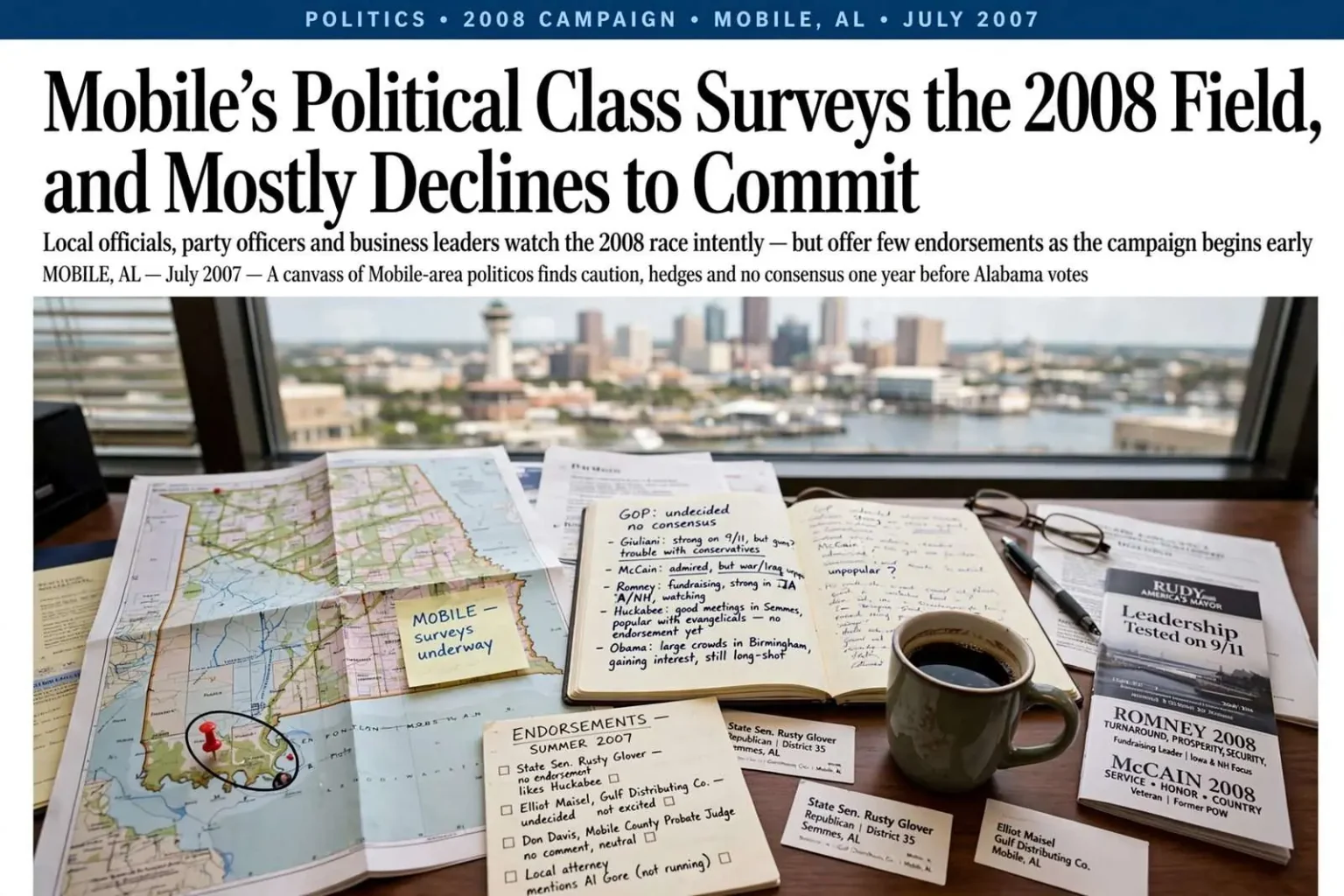
The 2008 presidential campaign began earlier than any in living memory, and by the middle of 2007 the candidates were already competing for the endorsements of people most Americans had never heard of. Local officials, party officers, attorneys and business figures are the connective tissue of a presidential primary, and in Alabama their commitments were still very much in play.
A canvass of Mobile-area politicos that summer found a political class watching intently and committing to almost nothing. The responses ranged from flat predictions to studied hedges to outright refusals, and together they sketched a portrait of a Republican Party not sure it liked its own leading men, and a Democratic establishment still sizing up a field it had not expected to matter much.
The mechanics of endorsement politics run differently in Alabama than in the states that vote first. With no early primary influence, the state’s value to campaigns lies in money, organization and the credibility that a known local name lends a candidate in the final stretch. County commission seats, probate judgeships, legislative offices and the leadership of the local parties are therefore worth courting — which is why so many campaigns had already made their calls to Mobile by midsummer 2007, a full year before Alabamians would vote.
The Republican problem
What emerged most clearly was the discomfort of conservative voters with their own front-runners.
A retired Mobile man said he would like to support Rudy Giuliani, but that the former New York mayor’s record on guns made it almost impossible. He allowed that he might, as a last resort, hold his nose and vote for him. What he would not do, under any circumstances, was vote for a Democrat. He hoped another Republican would emerge, noting reasonably that it was a long time until the voting started.
Giuliani’s dilemma with Alabama conservatives was structural. The man who had run New York through September 11 as a heroic, decisive executive — the image that kept him atop national polls through 2007 — had built that record in a city whose gun control laws were among the strictest in the nation, and on social questions he stood far from the positions southern Republicans took for granted. For the retired man on the porch, and for many like him, the question was whether 9/11 leadership could outweigh a lifetime of disagreement.
A veteran elected official, speaking without attribution, described being pulled between Giuliani and John McCain. Giuliani, he thought, would appeal to a wide range of voters who did not fit the Republican stereotype, but might alienate a large part of the party’s base. McCain carried the appeal of a veteran, a former prisoner of war and a maverick, and also had a knack for annoying that same base. That he liked both men, he suggested, might be exactly why he could not choose.
His broader assessment was bleaker than anything a Republican officeholder would say on the record in 2007. President Bush, he said, had become a huge disappointment. The controversy then engulfing the attorney general’s office was deplorable. The death toll among American service members in Iraq was beyond daunting, before one even counted the economic cost or the lost opportunities.
He also conceded, with visible reluctance, that a relative of his was enthralled with Barack Obama, and that the young senator was very bright.
That last admission — offered by a Republican insider about the Illinois senator who was then still thought of as a long-shot challenger to Hillary Clinton — captured how far Obama’s candidacy had already penetrated places where it was not expected to sell. By the summer of 2007, Obama’s books were bestsellers in suburban bookstores, his crowds in Birmingham had been enormous, and the argument that his candidacy was a curiosity was becoming harder to maintain even among people with no intention of voting for him.
Bets, hedges and refusals
A former newspaper city editor in Mobile made the flattest prediction of the group: Mitt Romney was going to be the guy.
The prediction was less eccentric than it may have sounded in Alabama that summer. Romney had spent 2007 methodically building the two things the nomination contest would actually reward — a vast fundraising operation and a durable lead in Iowa and New Hampshire — while Giuliani’s national poll lead rested on a strategy of skipping the early states. A newspaperman’s instinct for how campaigns are actually won pointed at Romney before the party’s voters got around to agreeing.
State Sen. Rusty Glover, the Semmes Republican and schoolteacher, said he had always admired former Arkansas Gov. Mike Huckabee, who had spoken in Mobile several times over the preceding years. He had not endorsed anyone.
Glover’s affection for Huckabee reflected the ex-governor’s appeal to exactly the constituency Giuliani was struggling with: evangelical, small-town, culturally conservative voters who responded to Huckabee’s pulpit-honed speaking style and his populist framing of the party’s economic message. His speaking trips through south Alabama, including several Mobile appearances, had built him a personal following long before the national media took his campaign seriously.
Elliot Maisel of Gulf Distributing Co. said he had not decided and was not yet excited about any of the declared candidates, a sentiment that ran through many of the responses. Maisel’s family firm, one of Mobile’s best-known beverage distributors, is precisely the kind of operation whose leadership every campaign tries to line up for hosting duties and check-writing introductions. His noncommitment was a data point in itself.
A Mobile attorney offered the name Al Gore, who was not a candidate, and declined to elaborate further. A political and media consultant confirmed only that he was working for a Republican and could not say which one. And Don Davis, the Mobile County probate judge, gave the shortest and most institutionally correct answer available: no comment, and neutrality, on the grounds that he was the chief election officer of the county.
Davis’ refusal deserves more attention than its brevity suggests. The probate judge runs Alabama’s county elections — qualifying candidates, ordering ballots, certifying results — and a public endorsement from that chair invites precisely the appearance of partiality the office cannot afford. His neutrality was not evasion; it was the office speaking.
What the answers reveal
Read from a distance, this small survey captures something that the eventual results obscure. In the summer of 2007, the Republican nomination looked genuinely open, and the party’s Southern base was unsettled. Giuliani led national polls while holding positions on guns and social issues that conservative Alabamians found disqualifying. Romney was working hard for the right flank and drawing interest. McCain, the eventual nominee, was viewed with a wary respect that fell well short of enthusiasm, weighed down by the immigration debate and by his association with the war.
Huckabee, who would go on to win the Alabama primary the following February, appears here only as a fond memory of a good speech.
That detail — the future Alabama winner present in Mobile’s summer conversation as an admired afterthought — is the survey’s sharpest lesson. Huckabee entered the fall with almost no money and thin organization, and rode debates and evangelical networks to victories no one in this canvass predicted. The professionals closest to the ground in Mobile, like their counterparts everywhere, were pricing the race on the visible fundamentals of mid-2007: poll positions, fundraising totals and name recognition. The primary electorate had other plans.
On the Democratic side, the local establishment was still weighing Hillary Clinton against a field it did not yet take entirely seriously, and Gore hovered over the whole conversation as the candidate people wished would run.
The Gore phenomenon was more than wishful thinking. The former vice president and Tennessee senator had won Alabama in 2000 as part of the ticket, remained a popular figure among the state’s Democrats, and spent 2007 collecting a Nobel Prize and an Oscar while pointedly declining to run. His presence in the answers — offered by a Mobile attorney without elaboration — marked him as the standard against which the actual candidates were being measured, and found wanting.
None of the people surveyed predicted the actual outcome. That is not a criticism. It is a reminder of how much of a presidential campaign remains unwritten a full year and a half before the inauguration, and of how the political professionals closest to the ground were, in the summer of 2007, mostly keeping their powder dry.
The reasons for their caution were sound ones. Endorsements given early can be held against a party figure if the candidate collapses; neutrality preserves access to whoever prevails. And in a cycle when the front-runner of each party was, by the summer’s end, to be displaced — Giuliani by McCain’s New Hampshire revival and Huckabee’s Iowa surge on the Republican side, Clinton by Obama’s organizational triumph on the Democratic one — the Mobile political class’s studied refusal to commit turned out to be the most accurate prediction in the whole exercise.
By the time Alabama’s primaries arrived in February 2008, the field the canvassers found in Mobile had transformed itself: Huckabee would carry the state’s Republican contest, Obama would win the Democratic one by a margin that startled the establishment, and most of the local figures who would not commit in the summer of 2007 were, by then, attached to candidates they had once described only as fond memories or fond wishes. The summer of 2007, in retrospect, was the moment when everything was still possible — and Mobile’s politicians, watching intently and committing to almost nothing, knew exactly what they were doing.