Mobile County Commission Approves ‘In God We Trust’ Plaque Amid Split Public Reaction
The Mobile County Commission voted 2-1 in June 2014 to display an 'In God We Trust' plaque at Government Plaza after a divided public hearing.
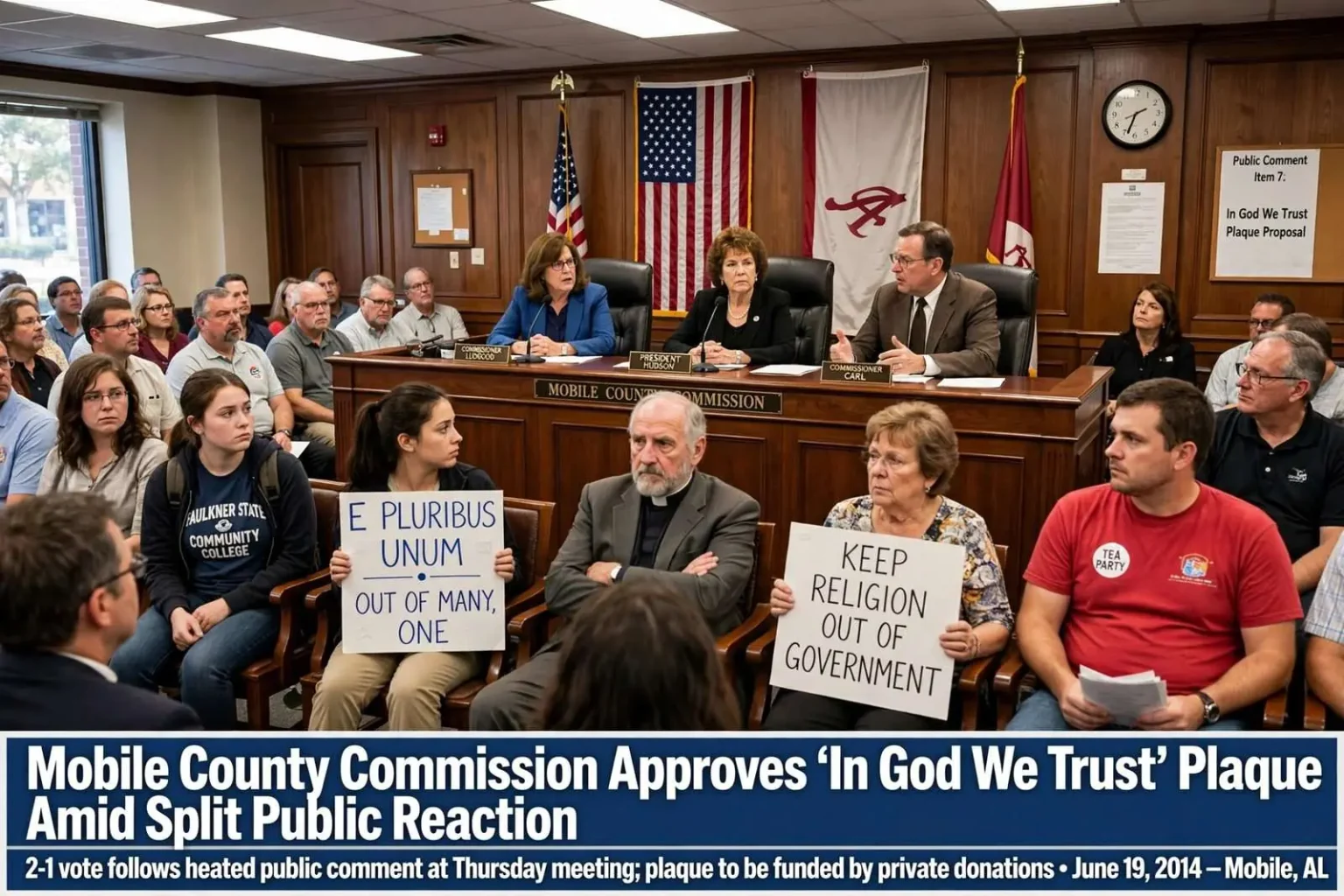
A routine Thursday meeting of the Mobile County Commission turned into a heated public debate on June 19, 2014, after commissioners took up a proposal to hang an “In God We Trust” plaque inside Government Plaza in downtown Mobile. Nine members of the public signed up to speak on the item, and eight of them urged the commission to reject the display, while only one speaker voiced support.
The commission ultimately approved the plaque on a 2-1 vote, with the display to be paid for entirely through private donations rather than public funds. The lopsided public comment — and the split vote that followed — made the item the most divisive moment of the commission’s otherwise ordinary agenda, and the packed chamber reflected how a seemingly symbolic question had drawn residents on both sides to a midday meeting that rarely draws a crowd.
Government Plaza, the shared city-county building on Government Street that houses the commission’s chambers along with city and county offices, is the most public building in the county — the place where residents pay property taxes, apply for permits, serve on juries next door at the courts, and conduct nearly every piece of business local government handles. That fact sat at the center of the entire argument: whether a plaque with a religious reference belongs on the wall of a building every resident owns a piece of.
Opponents Raised Religious Freedom Concerns
A Faulkner State Community College student who addressed the commission first argued that the motto would divide the community on religion and proposed the Latin phrase “E pluribus unum” as an alternative that would not exclude non-religious residents. She identified herself as an atheist and said the plaque would make people like her feel excluded in a public building.
Her suggested alternative carried its own historical weight. “E pluribus unum” — out of many, one — has appeared on the Great Seal of the United States since 1782 and remained the country’s de facto motto for more than a century and a half, a phrase that names unity rather than belief. The student’s argument was that the older motto performed the same patriotic function without the exclusionary cost.
A Unitarian Universalist minister told commissioners he opposed the display on religious grounds, saying the First Amendment was meant to keep religion out of government and government out of religion. His objection added a dimension the vote’s framing often misses: opposition to the plaque did not run along a believers-versus-nonbelievers line. The minister’s position — that entangling the state with religion damages the religion as much as the state — drew on a long tradition of religious dissent from state-sponsored faith, and it made the chamber’s opposition coalition broader than the atheist organization that also spoke against the item.
A former Catholic priest also spoke against the proposal, and the president of a national atheist organization suggested alternative phrasing such as “In Our Citizens We Trust” or “In the Constitution We Trust.”
The former priest’s appearance was notable for what it signaled about the breadth of the opposition — a speaker raised inside the church arguing against a religious display in a government building. The national organization’s suggested phrasings, meanwhile, offered the commission concrete alternatives: civic formulas that celebrate the document and the people the building serves rather than the deity the dispute centered on.
Supporters Cited Historical Precedent
Commissioner Jerry Carl pushed back on the idea that the phrase specifically endorsed Christianity, arguing that the word “God” could mean different things to different people.
That argument — that “God” in the motto functions as a broad civil-religious reference rather than a sectarian one — has been the standard defense of similar displays across the country, and Carl’s framing placed the proposal in that national conversation. A local real estate agent and Tea Party member who spoke in favor of the plaque cited historical quotes from Benjamin Franklin referencing divine providence as precedent for including the phrase in a government building, invoking the founding generation’s habit of providential language as evidence that the motto belongs to American tradition generally rather than to one faith.
One Commissioner Dissented
Commissioner Merceria Ludgood was the lone vote against the plaque, telling the packed room that she believed the commission’s role should be secular and that Government Plaza belonged to all residents regardless of their beliefs. She called the plaque “legally dubious” and said she personally trusted in God but did not believe that view should be legislated for others.
Her remarks drew applause from the audience, prompting Commission President Connie Hudson to ask the crowd to keep quiet for the sake of decorum. The exchange — a dissent drawing applause in a chamber where the vote was about to go the other way — captured the tone of an afternoon in which the debate stayed civil but ran genuinely heated, with a full room of residents who had shown up for a symbol.
Hudson, who voted in favor of the plaque, defended it as reflecting the country’s official national motto, noting it already appears on U.S. currency and in the Pledge of Allegiance. She emphasized that no taxpayer money would be used to fund or install the display, which was still awaiting a final location inside the building after the vote.
The national-motto argument was the legal and historical anchor of the case for approval. Congress designated “In God We Trust” the national motto in 1956, and the phrase has appeared on American coinage since the Civil War era, making it, supporters argued, as much a historical artifact of the government’s own language as a religious statement. Federal courts have generally sustained motto displays on that basis, distinguishing a motto on a wall from prayer or devotional exercise in the same space — a distinction the plaque’s opponents at the meeting explicitly disputed.
The Vote’s Fine Print
The private-funding condition attached to the approval shaped the display’s practical meaning as much as the vote itself. By requiring that the plaque be paid for entirely through private donations, the commission separated the question of the display’s appropriateness from the question of public expenditure — the county would authorize the words on the wall, but residents who objected would not be asked to buy them.
The unresolved location was the other piece of fine print. A plaque “awaiting a final location inside the building” is a display whose prominence is still being negotiated: a spot near the commission chambers carries the commission’s implied endorsement; a hallway placement is a different statement. Where the plaque ended up would determine how visible the decision remained in the daily life of a building that thousands of residents pass through each week.
The vote also fit a pattern that was, by 2014, well established across Alabama and the wider South, where county commissions, city councils, and school boards had taken up similar motto displays — often prompted by national organizations that encourage local governments to post them, and often meeting the same mix of support and objection that filled Government Plaza that Thursday.
What the Debate Was Actually About
Underneath the arguments about mottos and precedents, the June 19 meeting was a working through of a question local governments confront constantly and rarely resolve: whether a community’s most public building should speak in the vocabulary of a majority’s faith. The nine speakers gave the commission every side of it — an atheist student describing exclusion, a minister and a former priest describing theological reasons for separation, a national organization proposing civic alternatives, a supporter invoking Franklin, and a commissioner arguing that “God” is broad enough to belong to everyone.
The 2-1 vote answered the question for that Thursday. The private funding answered the money question. What the meeting did not settle — and what the applause for Ludgood’s dissent suggested — was whether the display would read to every resident of the county as the historical motto Hudson described or as the sectarian statement its opponents feared. That meaning, unlike the plaque itself, could not be voted on; it would be decided, plaque by plaque and visitor by visitor, in the daily traffic of the building where it hangs.
Public Comment in a Packed Room
The nine-speaker lineup was itself a measure of the item’s reach. County commission meetings run on zoning cases, bid awards, and consent agendas — items that rarely produce a single speaker, let alone nine. The comment period ran long by local standards, with each speaker allotted the customary minutes and the crowd responding in the ways crowds do: murmurs of agreement, applause that drew the president’s gavel-side reminder, and a room that stayed full through the end of the debate rather than emptying after its own speaker had finished.
For the commissioners, the dynamics were awkward by design. A 2-1 vote on a plaque is a small act of government, but it is also a recorded position on a question constituents carry to the next election, and all three commissioners treated the moment accordingly — Carl engaging the philosophical argument directly, Hudson supplying the legal and historical defense, Ludgood offering the dissent that the afternoon’s applause suggested had as much support in the room as the vote that overruled it.
The meeting closed with the plaque approved, unfunded by taxpayers, and unplaced — a display whose final meaning, like its final location, remained open after the gavel fell.