The December Scramble: Alabama’s Governor Candidates Race a Fundraising Deadline
With campaign finance reports due Jan. 31, the candidates for governor spent December begging, cajoling and raffling lunches, each trying to make the bottom line look like momentum.
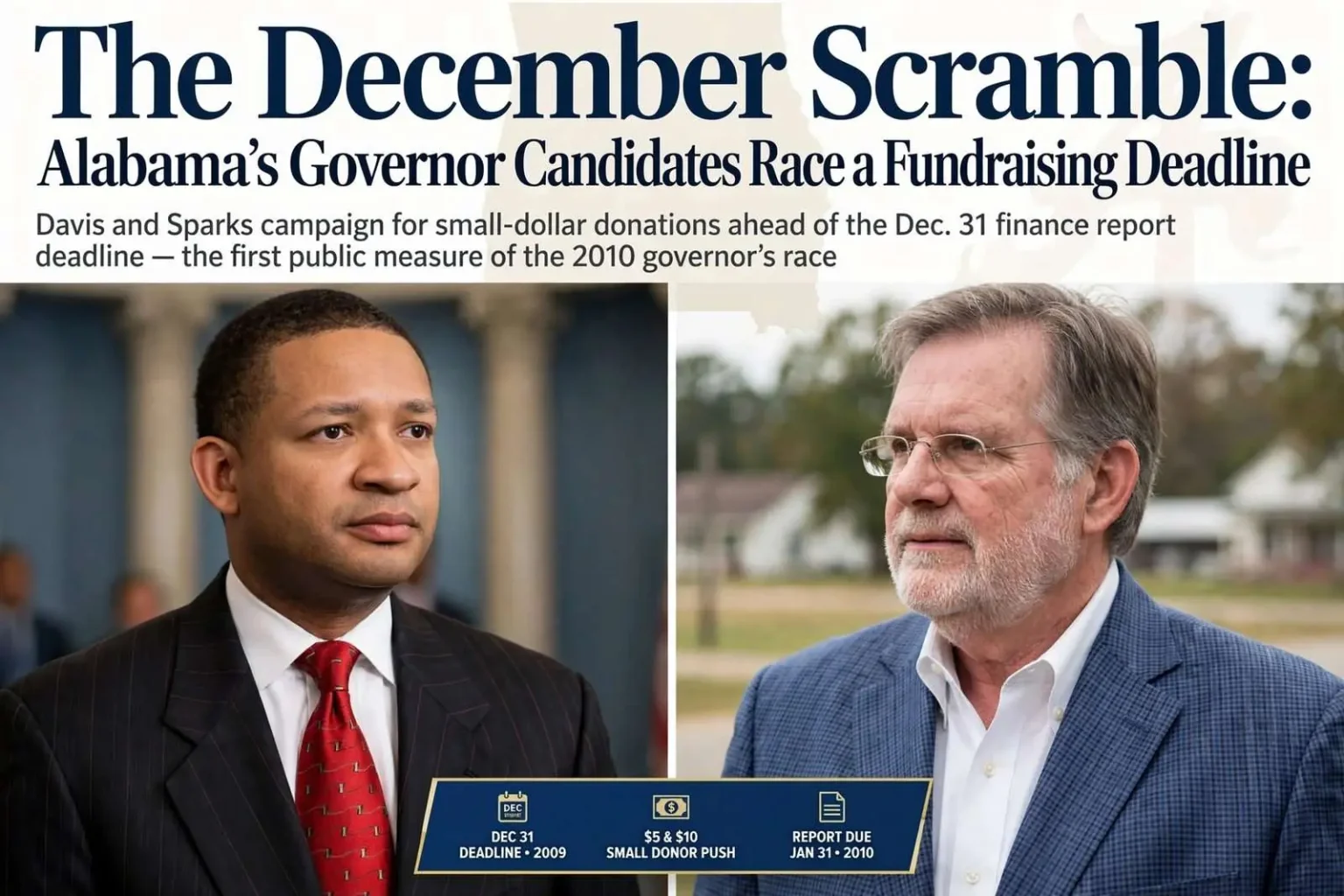
Alabama’s candidates for governor spent the middle of December doing the least glamorous work in politics: asking people for money, urgently.
The reason was a date. Contributions received by Dec. 31 would appear in the annual campaign finance reports due Jan. 31 — the first public accounting of the 2010 race, and the document by which reporters, donors and rival campaigns would decide who was real and who was not.
In a state whose campaign finance disclosures give the public its only regular window into who is backing whom, that year-end report functions as a scoreboard. A candidate who shows a healthy total and a broad donor list enters the new year as a serious contender; a thin report invites the quiet question every campaign dreads — whether anyone besides family and consultants is funding the effort.
Davis Makes the Ask Plain
U.S. Rep. Artur Davis of Birmingham, the front-runner for the Democratic nomination, made no attempt to dress up the appeal.
“Early next year, we’ll have to publish the first public report showing our fundraising,” his campaign wrote to supporters. “Contribute $5 or more to my campaign today, before the December 31st fundraising deadline, and help strengthen our 2009 public report!”
The email claimed a substantial lead over his Democratic opponent and polling that showed him even with or ahead of leading Republicans.
It also carried the unmistakable echo of the Obama presidential campaign, casting Alabama as a state on the verge of surprising itself: the Alabama of Rep. James Fields and Mobile Mayor Sam Jones, of Lilly Ledbetter, of communities that rebuilt burned churches in the Black Belt and took in Hurricane Katrina survivors.
The report would also invite scrutiny. Davis’s opponents were expected to comb it for out-of-state money — contributions from New York, New Jersey, Pennsylvania, Texas, California and Washington, D.C. — and to ask whether the new Alabama he described was being financed from somewhere else.
That vulnerability was the flip side of the Obama-style fundraising model. The small-donor, national-network approach that had powered the Obama campaign drew money from far beyond any single state, and for a sitting member of Congress from Birmingham, the donor universe included the national list built through years of House campaigns and Democratic committee work. A big number in the January report would make Davis the financial front-runner; a number visibly built on out-of-state checks would hand his rivals a story about who Alabama’s governor would owe.
The political geography of the pitch was deliberate as well. Davis’s email invoked a cross-section of the state’s Democratic identity: Fields, a north Alabama legislator from Cullman whose district was not naturally Democratic territory; Sam Jones, Mobile’s mayor, representing the party’s hold on the state’s second city; Ledbetter, the Goodyear retiree from Gadsden whose pay-discrimination case had made her name synonymous with workplace fairness; and the Black Belt communities whose church burnings in the 1990s and Katrina’s displaced families had tested the state’s capacity for solidarity. Each reference was a bid to define what kind of Alabama a Davis governorship would represent.
Sparks Tries a Raffle
Agriculture Commissioner Ron Sparks, Davis’s rival for the Democratic nomination, went in a different direction, setting a goal of 2,010 new online contributors by 2010 and asking supporters to give $10 apiece. Five names would be drawn for lunch with the candidate in January.
Twenty thousand dollars is a rounding error in a statewide campaign. The point was not the money; it was the list.
Sparks was building something his year-end report could show: hundreds of small contributions from inside Alabama, each one a name in a database and, more important, a demonstration that his candidacy had an organic base the old-money networks had not manufactured. In a primary where both Democrats would be judged by whether they looked like genuine statewide candidates, a report full of $10 contributions from small towns was worth more than its dollar total.
The raffle gimmick also fit the constituency Sparks had been cultivating as agriculture commissioner. His office’s visibility with rural Alabamians — the farmers, co-op members and small-town audiences that a commissioner’s traveling schedule reaches — gave his campaign a natural small-donor pool that a congressman’s national list does not. The $10 ask met that base where it was: willing to back a hometown candidate, not equipped to write four-figure checks.
Why December Matters in Alabama
The scramble’s intensity traces back to the mechanics of Alabama’s disclosure calendar. Annual reports filed at the end of January capture every contribution received in the closing days of the old year, and campaigns that push fundraising into the final week get a full year’s visibility from money raised in a matter of days. Candidates who raise steadily through the year, by contrast, spread the same total across multiple reports and dilute the headline. December’s urgency, then, is not superstition — it is an optimization of when dollars show up on the public record.
There is also a strategic reason specific to 2010. Alabama’s governorship was opening as a wide-open contest — a term-limited incumbent leaving, an open field in both parties, and a political climate in which the state’s electorate had been shifting. The January reports would set the field’s perceived hierarchy months before any qualification deadline, and money at that stage purchases more than ads: it purchases the perception, among county chairmen and potential endorsers, that a campaign is worth joining.
For Davis, the stakes were compressed by his own positioning. As the declared front-runner with Washington fundraising experience, he was expected to post a dominant number; anything less would be read as proof the Obama-style wave had not actually reached Alabama. His email’s $5 floor was designed to inflate the donor count as much as the total — hundreds of small givers in the report would rebut the out-of-state-money narrative more effectively than any single large check.
The primary that December built
The two candidates’ December strategies previewed the primary they would eventually run against each other. Davis ran as the candidate of change and scale — national networks, grassroots framing, a message about what Alabama could become. Sparks ran as the candidate of place — rural roots, agricultural constituency, a pitch built on who he had met and served. The year-end reports would capture that difference in numbers: one campaign’s total likely larger and more metropolitan, the other’s smaller but denser with in-state small givers.
The reports would also be mined for what campaigns call the soft-money story: PACs, party committees, business interests and labor, each of which discloses separately but whose December checks shape the totals. In Alabama, where political action committees have historically moved money between each other in chains that obscure the original source, the annual report’s PAC lines draw as much scrutiny as the individual donor list. Reporters reading the January filings would be tracing those chains as much as counting dollars.
That is the deeper function of the December scramble: it is the first round of a disclosure war that runs all year. Every dollar raised before Dec. 31 becomes public property in January — grist for opponent research, press analysis and the endless comparative tables that campaign coverage lives on. The candidates racing the deadline were not only raising money; they were drafting the first draft of their own public record for 2010.
How the numbers actually landed shaped everything that followed — the perception of momentum each campaign carried into the new year, the endorsements that followed perceived strength, and the narrative arc that would define the Democratic primary. And it all turned on a week of December asks: a congressman’s $5 appeal and a commissioner’s raffle, racing a calendar that would make their year-end ledgers public.
The 2010 governor’s race that those ledgers opened would become one of the most consequential in modern Alabama history, and the December groundwork showed why. Open-seat races in the state attract deep fields, expensive campaigns and national attention, because the governorship controls appointments, budgets and the state’s response to the federal politics of the moment. Candidates who established financial credibility in the January reports carried that credibility through qualification and into the primary season; candidates who did not found the field closing around them.
The contrast in methods also reflected a generational shift in Alabama politics. Davis’s email — small asks, digital lists, an Obama-inflected story about the state surprising itself — represented the post-2008 model that had reshaped fundraising nationally: broad, low-dollar, narrative-driven. Sparks’s raffle represented the older retail tradition adapted to the same calendar: personal connection, modest amounts, a prize that turned giving into an event. Both were answers to the same question — how to fill a year-end report with evidence of real support — and their competition was as much about methods as money.
Out-of-state scrutiny, the vulnerability Davis’s opponents planned to exploit, cuts both ways in Alabama campaigns. A candidate with national ties can be painted as someone else’s project; a candidate without them can be painted as too small to win. The January report was where each campaign would learn which framing stuck, and both understood that the document would be read by every combination of press, opposition researchers and PAC directors in the state before the month was out.
By the time qualifying closed and the primary arrived, the December scramble had receded into the record — but its effects were durable. The money raised against the year-end deadline bought the advertising, staff and travel that carried each campaign through a long primary year, and the donor lists built in those final weeks supplied the small recurring gifts that sustain a campaign between reports. Politics runs on calendars as much as ideas, and Alabama’s December deadline is the calendar’s most important page.
For the candidates themselves, the lesson of the scramble was the one every statewide campaign in Alabama relearns each cycle: the public ledger is the campaign’s first debate, it happens months before anyone votes, and the side that arrives in January with the stronger document has already shaped the story everyone else has to argue against.