Mobile and Baldwin County Schools Roundup: Free Lunches, Electric Cars and Campus Growth
A June 2014 look at Mobile and Baldwin County school news: free lunches for all, an electric car contest, and campus expansion updates.
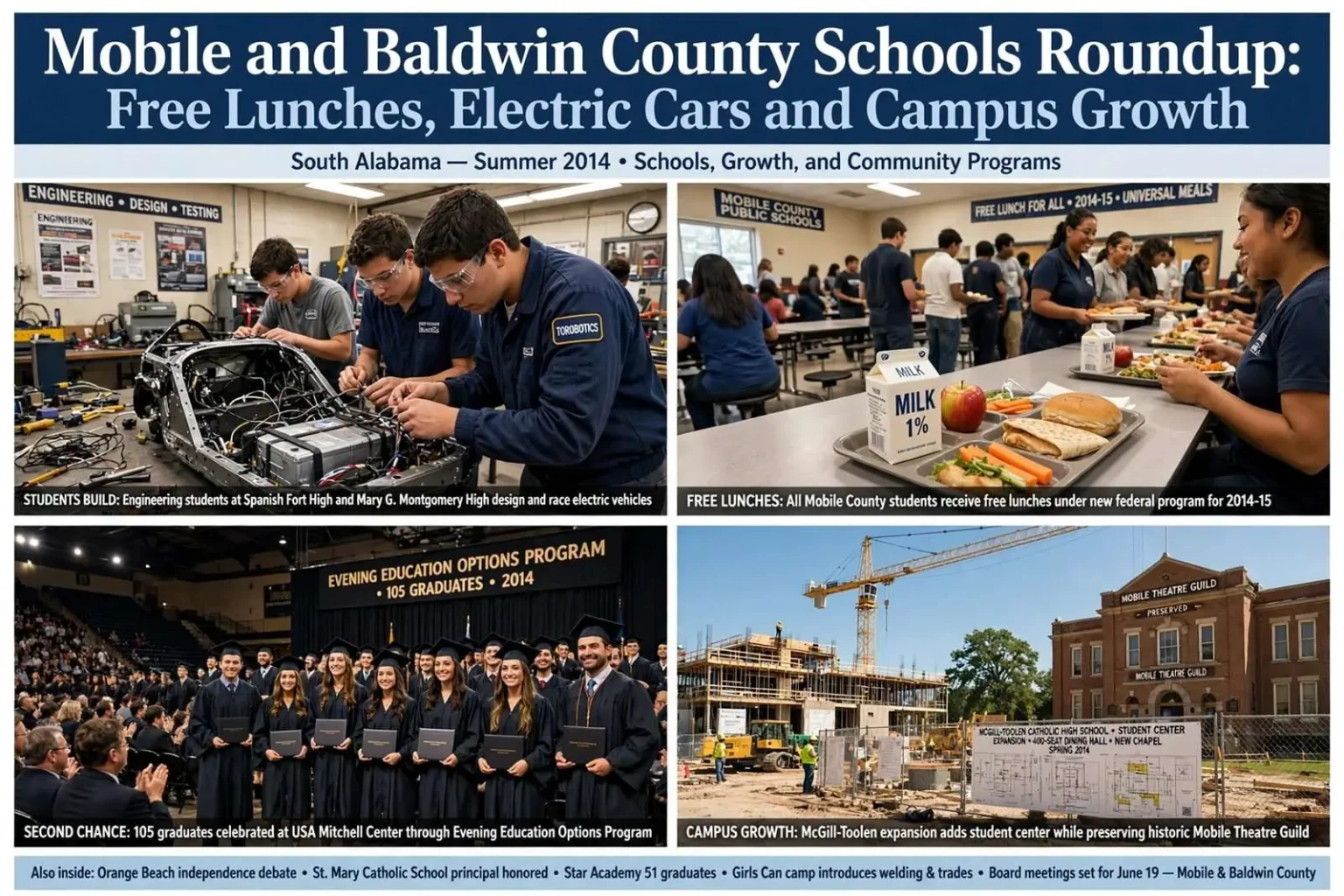
South Alabama’s school systems had plenty going on heading into the summer of 2014, from a heated dispute over a proposed independent district in Orange Beach to a new federal program that will put free lunches on every tray in Mobile County classrooms. The weeks before summer break delivered a familiar mix for the Gulf Coast’s two biggest school counties: budget and boundary fights, career-technical wins, graduation milestones and construction plans. Taken together, the headlines trace the pressures — and the opportunities — that come with rapid growth along the coast.
Orange Beach independence debate heats up
Baldwin County Superintendent Alan Lee and two members of the county school board pushed back hard against a feasibility study exploring whether Orange Beach should break away and form its own school system. The officials disputed revenue estimates prepared by consultant Ira Harvey, arguing that Orange Beach taxpayers would need to accept at least an additional 7.8 mills in property taxes to match current per-student funding levels. The dispute turned on the same question that shadows every secession study in Baldwin County: whether a small, wealthy beach city can replicate the scale of services a countywide district provides without a painful tax increase at home.
Orange Beach Mayor Tony Kennon fired back, accusing the county of spreading confusion rather than engaging with the substance of the study. His response reflected the frustration of city leaders who believe their tourism-fueled tax base contributes far more to county coffers than it receives back in classroom spending. The exchange set the tone for what promised to be a long, expensive argument over the city’s educational future, with both sides armed with dueling spreadsheets and a community divided over whether independence was ambition or risk.
The fight carried stakes well beyond Orange Beach’s city limits. Baldwin County has been among Alabama’s fastest-growing counties for years, and every new subdivision and condo tower along the coast adds students to a district already stretching to build schools fast enough. A city exit removes revenue from the county system even as growth continues elsewhere, which is why county officials followed the feasibility study with such alarm — and why other municipalities watched to see how the numbers came out.
Free lunches coming for every Mobile County student
The Mobile County school system announced it has qualified for a federal program that will provide free lunches to all students during the 2014-15 school year. The change builds on a free breakfast program the district rolled out the previous fall under the Universal Free Breakfast initiative, another federally funded effort aimed at making sure students start and get through the school day fed. For families, the practical effect is simple: no lunch money, no application forms and no stigma attached to a free tray, because every tray is free.
District administrators framed the move as both an anti-hunger measure and an academic one. Children who arrive at school hungry struggle to concentrate, and cafeteria lines move faster when cashiers are no longer tallying charges. The universal approach also spares schools the administrative burden of processing thousands of individual meal applications each fall, paperwork that federal officials have long recognized eats into lunchroom budgets.
Students build their own electric cars
Engineering students at Spanish Fort High School’s Torobotics Club and at Mary G. Montgomery High School spent the year designing and building their own electric vehicles, then put them to the test in competition. The hands-on projects gave students real-world experience in mechanical and electrical design. For the students involved, the year-end race was the payoff for months of planning, wiring, welding and troubleshooting — the kind of applied engineering that no textbook alone can teach.
Programs like these sit at the center of Alabama’s push to build a pipeline of technically skilled graduates. The state’s automotive manufacturing boom has made engineering know-how a marketable credential even before a student leaves high school, and teachers across the coast have leaned into competitions that reward teamwork, budgeting and precision. An electric-vehicle build touches all of it: motors, batteries, drivetrains, aerodynamics and the patience to find the short in a wiring harness the night before the race.
An alternative road to a diploma
The Mobile Area Education Foundation’s Evening Education Options Program, designed for students who were close to dropping out, notched a strong result this spring: 105 graduates walked with their classmates at the USA Mitchell Center. The night-class model gives at-risk students a flexible path back toward graduation. Many of the students in the program juggle jobs or family responsibilities that make a traditional school day impossible, and the evening schedule is often the only workable route to the diploma they need.
The ceremony at the Mitchell Center — the same arena where the University of South Alabama stages its largest gatherings — gave the graduates the full pomp of a conventional commencement. Educators with the foundation have long argued that a recovered student is worth far more than the cost of the extra hours it takes to reach him or her, both to the graduate’s lifetime earnings and to the district’s graduation rate. The 105 diplomas represented students who, by the program’s own design, might otherwise have become statistics.
McGill-Toolen expansion won’t touch historic theater
Rumors swirled that expansion plans at McGill-Toolen Catholic High School would spell the end of the Mobile Theatre Guild on Lafayette Street, but Monsignor Stephen E. Martin of the Archdiocese of Mobile said the historic theater is safe. The school and archdiocese are moving ahead with a new student center featuring a 400-seat dining hall, a student plaza, a new chapel and additional parking. The assurances aimed to calm midtown Mobile neighbors and theater lovers who had feared that the campus growth ring closing around the venerable playhouse would squeeze it out entirely.
The project is the latest chapter in the long coexistence of the Catholic school and the community theater that share the Government Street corridor. A dining hall and chapel serve a student body drawn from across Mobile County, but the added parking is the piece most likely to be noticed by neighbors — and by audiences arriving for evening performances at the guild’s stage.
Honors and milestones
St. Mary Catholic School principal Debbie Ollis was honored by the Mobile City Council for earning two National Distinguished Principal awards. The national recognition, presented through the National Association of Elementary School Principals, is reserved for principals who demonstrate extraordinary leadership, and a two-time award is a rarity by any measure. Ollis’s honor brought a moment of civic recognition for a small Catholic school whose reputation has long rested on the stability of its leadership.
Fifty-one students graduated from Mobile County’s Star Academy, a program that helps overage eighth-graders catch up on credits. The academy targets a specific and costly problem: students who arrive in their teens still two or more grades behind, at the age when disengagement curdles into dropping out. By compressing coursework into an accelerated setting, Star Academy aims to return students to the proper grade track before high school credits — or the lack of them — seal their path.
And 20 eighth- and ninth-grade girls completed the third annual Girls Can camp at Bryant Career Technical School in Irvington, learning welding, wiring, carpentry and pipefitting in a program backed by Alabama Power. The camp exists to crack open trades that remain heavily male, giving middle school girls a first hands-on taste of skills that can lead to apprenticeships, certifications and well-paying work. Bryant’s career-tech labs — welding booths, electrical bays, woodworking shops — gave the campers real equipment rather than scaled-down demonstrations.
Career and technical education has enjoyed a resurgence statewide as employers, from shipbuilders to utilities, complain about a shortage of skilled tradespeople. For Mobile County, whose port, aerospace plants and industrial yards form the backbone of the regional economy, programs that introduce students early to welding and electrical work are as much economic development as they are schooling. Alabama Power’s sponsorship reflects that corporate stake in the pipeline.
Upcoming board meetings
The Mobile County school board was set to meet Thursday, June 19, at its central office at Schillinger and Howells Ferry roads, while the Baldwin County school board planned to convene the same evening at its office on North Hand Avenue in Bay Minette. Summer sessions typically carry lighter agendas than the school year’s marathon meetings, but both boards had no shortage of unfinished business — from budget planning to the personnel moves that arrive with the end of every school year.
For parents tracking the Orange Beach question and the universal lunch rollout, the meetings offered the first formal chances to speak since the spring disputes flared. School boards along the coast learned long ago that growth keeps no one idle: every year brings a new crop of students, a new budget gap or surplus, and a new round of decisions about where the next classrooms will be built.