University of South Alabama Mobile
Five Schools, One Worry: A New Coalition Took On Underage Drinking in Mobile and Baldwin
Jean Downing described the Mobile/Baldwin Counties Community of Concern to Sunrise Rotary — a five-school partnership on alcohol and drugs, with a public forum on the adolescent brain set for Jan. 13 at UMS-Wright.
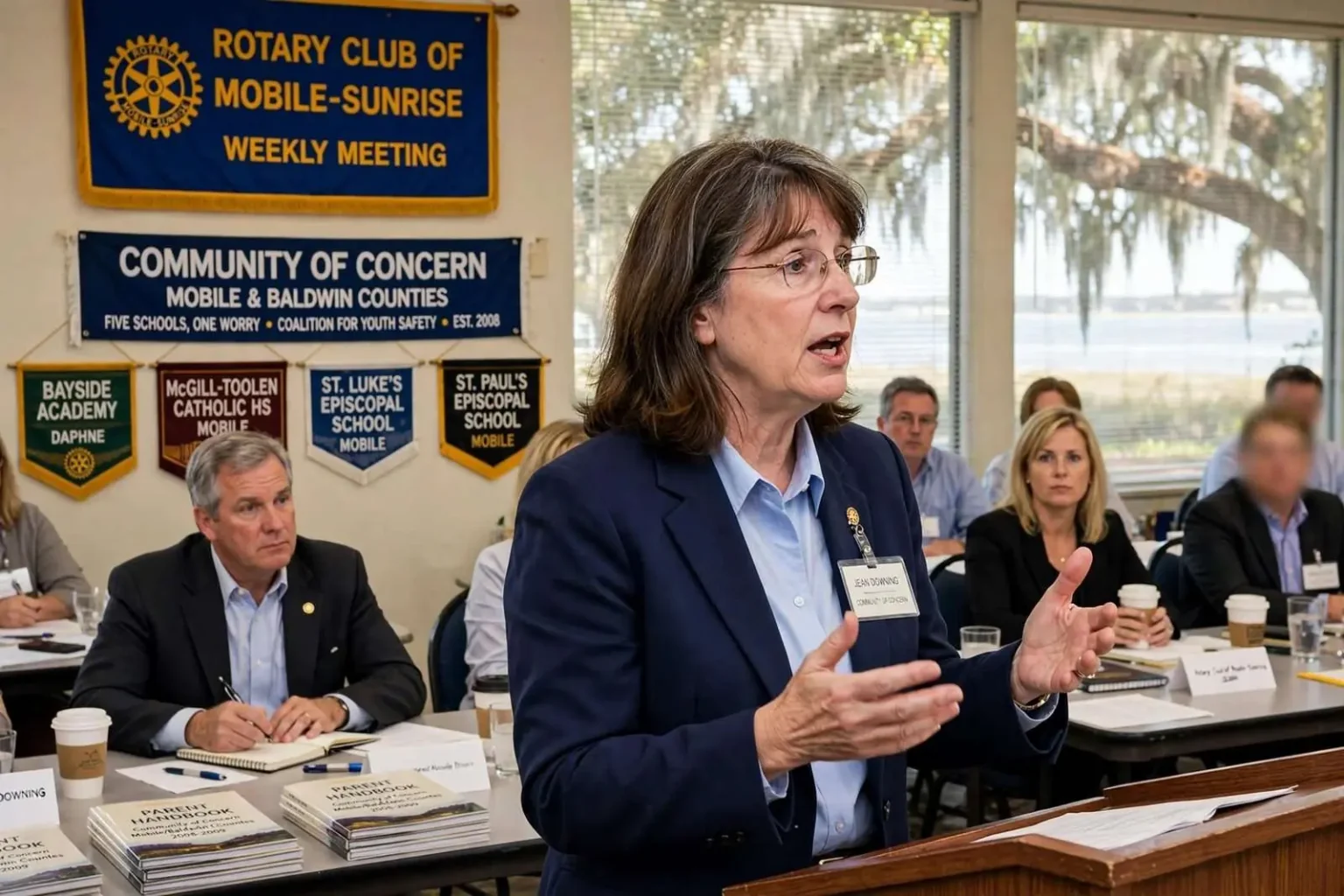
The Rotary Club of Mobile-Sunrise opened 2009 on Jan. 7 with a program on a subject that most families discuss reluctantly and most institutions discuss late: what teenagers are drinking, what they are taking, and what the adults around them intend to do about it.
The speaker was Jean Downing of the Mobile/Baldwin Counties Community of Concern, an organization then less than a year old.
Rotary clubs run on morning meetings and a weekly speaker, and the Mobile-Sunrise club — one of the several Rotary chapters meeting across Mobile, its name a nod to its early-hour format — draws members from the city’s business, professional and education circles. A program on adolescent substance use put a community organization in front of exactly the audience it was built for: parents, employers and civic leaders with influence over the institutions where teenagers spend their days.
The timing of the talk, a week into the new year, marked the halfway point of the coalition’s first full school year in operation — an organization young enough that its founding story was still being told, and old enough to have results to report.
How It Started
In early 2008, community leaders concluded that the region needed a program to help parents and students better understand alcohol, tobacco and illicit drugs. Their research turned up a national model: the Community of Concern, a program begun some two decades earlier and based in Washington, D.C.
The national organization grew out of a simple observation: parents at independent schools wanted honest, practical information about what their children faced, delivered in a form they would actually read. What began as a parent effort in the Washington area spread across the country as schools adopted the model and adapted its materials, building a network of local coalitions that shared the same premise — that students make safer decisions when the adults around them are informed, coordinated and consistent.
The local chapter took shape over the summer of 2008, when administrators and leaders from five schools met and agreed to pool resources and manpower. Those schools were Bayside Academy, McGill-Toolen Catholic High School, St. Luke’s Episcopal School, St. Paul’s Episcopal School and UMS-Wright Preparatory School — an unusual alignment of institutions that ordinarily meet as rivals on a Friday night football field.
The five schools span the two counties and the independent-school landscape of coastal Alabama. Bayside Academy sits in Daphne on the Eastern Shore, while McGill-Toolen, St. Luke’s, St. Paul’s and UMS-Wright anchor Mobile’s private school community. Between them they enroll thousands of students from families across Mobile and Baldwin counties, including many of the area’s most engaged parent communities. That breadth mattered to the design of the program: a message that travels across school lines reaches a larger share of the same social world, since teenagers at rival schools often run in overlapping circles on weekends.
The organization described itself as a grass-roots effort committed to providing current facts, effective tools and a growing partnership among students, parents, schools and other organizations, with the goal of keeping young people free of alcohol and other drugs.
Its stated hope was a base of active parents and educators, sharing information that would spread through the wider community and empower students to make safe decisions.
The framing was deliberate. Coalitions like the Community of Concern position themselves not as enforcement or as punishment but as information: research on adolescent development consistently shows that parents who set clear expectations, know where their children are and talk openly about alcohol and drugs reduce the likelihood of use. The obstacle is rarely willingness — it is coordination, because teenagers exploit the gaps between households. A handbook and a shared calendar of meetings aim to close those gaps by giving every family the same facts and, where possible, the same expectations.
The Plan
The coalition’s first step was a parent handbook distributed to families at all five schools — a short reference full of the facts that inform parental decisions and, as often, explain them.
Handbooks of this kind, in the Community of Concern model, cover the basics parents ask about most: the signs of alcohol and drug use, the legal consequences for minors and for adults who provide alcohol, the effects of specific substances, and the practical scripts for hosting parties, supervising gatherings and responding when a child admits to drinking. The format is deliberately compact — something a parent reads in one sitting and keeps on hand.
The second step was a series of three parent information meetings during the 2008-2009 school year. The first offered an overview of the program, with founders of the national effort sharing research on substance abuse. The remaining meetings were planned through the spring, giving parents at all five schools multiple chances to hear the program and ask questions.
Meetings hosted across the coalition’s member schools let parents see the network for themselves — to meet the administrators who would be enforcing school policies and the parents whose households their children visited. The national founders’ participation in the opening session brought the research base to Mobile directly, an unusual resource for a first-year chapter and a signal of the model’s spread to the Gulf Coast.
For the schools, the coalition formalized relationships that already existed informally. Mobile’s independent school leaders meet regularly on accreditation, athletics and professional development, and adding substance-use prevention to the agenda gave those relationships a concrete family-facing product. It also distributed the cost: producing a handbook and staging three meetings is manageable when five institutions share the expense and the volunteer labor.
The Rotary audience on Jan. 7 heard the results of that first semester. Downing’s presentation covered the coalition’s formation, the handbook distribution and the meeting schedule, along with the reasoning behind the national model — that consistent, fact-based messaging from parents and schools together moves adolescent behavior in ways neither can accomplish alone.
Why the Region Needed It
Mobile and Baldwin counties present the conditions that substance-use prevention programs worry about most. Alcohol is widely available and heavily marketed along the Gulf Coast, with a tourism economy that normalizes drinking; the interstate corridor that runs through Mobile carries traffic between New Orleans and Florida; and the region’s waterfront culture, with boats, beaches and long summer breaks, creates the unstructured social settings where underage drinking most often happens.
Alabama law sets the drinking age at 21 and penalizes adults who provide alcohol to minors, but enforcement reaches only the visible edges of the problem. Most underage drinking happens in private settings — homes, camps, boats — supplied through older friends or sympathetic adults, beyond the reach of any patrol. That is precisely the territory a parent coalition is designed to occupy: the households where decisions are made.
The coalition’s birth in 2008 also coincided with a broader shift in how schools and communities approached the subject. The older models — assembly lectures, scare materials, one-time presentations — had fallen out of favor as research showed their effects fading quickly. What replaced them emphasized sustained parental engagement, clear family rules and school policies that applied consistently across the community. The Community of Concern model embodies that shift, which is why its handbook-and-meetings structure rather than a single event.
Rotary’s role in the story fits the organization’s civic tradition. Rotary International’s clubs take on local service projects and use their weekly programs to connect community organizations with the professional class that staffs and funds them. A first-year coalition speaking to Rotary members gains credibility, contacts and potential volunteers — the same resources that sustain such organizations after their founding energy fades.
By the time the 2008-2009 school year closed, the Mobile/Baldwin Counties Community of Concern had completed the cycle it planned in the summer of 2008: a handbook in the homes of five schools, a series of parent meetings across both counties, and a standing organization positioned to continue into the next school year. Its founders’ measure of success was straightforward — that the region’s independent school community would keep the conversation going, family by family, with the same facts in hand.
The five-school partnership also reached families who might otherwise have heard the message from only one institution. A McGill-Toolen student and a Bayside Academy student may never sit in the same classroom, but they are far more likely to share a weekend gathering than either school’s administration can track — which is the operational logic of building the coalition across school lines rather than school by school.
Each school retained its own disciplinary policies; the coalition’s work sat above them, in the space where parents coordinate. Administrators involved in the founding described that division of labor as essential: schools enforce conduct codes on campus and at school events, while the coalition equips parents for everything that happens away from school, which is where most adolescent substance use occurs.
The Jan. 7 Rotary program also served as an invitation. Coalition organizers were recruiting parent volunteers for the remaining meetings and for the next year’s handbook update, and a room of Rotary members — many of them parents or grandparents of school-age children — was a natural place to find them. Community organizations of this kind survive on precisely that pipeline: parents who attend one meeting, take on one task and stay for the long term.
For Mobile’s civic community, the coalition’s arrival marked another entry in a longer local tradition of addressing youth substance use through civic institutions rather than waiting on state or federal programs. From school-based organizations to faith communities to service clubs, the region’s response to the problem has historically been assembled locally — and the Mobile/Baldwin Counties Community of Concern became, in 2008, that tradition’s newest chapter.