University of South Alabama Mobile
Mobile County Schools to Broadcast a Live Panel on Alabama’s College and Career Ready Standards
The Mobile County school system planned a live, televised panel discussion on the Alabama College and Career Ready Standards, featuring the superintendent, principals and classroom teachers.
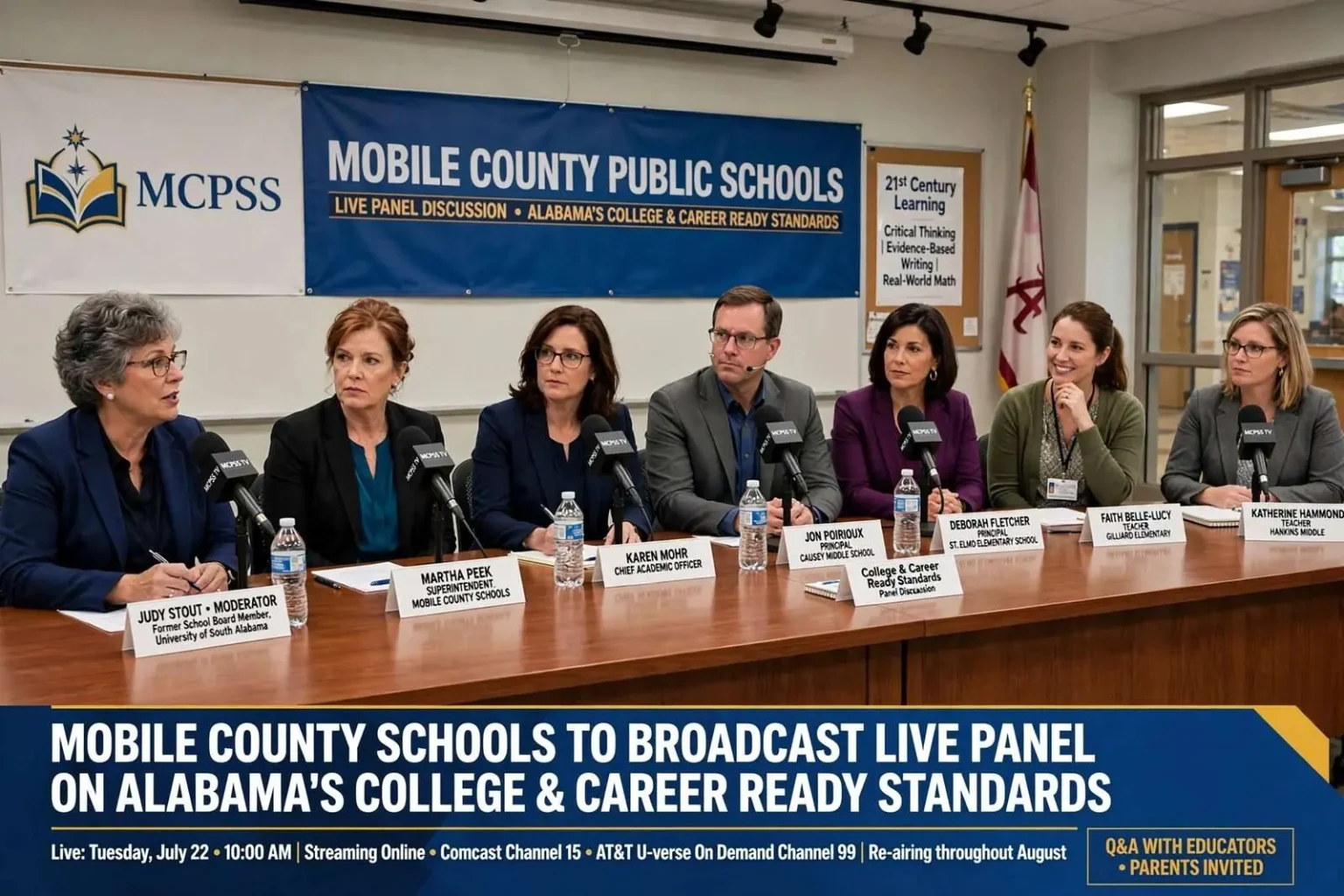
In the summer of 2014, the Mobile County school system set out to take one of the era’s most debated education topics directly to the public, planning a live televised panel discussion on the Alabama College and Career Ready Standards, the state framework widely known as Common Core.
The broadcast was scheduled for Tuesday, July 22, at 10 a.m., streamed online and carried on Comcast channel 15 and AT&T U-verse On Demand channel 99. The system said the program would be available afterward through an online link and re-aired on its television channel throughout August, giving parents multiple chances to watch even if they missed the live broadcast.
The format was a deliberate choice by the state’s largest school district. Rather than a single administrator issuing a statement, the system assembled a panel of educators — administrators, principals and classroom teachers — to answer questions about standards that had become the subject of rallies, legislative hearings and radio talk shows across the state. Mobile County schools serve roughly 59,000 students across more than 90 schools, and district leaders wanted parents to hear about the standards from the people actually teaching them.
A panel of educators
Moderating the symposium was Judy Stout, a former Mobile County school board member and University of South Alabama administrator. Stout’s dual background — years of governance at the district level and higher-education administration at USA — made her a familiar and credible presence for a discussion expected to range from kindergarten classrooms to college expectations.
The panel gathered leaders and classroom teachers from across the district, an effort to put familiar local faces on a national conversation. Those scheduled to appear included:
Martha Peek, superintendent of Mobile County schools; Karen Mohr, the system’s chief academic officer; Jon Poirioux, principal at Causey Middle School; Deborah Fletcher, principal at St. Elmo Elementary School; Faith Belle-Lucy, a teacher at Gilliard Elementary; and Katherine Hammond, a teacher at Hankins Middle.
The mix was intentional. Peek and Mohr could speak to district-wide policy and the system’s budget and training decisions; Poirioux and Fletcher could describe what the standards looked like inside two very different schools — Causey, a large west Mobile middle school, and St. Elmo, a small community elementary in south Mobile County; and Belle-Lucy and Hammond could describe the day-to-day reality of teaching under the new standards, from lesson planning to how students responded.
By assembling both administrators and teachers, the district signaled that it wanted the discussion grounded in day-to-day classroom experience rather than policy abstractions alone.
What the discussion covered
According to information from the school system, the panel intended to explore how the standards were changing the way students were taught, precisely what students were learning, and the long-term impacts of the shift. Those were the very questions that had made Common Core a subject of intense debate among parents, educators and elected officials across Alabama at the time.
The standards had drawn both praise and skepticism. Supporters argued they raised expectations and better prepared students for college and careers, while critics questioned everything from classroom methods to the cost of new technology and testing. The broadcast was designed to address those concerns directly, in the district’s own words, rather than leaving parents to sort through national commentary.
Behind the panel discussion was a significant shift in how Alabama classrooms operated. The state Board of Education adopted the College and Career Ready Standards in 2010, building on the state’s own 2007 Alabama Reading and Mathematics standards initiative, and districts spent the following years retraining teachers, adopting new textbooks and reworking assessments. Mobile County, as the largest system in the state, trained thousands of teachers and reorganized its curriculum guides around the new expectations for what students should master in mathematics and English language arts at each grade level.
For parents, the most visible changes were the ones that showed up in homework. Mathematics instruction under the standards emphasized understanding why an answer is correct, not just producing it, and parents often found themselves puzzled by methods that looked nothing like the arithmetic they had learned. English classes shifted toward more nonfiction reading, evidence-based writing and texts of increasing difficulty across subjects. The panel was expected to explain those shifts and why the state had made them.
The politics surrounding the standards
By the summer of 2014, the standards had become entangled in Alabama politics. Legislative efforts to repeal the standards had been introduced in Montgomery, with opponents arguing that the framework represented an overreach by the federal government into state classrooms, and supporters countering that the standards were adopted by the state Board of Education, controlled by Alabamians, and simply set expectations rather than dictating lesson plans.
State Superintendent Tommy Bice and the state department had repeatedly emphasized that Alabama’s version was the College and Career Ready Standards — unique in allowing the state to add its own content, such as additional mathematics standards on personal finance and algebra — a point that Alabama’s two prior state superintendents also signed on to in a joint letter to legislators.
Why the district took the discussion public
School systems across Alabama had found that silence on the standards left a vacuum filled by national commentary, chain emails and social media posts that often bore little resemblance to what was happening in local classrooms. Mobile County’s answer was to put the topic on its own television channel, in front of its own educators, with questions taken from the community.
The district’s broadcast operation had become a central communication tool in recent years. Programming on the system’s television channel ranged from board meetings to instructional content, and carrying the panel on Comcast channel 15 and AT&T U-verse On Demand channel 99 meant it could reach households regardless of which provider they used. The online stream extended the audience to parents watching from work, and the August re-airings were timed for families preparing for the new school year.
Timing mattered in another way as well. The July 22 broadcast came weeks before students returned to classrooms, when parents were registering children, buying supplies and asking questions about what the coming year’s coursework would require. An explanation of the standards in late July reached families at the moment they were most likely to be paying attention. School officials encouraged parents to submit questions in advance and to watch with their older students, so the discussion could double as a preview of the year ahead.
What the standards meant for Mobile County classrooms
In practical terms, the College and Career Ready Standards aimed to ensure that a student moving from an elementary school in Theodore to a middle school in Citronelle, or from a Mobile County high school to the University of South Alabama or a two-year college, would be working from the same baseline expectations as students anywhere in the state. Uniform expectations also mattered to the many military-connected families in the county, whose children moved in and out of schools nationwide and needed coursework that transferred smoothly.
The county’s size made the stakes higher. Mobile County Public Schools spanned communities as different as downtown Mobile, the industrial corridors of the Port City, the agricultural south county and the fast-growing western suburbs, and its graduates went on to everything from shipbuilding apprenticeships at the state’s growing yard to engineering programs at Auburn and USA. Employers across the region had complained for years that too many applicants needed remedial training in basic skills, and the standards were pitched as the correction — a definition of readiness written with college faculty and employers at the table.
For teachers, the shift meant rethinking lesson design. The standards emphasized depth over breadth — fewer topics per grade, taught to greater mastery — and required students to explain their reasoning, cite evidence and apply skills to real-world problems. District instructional coaches and summer training institutes had been building those practices for several school years, and principals on the panel could speak to how the work had changed inside their buildings.
For the district’s leadership, the standards were also tied to accountability. Student progress under the new expectations fed into the state’s testing and reporting systems, and school administrators were keenly aware that public understanding of the changes would shape how the community read the results.
Continuing the conversation
Neither the July broadcast nor the August re-airings were expected to end the debate over the standards, which continued in the Legislature and in communities across the state. But district officials framed the panel as the start of an ongoing conversation — a way of making sure that when parents, employers and taxpayers formed opinions about the College and Career Ready Standards, those opinions rested on what Mobile County’s own educators, from the superintendent’s office to the elementary classroom, could show them was actually happening in local schools.