Bay Minette Weighs a Retail Study as a New Cafe Bets on the Courthouse Square
As Bay Minette leaders considered paying for a study to recruit new retail, a pair of restaurateurs prepared to open a second Sugar Kettle Cafe near the Baldwin County courthouse square.
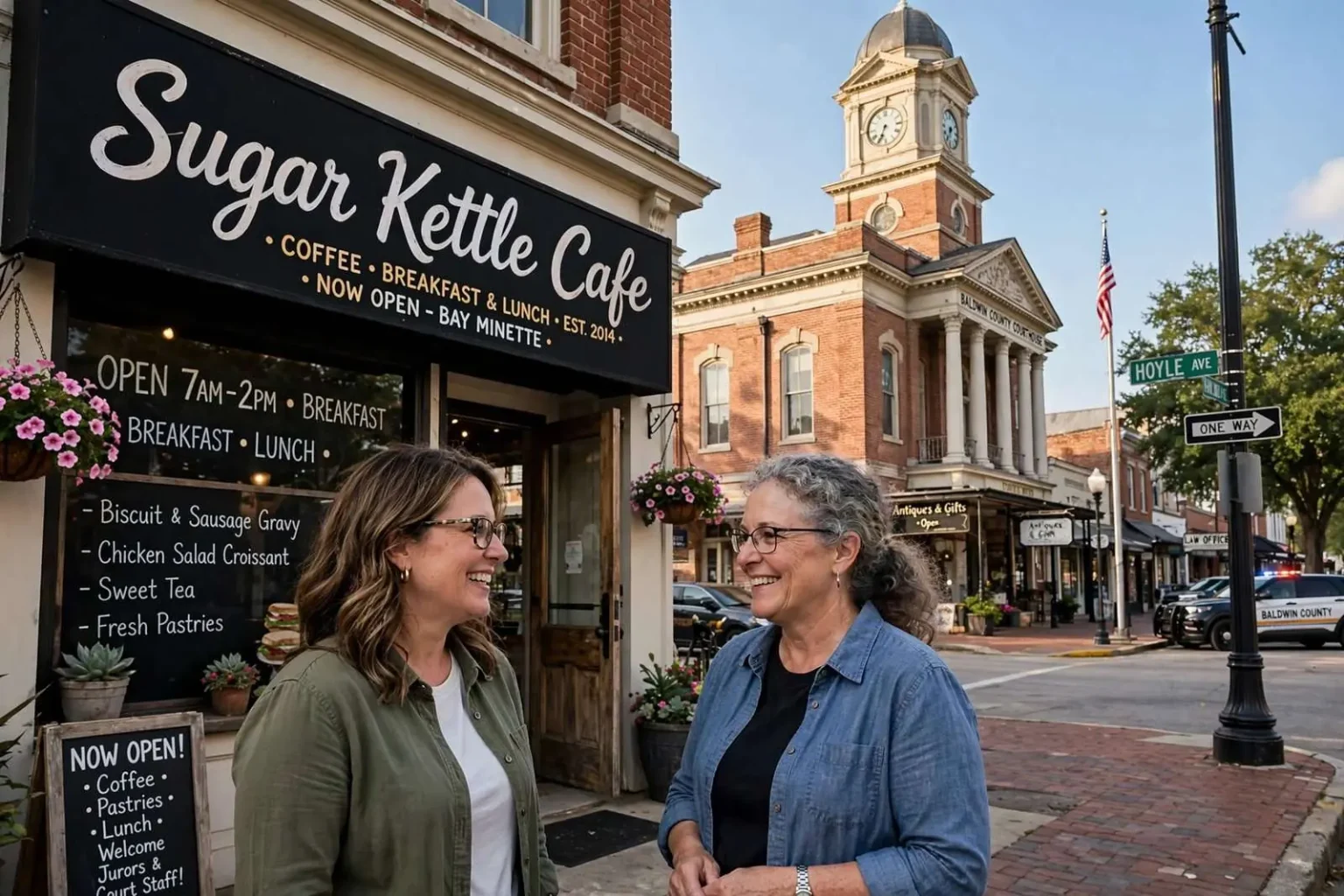
For years, Michelle Young had heard the same lament from people summoned to the Baldwin County Courthouse for jury duty: there simply were not enough places to eat near the square, and the scramble for parking made driving anywhere else unappealing.
“We heard it several times,” said Young, 44. “Multiple people had told us that there was a need. There was a need in Bay Minette.”
The courthouse square is the practical center of Baldwin County government life. jurors, litigants, clerks, attorneys and the county employees who staff the courthouse complex all funnel through downtown Bay Minette on weekdays, and most of them have an hour or less for lunch. When the nearest sit-down options fill up, the alternatives are a drive across town on crowded two-lane streets — a detour that eats the whole break — or nothing at all.
That need pushed Young and her business partner, Cheryl Reed, 56, to expand. In the summer of 2014 the pair prepared to open a second location of their Sugar Kettle Cafe — the first was in Daphne — on Hoyle Avenue, one of the storefront-lined streets a short walk from the courthouse square.
The partners’ first cafe built its following in Daphne’s Eastern Shore corridors, where the growth that has reshaped Baldwin County over two decades has been concentrated. Choosing Bay Minette for location number two was a deliberate bet on a different kind of customer: not the tourists streaming toward the beach towns at the county’s southern end, but the steady weekday population that government business delivers to the county seat.
A city thinking about its future
Their decision arrived just as city leaders were weighing whether to invest in a study of what kinds of retail Bay Minette should try to recruit. Mayor Bob Wills said he heard the complaint about restaurants constantly.
“I know we get complaints all the time about restaurants… because we are very limited,” Wills said. “I know that is certainly something we’d like to bring in. I know there is a need for that because I hear it a lot.”
Bay Minette, the Baldwin County seat, had an estimated population of 8,934 and roughly 230 businesses. Those numbers place it in a middle tier among Baldwin’s municipalities — larger than the county’s small towns but a fraction of the size of the Eastern Shore cities whose commercial corridors have boomed along the Interstate 10 corridor.
City Councilman Chris Norman noted that the city had not seen the kind of rapid growth reshaping communities to the south. “We don’t have a lot of major new growth like they have down in Malbis, Spanish Fort and those areas like that,” Norman said, attributing much of that expansion to people relocating from Mobile into Baldwin County.
The pattern Norman described is familiar across the county. Spanish Fort’s retail explosion around the Eastern Shore Centre, Malbis’ transformation from a quiet crossroads into a shopping destination, and Daphne’s continuous subdivision growth have all been driven by the migration of Mobile metropolitan area residents across Mobile Bay — households chasing lower costs, newer schools and the county’s reputation as a family-friendly place to settle.
Still, he believed Bay Minette could attract more if it marketed its strengths, among them a low crime rate and good schools. “It’s just a great place to live and raise a family,” he said. The city’s case to retailers rests on exactly those qualities, along with its role as the seat of county government and its position at the junction of the highways that carry north Baldwin County’s farm and timber country traffic through downtown.
Two competing pitches
The idea of a study took shape after Retail Strategies reached out to the city and the North Baldwin Chamber of Commerce. The firm proposed a three-year agreement priced at $84,000 that would cover the study, its implementation and business recruitment, said Ashley Jones, executive director of the chamber.
Retail Strategies, a Birmingham-based firm that markets retail recruitment packages to small cities across the Southeast, works on a model in which a municipality subscribes for a multi-year term and receives market analysis, targeted lists of restaurant and retail chains that fit its demographics, and ongoing solicitation of those chains on the city’s behalf. For a city of Bay Minette’s size, an $84,000 commitment is a substantial share of a year’s economic development spending, which is why the proposal went to the council rather than being handled administratively.
Jones also invited Richard “Tucson” Roberts, a well-known Alabama economic developer, to make a competing pitch. Roberts sought $18,000 for an assessment and plan, plus $1,500 for travel, though his proposal did not include implementation or recruitment.
Roberts estimated a study could take two to three months and would weigh competition, drive times and the city’s trade area. “They are pulling shoppers from as far away as 50 miles to the north, which indicates to me they have a possibility of adding some more retail,” Roberts said.
The comparison between the two proposals turned on what the city was actually buying. Roberts’ plan would deliver an independent diagnosis — where Bay Minette’s customers come from, what spending they export to other towns, and which retail categories the trade area could support — and leave execution to the city. Retail Strategies’ package bundled that analysis with years of outreach to chains, which proponents argued was the part small cities rarely manage to sustain on their own.
When the City Council met on July 7, Wills asked Jones to find out what it would cost to add industrial recruitment to the effort. Jones said she expected to update the mayor and council in August. “This is a process that is going to take a while for the city to narrow down,” she said.
The question of adding industrial recruitment reflected a second anxiety behind the retail discussion: Bay Minette wants employers as much as storefronts, and the North Baldwin Industrial Park on the city’s edge — home to manufacturing employers that anchor the local wage base — has been the traditional venue for that pursuit. Folding both pursuits into one agreement could spread the cost across two goals; keeping them separate would let the council judge each on its own merits.
What residents wanted
Jones said residents frequently told her what they were missing. “When it comes to the retail side, women want a shoe store,” she said. “They want a clothing boutique.”
Joyce Carl, 61, who had lived in Bay Minette for 40 years, said she often drove to Malbis to shop. “I think we should have a Shoe Station or something like that,” she said.
Carl’s routine is the trade-area story in miniature: household spending that Bay Minette’s stores cannot capture flows instead to the Eastern Shore, and every trip to Malbis or Spanish Fort carries the possibility that the shopper stops there again for groceries, prescriptions or dinner. Recruiting even a few anchor categories back home recaptures not just those purchases but the payroll that comes with them.
Along Alabama 59, drivers passed fast-food outlets, a Walmart and the Bay Minette Marketplace, anchored by a Ruby Tuesday and a Winn-Dixie, with a sign promising a Mexican eatery on the way. Streets Seafood on U.S. 31 remained a local favorite, while the square itself held many shops but few restaurants.
That inventory sketch explains the gap the Sugar Kettle partners saw. Bay Minette’s national-chain retail is scattered along the highway corridors a mile or more from the courthouse, while the historic square — the walkable, pedestrian-scaled part of town — offers antique and specialty shops without the lunch trade that would keep its storefronts full through the week. A cafe within sight of the courthouse is an attempt to prove that weekday traffic can support a fuller downtown, which in turn is the argument city leaders would need if they hope to recruit restaurants onto the square itself.
Young and Reed were betting on the locals rather than the tourists bound for Gulf Shores. Their 100-seat cafe planned to serve breakfast and lunch from 7 a.m. to 2 p.m. The short service window is a deliberate match to the courthouse calendar: jurors and staff need breakfast before selection and a quick lunch at midday, and the partners can run a lean operation rather than staffing a full dinner shift in a town whose evening traffic thins after the courthouses close.
They acknowledged the risk — friends had warned that restaurants come and go in Bay Minette — but said curious neighbors kept stopping by the building they were renovating to ask when it would open. “They’re really, really excited,” Reed said. “It’s like they are starving for something else, something different.”
The warning from friends reflects the town’s own recent history of short-lived eateries, a pattern common in small county seats where a new restaurant’s opening-week crowd is drawn from a customer base too small to sustain it once novelty fades. The partners’ answer is the location: by planting themselves where the county’s business is transacted daily, they are counting on a captive weekday audience that does not depend on Bay Minette’s own population alone.
For the city, the cafe’s opening weeks will be a small-scale test of the same proposition the retail study would evaluate at $84,000: whether Bay Minette’s trade area — pulling shoppers from up to 50 miles to the north, by Roberts’ estimate — can actually support more of what its residents say they want. If the Sugar Kettle’s second location fills its 100 seats through the jury calendar and the weekday rush, the partners will have produced evidence cheaper than any consultant’s report that the demand downtown is real.
The council’s decision on which recruitment path to take was expected to come later in the summer, after Jones reported back in August on the cost of adding industrial recruitment to the package. Whatever the council chooses, the sequence of events — a cafe betting on the courthouse crowd while the city weighs a formal study — has put the same question in front of Bay Minette twice in one summer: what would it take for the county seat to keep the spending its own residents now drive out of town to do?