Trip Pittman Enters the Race for Baldwin County’s Vacant Senate Seat
Montrose businessman Trip Pittman announced a Republican campaign for the Alabama Senate seat left open when Bradley Byrne took over the state's two-year college system, with the primary set for Aug. 7.
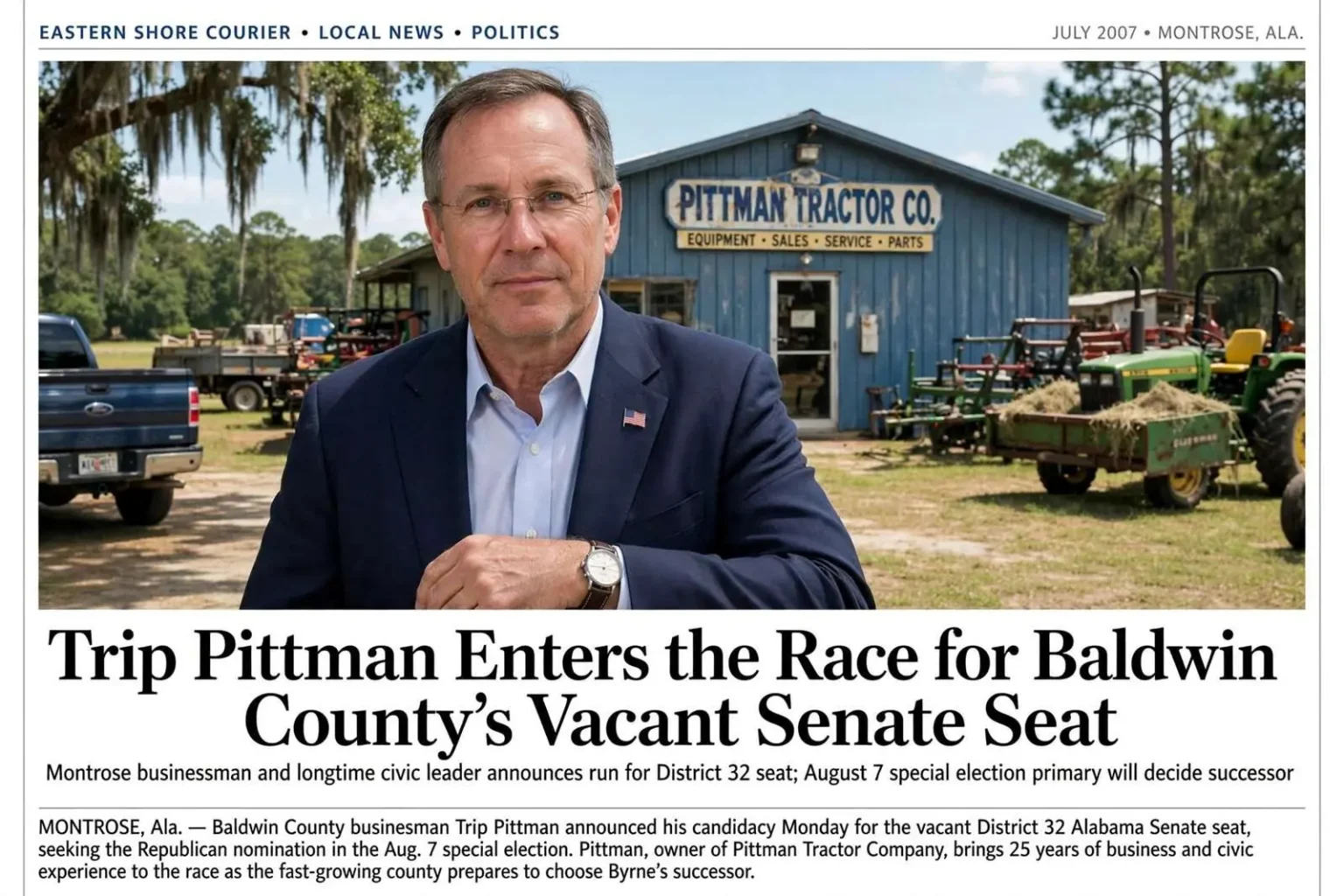
MONTROSE, Ala. — Trip Pittman, a Baldwin County businessman who had spent more than 25 years in commerce on the Eastern Shore, announced his candidacy for the Alabama Senate seat in District 32, running as a conservative Republican for a post that had come open unexpectedly. The announcement set the stage for a short, fast-moving special election campaign in one of the fastest-growing counties in Alabama, where the primary would effectively decide who held the seat. Pittman entered the race with deep roots in the county’s business community and a civic resume that stretched from planning boards to higher education governance.
“I am excited about the prospect of going to Montgomery to work for the people of Baldwin County,” Pittman said in launching the campaign. “I believe that good government comes from the people exercising their right to vote to elect good responsible leaders that can deal with the tough issues with real solutions.”
How the Seat Came Open
District 32 had been held by Bradley Byrne, one of the more prominent Republicans in the Mobile Bay region’s legislative delegation. Byrne stepped down from the Senate to accept appointment as chancellor of Alabama’s two-year college system, a post that placed him at the head of a sprawling network of community and technical colleges then under heavy scrutiny for patronage and mismanagement. The two-year college system’s troubles had dominated state headlines for years, and Byrne’s appointment was framed as an attempt to install a reformer at the top of an institution badly in need of one.
His departure triggered a special election, with the Republican primary scheduled for Aug. 7, 2007. In a county that had by then become one of the most reliably Republican in Alabama, the primary was widely understood to be the decisive contest. Whoever emerged from the Republican field would face only token opposition in the general election, which concentrated the entire campaign — and its spending, debates and door-knocking — into a compressed summer window.
That dynamic shaped the race from the start. Candidates had to introduce themselves to voters quickly, in the middle of vacation season, with little time for the months of retail politics a regular election cycle allows. For Pittman, whose name carried weight in Eastern Shore business circles but had never appeared on a countywide ballot, the calendar made name recognition a central challenge of the campaign.
A Tractor Dealer’s Resume
Pittman owned Pittman Tractor Company in Daphne, and he built his announcement around the argument that a business background translated into competence in Montgomery. The pitch was a familiar one in Alabama politics, but Pittman could point to a quarter-century of running an equipment dealership that served the contractors, farmers and developers driving Baldwin County’s building boom. His civic record was extensive and squarely establishment: the Baldwin County Planning and Zoning Commission, the Baldwin County United Board of Directors, the Alabama Commission on Higher Education, the Bayside Academy Board of Trustees, the Eastern Shore Sertoma Club and the Baldwin County Compass Bank Board.
The seat on the Alabama Commission on Higher Education was a notable line on the resume, given that the vacancy he sought had been created by a shakeup in the state’s other higher education system. His time on the commission gave him firsthand knowledge of how Alabama funded and governed its public colleges and universities — experience that mapped directly onto the education budget work that dominates any state senator’s agenda. The planning and zoning service, meanwhile, spoke to the growth issues that were transforming Baldwin County’s landscape.
Pittman earned a bachelor’s degree in commerce and business administration from the University of Alabama. He participated in the Army ROTC program there and received a reserve commission as a second lieutenant upon graduation, later serving in the Alabama National Guard as first platoon leader in Troop E of the 31st Armor Brigade, based in Sylacauga. The military chapter added a dimension to his candidacy that distinguished him in a field of business-oriented contenders.
“My business, civic, military and personal experiences have prepared me for the job in Montgomery,” Pittman said. “With the support of my family and the voters of District 32, I look forward to the opportunity to represent Baldwin County in the state Senate.”
Rooted on the Eastern Shore
Pittman was married to the former Lynn Kittrell. The couple had three children: daughters Reynolds, 17, and Virginia, 12, and a son, Lee, 15. They lived in Montrose and were members of Fairhope United Methodist Church. The family’s ties ran through some of the oldest communities on the Eastern Shore, where the Pittman name had been part of the local business landscape for generations.
That geography mattered in a district where the Eastern Shore communities of Daphne, Fairhope and Montrose had grown rapidly through the 1990s and 2000s, drawing new residents from Mobile across the bay and from far outside Alabama. Baldwin County’s population boom was reshaping its politics, its schools and its roads faster than its institutions could comfortably absorb, and growth management was among the issues waiting for whoever won the seat. New subdivisions were multiplying along the U.S. 98 and Alabama 181 corridors, school enrollment was climbing every year, and the county’s elected officials were under constant pressure to extend infrastructure ahead of the rooftops.
For voters along the Eastern Shore, the question was less about ideology than about who could manage the consequences of the county’s own success. Traffic on the bay bridges and the beach routes, classroom crowding in Daphne and Fairhope, and the steady conversion of farmland into development were everyday concerns in a way they were not in slower-growing parts of the state. Pittman’s background in the equipment business put him in daily contact with the construction economy that was driving much of that change.
The special election also arrived at a moment of transition in Baldwin County Republican politics. The party’s dominance in the county had hardened over the previous decade, with Democrats increasingly unable to contest local offices, and the September 2007 general election was expected to be a formality. That reality put a premium on organization and turnout within the primary itself, where a modest number of votes separated victory from defeat in a summer contest.
Business leaders across the county watched the race closely, aware that the senator from District 32 would sit at the table when the Legislature divided transportation dollars and weighed education budgets. The district stretched across the Eastern Shore and into parts of southern Baldwin County, tying the political fortunes of Montrose and Daphne to those of the beach communities and the agricultural interior. Balancing the interests of rapidly suburbanizing shore communities against the needs of the county’s smaller towns was part of the job description from the day the seat opened.
Pittman’s entry also underscored the depth of the county’s civic pipeline. Organizations like Baldwin County United, the planning commission and the local bank boards had long functioned as proving grounds for residents who would later seek public office, and his path from those posts to the Senate race followed a well-worn route in Baldwin County public life. The Sertoma and church affiliations, routine lines in a campaign biography, signaled to voters the kind of community-centered conservatism that dominated Eastern Shore politics.
For his part, Pittman framed the campaign as a continuation of service rather than a career change — a businessman and Guardsman stepping forward because his county needed a voice in Montgomery. The message acknowledged the unusual circumstances of the race: a seat vacated mid-term, a summer election, and a county growing quickly enough that its representation in the Statehouse could not afford an extended learning curve. Voters, he argued, needed someone ready to work from the first day of the session.
The Road Ahead in Montgomery
Whatever the outcome of the August primary, the winner of the special election would inherit a legislative agenda defined by Baldwin County’s growth. Road funding, school construction and the protection of the county’s share of state revenue were the recurring themes of the district’s legislative history, and they would frame the next term no matter who held the seat. The compressed special election calendar meant the campaigns had weeks rather than months to make their case.
As the Aug. 7 primary approached, the contours of the contest were set: an establishment businessman with deep civic credentials, running in a solidly Republican district, for a seat whose previous holder had traded the Senate for one of the most demanding reform jobs in state government. The result would set the course of Baldwin County’s representation in Montgomery for years to come.
What followed: Pittman won the District 32 seat and went on to represent Baldwin County in the Alabama Senate for more than a decade, becoming a significant figure in state budget politics as chairman of the chamber’s education budget committee. In that role he helped shape the Education Trust Fund budgets that fund Alabama’s public schools and universities, giving Baldwin County an influential voice in how education dollars flowed across the state. His longevity in the seat far outlasted the special election that put him there.
Byrne, whose exit created the opening, would later mount a campaign for governor and ultimately serve in the U.S. House representing Alabama’s 1st Congressional District. The two men’s careers would stay intertwined with the region’s political story long after the summer of 2007, each in his own way carrying the Mobile Bay area’s agenda in Montgomery and Washington.
At the time of the announcement, though, all of that lay ahead. What was in front of Baldwin County voters in the summer of 2007 was a short, hot special election campaign for a seat whose previous occupant had left to try to clean up a troubled college system. For Pittman, the announcement in Montrose marked the start of a political career that neither he nor the county could yet measure.