Baldwin County Politics Stirs: A Challenger Eyes the DA’s Office, a Forester Waves Off a Draft
Attorney Russell Watson confirmed he was weighing a run for Baldwin County district attorney against incumbent Judy Newcomb, while Art Dyas said talk of a commission bid was not coming from him.
BAY MINETTE – Baldwin County’s political class spent the tail end of winter doing what it does in the year before an election: taking soundings. Two stories emerged from the season’s quiet maneuvering — a potential challenge to the county’s entrenched district attorney, and a prominent forester’s firm refusal to be drafted into a race for the county commission. Together they offered a snapshot of a county that had grown fast enough to make every countywide office consequential, just as a recession was reshaping the economics of public service and private livelihood alike.
A challenge to the district attorney Russell Watson, of the law firm Ball, Koon and Watson, confirmed that he was considering a run for Baldwin County district attorney. Watson had been practicing law for roughly 15 years and was a graduate of the University of Alabama School of Law. The incumbent, District Attorney Judy Newcomb, was seeking re-election.
Newcomb was a familiar figure at Republican gatherings across the Eastern Shore that season, and she was widely regarded as entrenched. A challenge from an established local attorney was, therefore, not a small thing. Countywide races in Baldwin rarely drew experienced opposition, and the prospect of a contested race for the county’s top prosecutorial job immediately gave the coming election season more substance than most.
Watson’s firm, with roots in the Baldwin County legal community, gave him a name that local voters would recognize. His practice and his years before the bar placed him among the established attorneys who appear in the county’s courtrooms daily — the same circles from which prosecutors, judges and their challengers have traditionally been drawn.
A Prosecutor’s Office Grown With the County
The district attorney’s office in Baldwin County had grown in importance along with the county itself. Baldwin was among the fastest-growing counties in Alabama through the 2000s, its population swelling with retirees, beach development and commuters crossing the bay to Mobile. Growth of that speed brings the kind of caseload – property crime, drugs, traffic deaths, white-collar fraud – that turns a county prosecutor’s office from a small operation into a substantial one.
The demographics behind that growth were familiar to anyone who had watched the county change. Gulf-front and bayside development drew retirees and second-home buyers from across the region. Interstate 10 and the Causeway carried a daily tide of commuters who could live in Baldwin’s neighborhoods and schools while working in Mobile. The county’s population gains translated directly into court filings: more households meant more divorces and disputes, more cars on more roads meant more fatal accidents to prosecute, and a larger economy meant larger fraud cases when deals went bad.
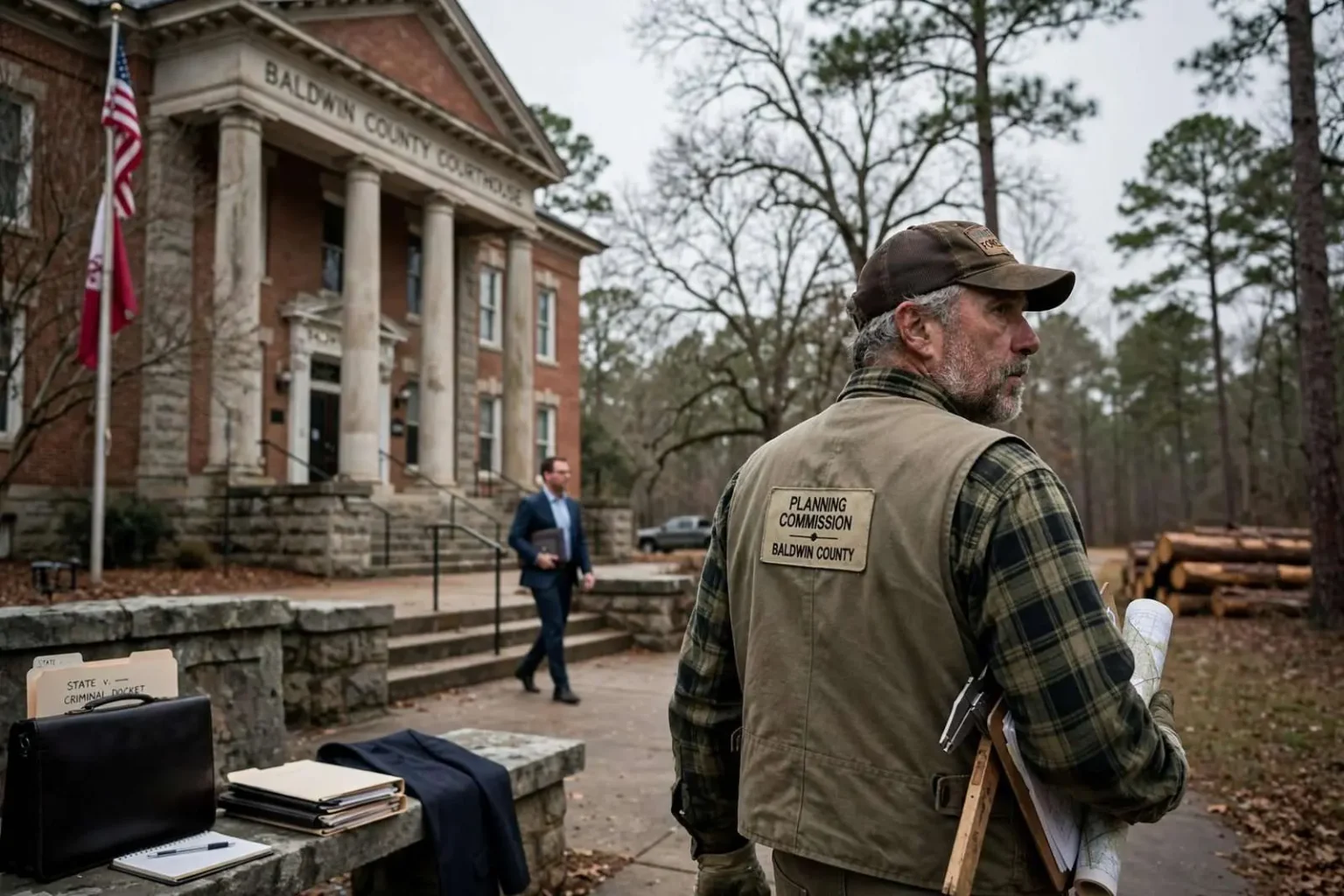
Bay Minette, the county seat, is where that workload lands. The Baldwin County Courthouse anchors the judicial system for a county that stretches from the Tennessee Street courthouses of the north county to the beach communities of the Gulf, and the district attorney’s office handles felony prosecutions, grand jury presentations and the support services that follow a modern prosecutorial operation. Whoever held the office in the coming term would inherit not the small-town practice of decades past but a prosecution load matching those of metropolitan counties elsewhere in the state.
That is the context in which any challenger would have to make the case. Newcomb’s incumbency, her visibility in party circles and the ordinary advantages of an officeholder meant Watson would be running against both a person and a pattern — the long Baldwin tradition of incumbents returning without serious opposition.
Dyas declines to be drafted
Elsewhere in the county, speculation had attached itself to Art Dyas, who was mentioned as a possible candidate for the Baldwin County Commission. Dyas made it plain the talk was not his doing.
“My attitude at the moment is I’m not giving it any consideration at a time like this when I’m struggling to do what I do for a living,” Dyas said. “I’m not seriously considering it. It’s really not on the forefront of things I’m considering at the moment.”
Dyas, 57, was a forester and served as vice chairman of the Baldwin County Planning Commission. His candor about the pressures of making a living was a mark of the moment. The recession had hit Baldwin County’s growth economy hard: construction had stopped, land values had fallen and the timber and development businesses that fed the county’s boom were feeling it directly.
For a forester whose livelihood ran through the land economy — timber tracts, development parcels, the buying and selling of property on the county’s eastern side — the downturn was not an abstraction. Projects that would have cleared ground a year earlier sat still. Land that would have sold sat unsold. A run for county office, with its demands on time and attention, offered little appeal to a businessman trying to keep a practice whole through the worst economy in a generation.
Dyas’s position on the Planning Commission gave the speculation its plausibility. The commission shapes development across the county’s unincorporated areas, reviewing subdivisions, zoning questions and the growth pressures that had defined Baldwin for a decade. Members of that body are, by the nature of the work, visible to the county’s political community, and names surface for county commission races with regularity when terms come open.
His answer, though, closed the door as plainly as a non-candidate can. There was no committee, no exploratory effort, no quiet sounding of supporters — only a working man’s explanation that the timing was wrong and the effort would take him away from the business that supported his family.
What It Says About Baldwin
The two stories, read together, describe a county at a turning point. Baldwin County had spent a decade absorbing growth unlike anything in its history, and the offices that govern it — prosecutor, commissioners, planning authorities — had become jobs with real reach over how the next decade would look. The same recession that made Dyas hesitate was squeezing county budgets everywhere, which meant the next district attorney and the next commissioners would be managing demand for services with constrained resources.
For the Eastern Shore communities of Daphne, Fairhope and Spanish Fort, and for the growing population centers up the Interstate 10 and Highway 59 corridors, the quality of county government had become a daily concern rather than an abstraction: traffic, stormwater, schools, law enforcement coverage. A contested district attorney’s race promised the county a genuine debate about criminal justice; a declined candidacy left the commission field to others.
The season of soundings would soon give way to qualifying, and Baldwin County’s voters would learn which of the winter’s whispers became candidacies. What the tail end of winter made clear was that the county’s politics had matured with its population — contested top-of-ticket races, established names weighing runs, and officeholders whose decisions now shaped a county of substantial size rather than the small one many of its institutions had been built to serve.
The economics of the moment shaped both races in ways that had little to do with party or personality. Across Baldwin County, the industries that had powered the boom — homebuilding, real estate, land development, beach hospitality — had slowed sharply. County government, which had spent years expanding services to keep pace with new rooftops, now faced the opposite problem: revenue growing slowly while the demands built up during the boom continued to arrive.
That backdrop weighs heaviest on candidates whose careers are outside government. An attorney in private practice can move to a public salary without much disruption, and a district attorney’s race carries with it the prestige that many lawyers seek at some point in their careers. A businessman whose income depends directly on the land economy has no such cushion; a county commission seat in Baldwin is a part-time office, but the time it takes is time not spent keeping a business alive in a downturn.
Dyas’s refusal also reflected a habit of Baldwin politics that observers have noted for years: the county’s most qualified names are often its most reluctant candidates. People who have built businesses in the county, or who already serve on appointed boards, understand exactly how much work county offices involve in a fast-growing place, and many conclude that they can serve better where they are.
The Race Ahead
For Watson, the calculus was different. A challenge to an entrenched incumbent requires either strong conviction, strong encouragement from the local party and legal community, or both. His consideration of the race this far out — a full year before the election — is the timetable challengers generally follow, because name recognition in a county of Baldwin’s size takes months to build. A late entry against an incumbent who spends the year at Republican gatherings would be a steep climb.
Newcomb’s side of the ledger was unchanged by the speculation. An incumbent district attorney running for re-election holds the advantages of office: a public record of prosecutions, relationships with law enforcement agencies across the county, and a visibility that comes with every major case her office handles. If she drew a contested race, it would be her first serious test at the polls in some time.
Whatever the outcome, the campaign would be fought across a county whose geography complicates every countywide race. Baldwin stretches from Washington County’s line to the Gulf, from the Mississippi line to the bay — one of the largest counties in Alabama by area, with distinct communities in Bay Minette, Foley, Fairhope, Gulf Shores, Robertsdale and points between. Reaching all of them in a single campaign is a logistical exercise that filters out unprepared candidates before the first fundraiser is held.
The year before an election is when those realities get weighed, and in Baldwin County that winter they were weighed in two very different ways: by a lawyer deciding whether to take on the county’s top prosecutor, and by a forester deciding, firmly, that he had a living to make first.