Baldwin County Asks Local Agencies to Help Pay for Its $4.5 Million Emergency Radio Network
Baldwin County set aside $335,000 to maintain the countywide emergency radio system in 2015 and asked the cities and volunteer fire departments that rely on it to share the cost.
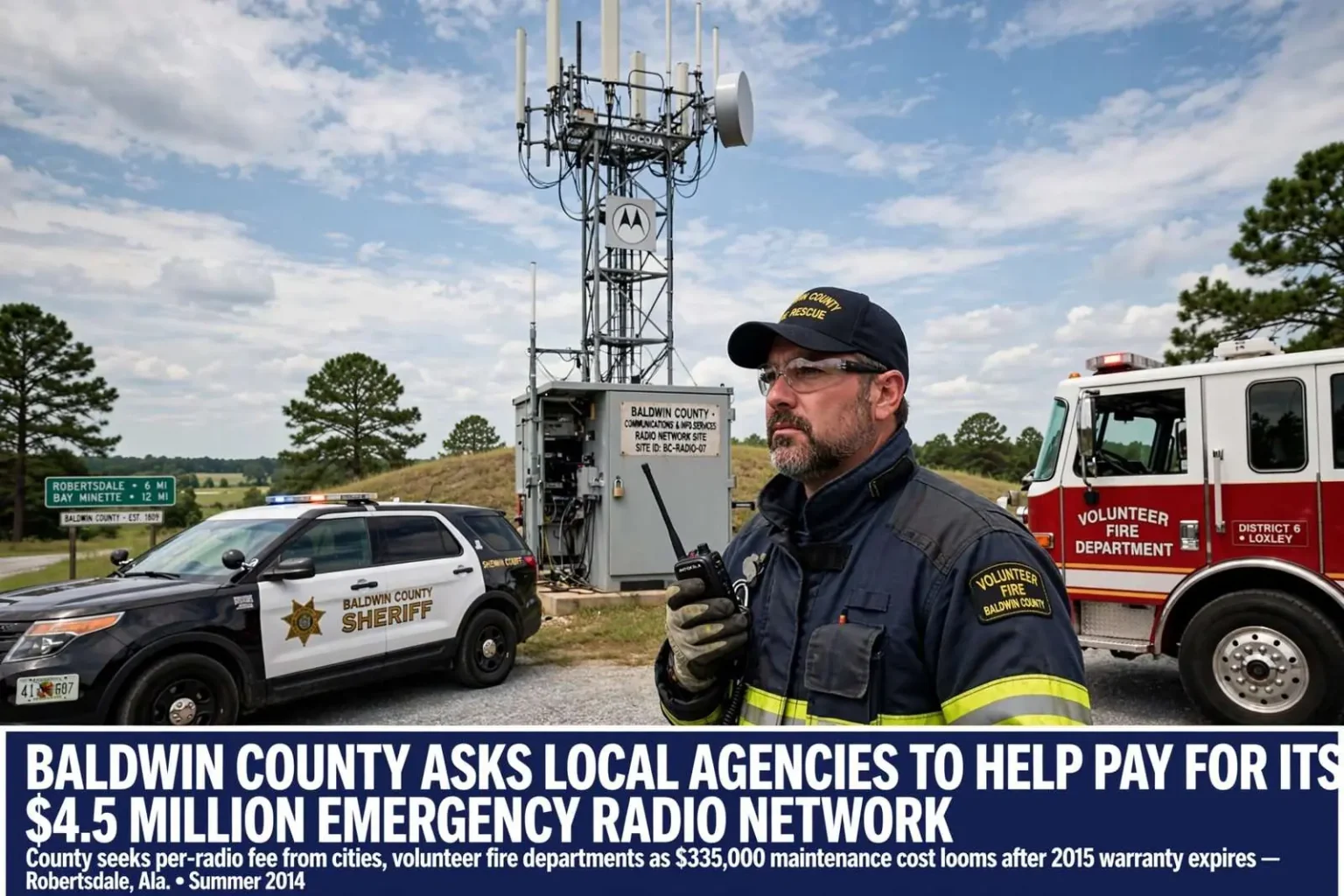
Baldwin County officials in the summer of 2014 opened a difficult conversation with the cities and volunteer fire departments that shared its countywide emergency radio network: the county wanted help paying to keep the system running. The network, which allowed police officers, firefighters and other agencies across Baldwin County to talk to one another on a single interoperable system, had been built after the county secured a $4.5 million grant to buy radios and related equipment. Maintaining that investment, however, was proving to be an expense the county did not believe it should shoulder alone. The dispute that followed was less about the technology than about a familiar question in Alabama local government: once a grant pays to build something, who pays to keep it alive?
A $335,000 line in the budget
The county earmarked $335,000 in its proposed fiscal year 2015 budget to cover the cost of maintaining the radio system. Because agencies throughout the county depended on it, commissioners argued, those agencies ought to contribute. “I really do feel that the municipalities should bear some of the operational cost of this,” Commissioner Mack said during a commission budget meeting in Robertsdale, adding that whether the arrangement began immediately or a year later, “they have got to become partners.” The wording mattered: the commission was not proposing to shut anyone out of the system, but to convert the users of a county-financed asset into paying stakeholders in it.
Brian Peacock, director of the county’s Communications and Information Services, suggested the commission collect a per-radio monthly fee from the agencies that used the network. The idea was straightforward — the more radios an agency put on the system, the more it paid — and it spread the cost in rough proportion to use rather than across a flat tax or a negotiated split. Peacock explained that maintenance was covered under a warranty included in the system’s original cost, but that warranty was set to expire in July 2015. Once the warranty ended, Peacock said, about $44,000 would be needed to keep the system maintained through the rest of 2015. After that, annual maintenance was projected to cost roughly $85,000 a year.
He also floated the option of a $289,000-a-year Motorola hardware and software service agreement for the network. The gap between the two figures — roughly $85,000 a year for basic maintenance against nearly $290,000 for a full manufacturer’s service agreement — framed the choice the commission faced. The cheaper path kept the system running with repairs as needed; the agreement path bought manufacturer support for the hardware and software that kept the county’s dispatchers, deputies and fire crews talking. Neither number fit comfortably inside a county budget that had not planned, a decade earlier, to become the permanent custodian of a network the grants had built.
The fiscal year 2015 budget was being assembled during those same summer meetings in Robertsdale, where the Baldwin County Commission conducts its business, and the radio line sat among the county’s other fixed obligations: road and bridge maintenance, the sheriff’s office, the county’s share of courthouse and administrative costs. Baldwin County is Alabama’s largest county by land area, stretching from the Gulf beaches of Gulf Shores and Orange Beach up through Foley, Robertsdale, Fairhope, Daphne, Spanish Fort, Loxley and Bay Minette, the county seat. Public safety radio there is not a luxury — it is the connective tissue between a county sheriff’s office, more than a dozen municipal police departments, and the volunteer fire departments that cover the rural expanses between the cities.
Why the network exists
The countywide radio network was built for exactly the scenarios that southwest Alabama knows best. Baldwin County sits on the Gulf of Mexico, and the storms that have shaped its modern history — Hurricane Frederic in 1979, Hurricane Ivan in 2004, Hurricane Katrina’s sweep across the region in 2005 — demonstrated again and again that in a major emergency, the first responders who arrive are not all wearing the same uniform. A Gulf Shores police officer, a Foley firefighter, a Baldwin County sheriff’s deputy and a volunteer fire crew from a rural district may all be working the same incident, and in the years before interoperable radio, agencies whose radios operated on different frequencies and different systems simply could not talk to one another at the scene.
That fragmentation was a national problem after the September 11, 2001 attacks, when federal reviews of the response to the World Trade Center highlighted the failures of incompatible police and fire radios, and Washington began pouring grant money into regional interoperable communications. Baldwin County’s $4.5 million grant to buy radios and related equipment fit that era: federal dollars built the backbone, local agencies bought or were issued radios, and for the life of the equipment the system worked without anyone having to budget for it. The warranty that accompanied the original purchase quietly covered maintenance — until it did not.
Interoperable systems also change how daily work gets done, not just how disasters are handled. A deputy in the northern part of the county coordinating with a municipal officer on a traffic stop, a volunteer department requesting a mutual-aid ambulance, dispatchers routing a call across jurisdictional lines — all of it depends on the shared network. When one agency’s radio goes down, it is not just that agency’s problem; it is a gap in a system every other user assumes is complete. That is the argument commissioners made for spreading the cost: the value of the network is collective, so the cost should be too.
Fire departments push back
The proposal did not sit easily with the volunteer fire community. Raymond Lovell, president of the Baldwin County Fire Chiefs Association, said agencies had been stretched thin for years, and that new monthly charges for radios they already carried would land hard on departments that operate on bake sales, donations and modest tax districts. Volunteer departments in Baldwin County protect a great deal of territory — the unincorporated stretches between the county’s cities, where a paid fire department does not exist and the nearest engine may belong to a small volunteer company funded largely by its community.
The economics of a volunteer department are unforgiving. A small company’s budget covers fuel, turnout gear, truck maintenance, insurance and training for members who respond on their own time, and many Baldwin County departments have historically supplemented their district tax money with fundraisers because the tax base alone does not cover operations. A per-radio fee — even a modest monthly charge multiplied across every portable and mobile radio a department fields — competes directly with those core costs. From the fire chiefs’ side of the table, the county was asking the agencies with the least money to help retire the maintenance bill on a system the county built.
Municipal governments had their own version of the same objection. Cities from Daphne to Foley employ their own police officers and firefighters and already pay for their dispatch centers, their equipment and their personnel; a new line item for a county radio network, on top of everything else, reads in a city budget as a transfer of county costs onto city taxpayers. Whether the arrangement began immediately or a year later, as Commissioner Mack put it, the cities were being told that partnership had a price — and every city manager and fire chief in the room was calculating what that price meant for the budgets they had just closed.
The broader pattern
Baldwin County’s dilemma was not unique to Baldwin County. Across Alabama and the nation, the 2000s built a generation of regional radio systems on federal homeland security and hurricane-recovery grants, and the 2010s found those counties confronting the same arithmetic: hardware ages, warranties expire, software licenses renew, and the bills arrive at the exact moment the original grant money has long since been spent. A radio network is not a building that can simply be closed if funding lapses — it is dispatch traffic, officer safety and mutual aid — so counties have little leverage to walk away. The only real choice is who writes the maintenance checks.
Vendor economics sharpen the problem. A network built on Motorola equipment ties its upkeep to Motorola’s service offerings, and the difference between informal maintenance and a manufacturer’s service agreement — the roughly $85,000 against the $289,000 Peacock put before the commission — is the difference between a system that gets repaired when it breaks and a system that is monitored, patched and supported before it breaks. Large agencies with in-house technicians can sometimes split the difference; a county serving dozens of small departments generally cannot, because the smallest user on the network has no technician at all.
The per-radio fee Peacock proposed is one of the standard answers, and it has a logic the fire chiefs’ objections partially acknowledge: radios are a countable, fair proxy for use. A large municipal department running a hundred radios pays more than a five-truck volunteer company running a dozen. But fairness by radio count is not the same as ability to pay, and in Baldwin County the agencies with the most radios — the big cities along the eastern bay and the coast — are also the ones with paid staffs and larger budgets, while the volunteer departments lean the other way. The commission had to decide whether the fee’s fairness or the departments’ fragility would set the terms.
What it means for residents
For the public, the debate was largely invisible until it threatened service. Residents dialing 911 in Baldwin County do not choose which radio network answers; they call a dispatch center that reaches whichever agency covers their address, and the countywide system is what lets those agencies hand a call across a city limit without dropping it. Every structure fire worked by a volunteer department alongside a municipal engine, every pursuit that crosses from Spanish Fort into Daphne, and every coastal storm that brings a dozen agencies to one incident zone depends on the system staying on the air.
The stakes rise with the county’s growth. Baldwin County has been among the fastest-growing counties in Alabama for years, adding subdivisions along the Highway 98, Highway 181 and Highway 59 corridors, and every new neighborhood adds calls, radios and users to the network. A maintenance model set when the system was new does not automatically stretch to fit a bigger system a decade later, which is one reason the commission chose a budget season — when every agency is already arguing about money — to force the partnership question rather than springing it during storm season.
Whatever arrangement the commission and the agencies reached, the conversation of the summer of 2014 marked the transition of the network from a grant-funded project to a permanent public utility, with all the cost-sharing politics that status implies. The $335,000 line in the fiscal year 2015 budget, the July 2015 warranty expiration, the $44,000 bridge to the end of that year, the projected $85,000 in annual maintenance and the $289,000 service agreement option gave every agency at the table the same numbers. What they differed on was who should pay them — and that question, in one form or another, is one Baldwin County agencies have continued to negotiate every budget year since, because the radios do not stop aging when the meeting adjourns.