First Jobs: Paper Routes, Ice Cream Plants and a Teenage Interview With George Strait
As another crop of graduates went looking for work, a group of Mobile-area figures were asked to recall the first jobs that started them off, from a Des Moines paper route to an Avondale foundry pattern shop.
Every summer produces the same anxious ritual. College graduates begin or hunt for their first real job, high school students scramble for part-time work and a little spending money, and everyone older watches with a mixture of sympathy and amusement. Plenty have gone before them. A number of Mobile-area figures were asked to recall the work that started them off, and the answers said as much about the century they grew up in as about the jobs themselves.
Behind the microphone at seventeen
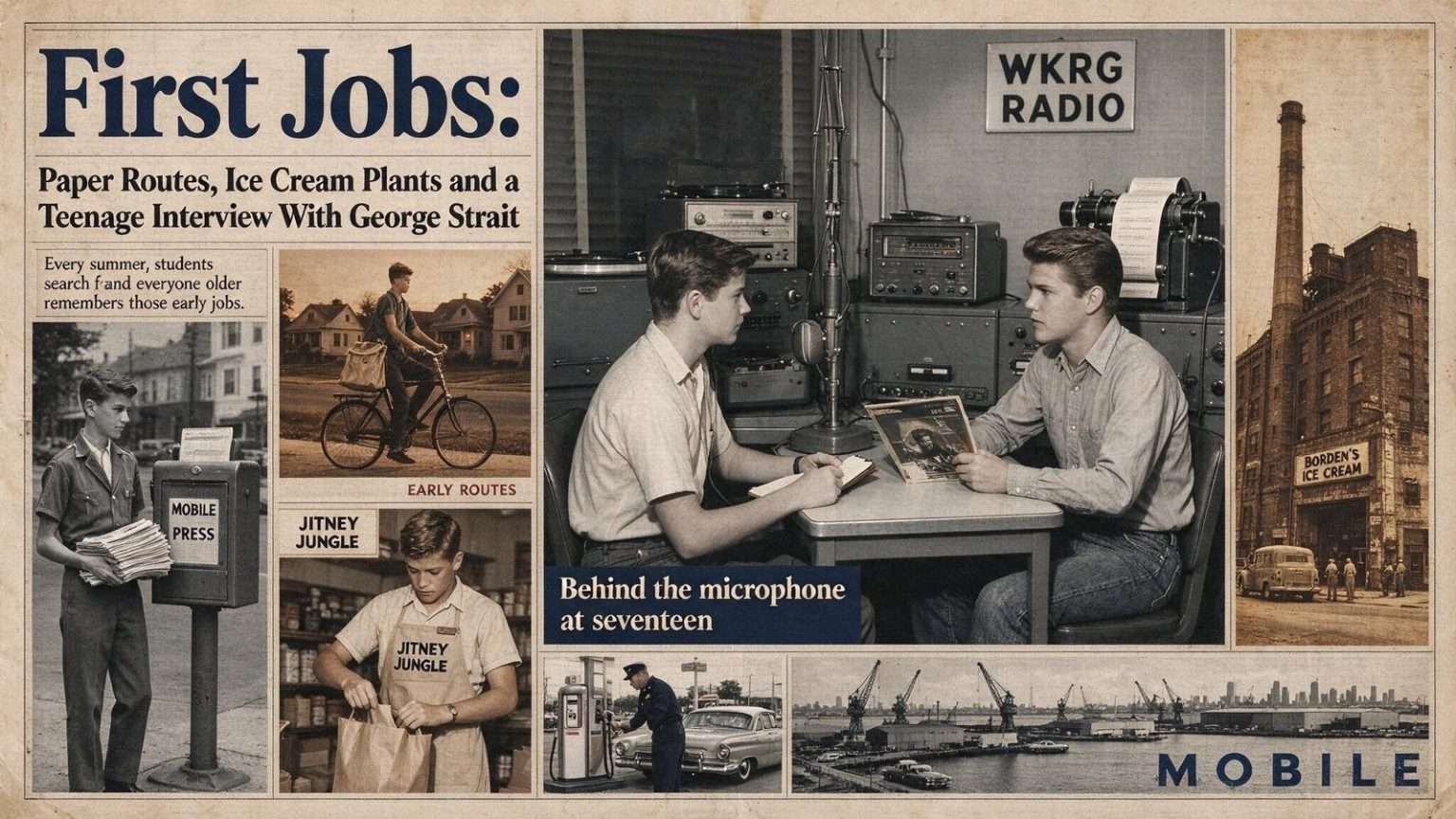
Public relations professional Amy Greer Thompson spent her high school summers at her father’s bank in East Texas, first working the safe deposit box desk as a new accounts representative, later moving up to the teller line. In her second summer she was promoted to demonstrating the automatic teller machine, no small event in a town of 2,300 with not so much as a traffic light at its center. That was the day job. At night she worked at a tiny AM country station where records still spun on a 1960s turntable, Patsy Cline and Barbara Mandrell and Ronnie Milsap, and where her duties included shutting down the transmitter and playing the national anthem off a cartridge at midnight. She ripped weather and headlines off an old wire service teletype. The highlight, and the moment she credits with infecting her permanently with the news bug, was interviewing George Strait when he came by to talk about a new album. She was about 17. She suspects the interview was terrible. She is certain it mattered.
Thompson’s experience captures a vanishing media landscape. The small-town AM station, locally owned and operated, served as both community bulletin board and cultural lifeline. The wire service teletype — a clattering machine that spat out Associated Press or United Press International copy on continuous roll paper — connected rural Texas to the wider world. Signing off at midnight with the national anthem was a ritual mandated by FCC regulations that required stations to broadcast the anthem at sign-on and sign-off, a practice that faded with the rise of twenty-four-hour programming. Interviewing George Strait in the early 1980s, before he became the “King of Country” with sixty number-one hits, meant sitting across from a young Texan with a debut single and a traditional sound that Nashville wasn’t sure it wanted. That Thompson remembers the interview as terrible but transformative speaks to the way first brushes with professional identity often work: the competence comes later; the spark arrives first.
The paper route generation
The single most common first job in the group was throwing a newspaper, and the accounts converge on the same details: an alarm before dawn, a route measured in miles, and the unwelcome education of collecting money from people who do not want to pay. A Mobile chiropractor delivered the Des Moines Register in the early 1960s, walking a three-mile route from 4:30 to 6 a.m., and did it for four years. He had money in the bank, a good bicycle, a car and a college fund before he graduated high school. The paper taught him, he said, that money comes from showing up when you don’t want to, in weather you don’t like, for people who don’t care.
Newspaper delivery in mid-century America was a child-labor institution disguised as entrepreneurship. Carriers were independent contractors, not employees, responsible for purchasing their papers at wholesale and collecting retail from subscribers. The profit margin was thin; the real money came from tips at Christmas and from the subscription bonuses publishers offered for new sign-ups. In Mobile, the morning Mobile Press and the afternoon Mobile Register (merged into the Press-Register in 1997) employed hundreds of carriers across the city and suburbs. Routes were awarded by seniority, and the best ones — dense neighborhoods with high subscription rates — were coveted. The physical demands were real: a loaded canvas bag could weigh thirty pounds, and the bicycle miles added up. The chiropractor’s four-year tenure was exceptional; most carriers quit within months.
Ice cream plants and the summer economy
Another Mobile respondent, a retired engineer, spent his summers at the Borden’s ice cream plant on Michigan Avenue, where the smell of vanilla and chocolate permeated the neighborhood and the work was cold, wet, and fast. He stacked fifty-pound cartons in a freezer that ran at twenty below, loaded delivery trucks before dawn, and learned that industrial food production runs on a schedule that does not negotiate. The plant, a major employer in mid-century Mobile, produced the gold-standard ice cream for a region where air conditioning was still a luxury and a nickel cone was a daily ritual. Borden’s, like the paper mills and the shipyards, operated on shift work that structured the lives of entire families. The engineer’s summer there paid for his textbooks at Auburn and taught him that the line between skilled and unskilled labor is often just a matter of who holds the clipboard.
The Borden’s plant on Michigan Avenue was part of a national network that made the company a household name. The Mobile facility, opened in the 1930s, processed milk from dairy farms across Baldwin and Mobile counties, turning raw product into fluid milk, butter, cheese, and ice cream for distribution across the Gulf Coast. The plant’s whistle marked time for the surrounding neighborhoods — shift change at 7 a.m., 3 p.m., 11 p.m. Workers walked or rode bicycles from nearby streets, their lunch pails clanking. The engineer’s freezer duty was considered a plum assignment compared to the loading dock, where the heat and humidity off Mobile Bay made summer afternoons brutal. But the freezer had its own hazards: frostbite, hypothermia risk, the numbing of fingers that made carton stacking dangerous. The company provided insulated gear, but the cold penetrated anyway.
The teenage interview that launched a career
A third respondent, a longtime Mobile television anchor, traced his start to a high school job at WKRG radio, where he answered phones during a call-in show and one night found himself on air when the host stepped out. The station manager heard him, liked the voice, and offered a weekend shift reading farm reports and spinning records. The anchor, then sixteen, had to get a work permit signed by his principal and promise to keep his grades up. He lasted three years, through high school and into his first semester at the University of South Alabama, before moving to the television side of the operation. WKRG, Mobile’s first television station (signed on in 1955), was a training ground for a generation of broadcasters who learned the craft in a market small enough to forgive mistakes but professional enough to demand standards.
The farm reports, broadcast at 5:30 a.m. and 12:15 p.m., were a relic of an agricultural economy that still fringed the city. Mobile County in the 1960s and 1970s produced soybeans, corn, cattle, and nursery stock on thousands of acres that have since become subdivisions and shopping centers. The reports included commodity prices from the Chicago Board of Trade, weather forecasts from the National Weather Service office at the Mobile Regional Airport, and announcements from the County Agent’s office at the Alabama Cooperative Extension. Reading them required a steady pace, clear diction, and the ability to pronounce “soybeans” and “cotton futures” without stumbling at 5:30 in the morning. The anchor credits those early shifts with teaching him the discipline that carried him through four decades on air.
Bagging groceries, pumping gas, and the service economy
A Mobile attorney remembered bagging groceries at the Jitney Jungle on Airport Boulevard, where the competition among baggers for speed and care was fierce enough that the store held weekly contests with cash prizes. The paper-or-plastic question had not yet arrived; paper was the only option, and a well-packed bag — heavy items at the bottom, bread and eggs on top, chemicals separate from food — was a point of professional pride. The attorney, who later argued cases before the Alabama Supreme Court, said the bagging contests taught him more about performing under pressure than any moot court exercise. Jitney Jungle, a Southern grocery chain founded in Mississippi, anchored shopping centers across Mobile until the chain’s sale and rebranding in the late 1990s. The Airport Boulevard location, opened in the 1960s, served the expanding suburbs west of I-65, where young families filled the new ranch houses and split-levels.
Another respondent, a civil engineer who designed bridges for the Alabama Department of Transportation, pumped gas at his father’s Pure Oil station on Government Street in the 1950s. Full service meant checking oil, washing windshields, airing tires, and handing the customer a green stamp book with every fill-up. The station was a social hub; travelers on the Old Spanish Trail (U.S. 90) stopped for directions, locals lingered for gossip, and the engineer’s father knew every regular’s preferred octane and payment habit. The Pure Oil brand, with its distinctive blue-and-white Art Deco canopy, vanished in the 1970s consolidation that gave way to self-serve islands and convenience stores. The engineer said the station taught him that infrastructure — roads, bridges, pipelines — exists to serve the people who move across it, a lesson he carried into a career of designing highway spans across Alabama.
What first jobs reveal about a changing city
The collected memories span a period — roughly 1950 to 1990 — when Mobile transformed from a port city of ninety thousand to a metropolitan area of four hundred thousand. The jobs reflect that arc: newspaper routes and gas stations in the pedestrian-scale downtown and early suburbs; ice cream plants and shipyard apprenticeships in the industrial era; radio stations and bank teller lines in the service-sector transition; fast-food counters and mall retail in the suburban boom. Each job carried its own curriculum: the paper route taught reliability; the ice cream plant taught industrial discipline; the radio station taught communication; the grocery store taught customer service; the gas station taught human nature.
What distinguishes the Mobile version of this universal story is the specificity of place. The Des Moines Register route in the 1960s existed because the Register’s circulation manager believed Mobile’s growing population justified a Midwest paper’s investment. The Borden’s plant operated because the Gulf Coast’s dairy farms and hot summers created a natural market. WKRG existed because the FCC allocated Mobile a VHF channel and local investors built the station. The Jitney Jungle on Airport Boulevard opened because the Interstate Highway System made that corridor accessible. The Pure Oil station on Government Street thrived because U.S. 90 was the Gulf Coast’s main east-west artery before I-10. Every first job was a node in an economic geography that the workers could not see but that shaped their options.
The ritual continues
Today’s Mobile teenagers bag groceries at Publix and Rouses, work the drive-thru at Chick-fil-A and Raising Cane’s, lifeguard at the city’s community pools, and intern at the Airbus engineering center in Brookley Field. The paper routes are gone, replaced by digital subscriptions. The ice cream plant closed in the 1990s; the site is now a distribution center. WKRG is owned by a national media conglomerate; the farm reports are history. Jitney Jungle is a memory. The Pure Oil canopy was demolished decades ago. But the ritual — the alarm before dawn, the responsibility that exceeds the paycheck, the lesson that arrives disguised as drudgery — remains. The Mobile chiropractor who walked three miles at 4:30 a.m. would recognize the discipline in the teenager showing up for a 6 a.m. shift at the Airbus apprenticeship program. The engineer who pumped gas on Government Street would see his own curiosity in the high school senior asking questions at the USA Health volunteer desk. The century changes. The city changes. The first job, in all its awkward, exhausting, transformative glory, does not.