Bay Minette Seeks $450,000 Grant to Ease Flooding and Rebuild Infrastructure Along East Hurricane Road
Bay Minette is pursuing a $450,000 Community Development Block Grant to fix chronic flooding and upgrade drainage, sewer, water and roads in the East Hurricane Road area.
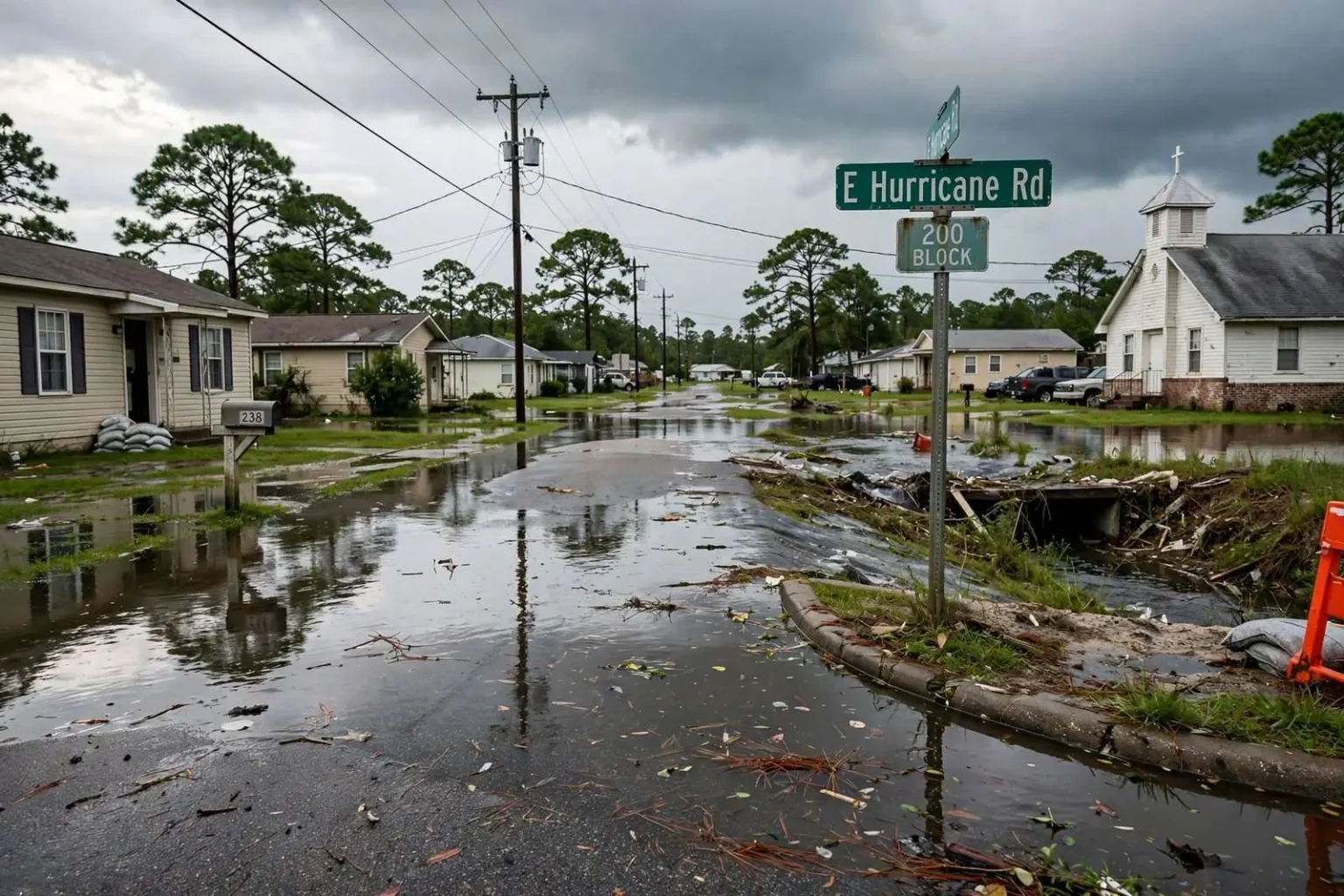
The city of Bay Minette is seeking a $450,000 grant to overhaul aging infrastructure and relieve chronic flooding in the East Hurricane Road area, where officials say heavy rains routinely swamp homes and businesses. For a neighborhood on the low ground of north Baldwin County, where Gulf storm systems can drop inches of rain in a single afternoon, the difference between functioning drainage and failing drainage is the difference between an inconvenience and a ruined floor.
The city is applying for Community Development Block Grant funds through the Alabama Department of Economic and Community Affairs. If awarded, the money would pay for a broad package of improvements to drainage, water, sewer and road facilities in the neighborhood—a scope that city leaders deliberately widened, betting that a comprehensive plan would stand out in a competitive field.
A comprehensive fix
The project area takes in businesses, churches and roughly 70 houses, said Stacy McKean, the city’s grant consultant. The neighborhood floods often, she said, and the bulk of the grant would go toward drainage work to ease the flooding that follows heavy rain. In older sections of Baldwin County towns, drainage ditches and culverts installed generations ago have been outgrown by development upstream and by more intense downpours, and piecemeal patching rarely keeps pace.
“In addition to that, we are going to construct some sewer improvements, water improvements and fixing the road and resurfacing,” McKean said. “It’s a very comprehensive approach to fixing the issues in that community.” The logic is practical: tearing up a street to replace failing sewer lines and then resurfacing it makes little sense unless the drainage underneath is fixed at the same time, so bundling the work saves money and spares the neighborhood a second round of construction disruption.
To strengthen the application, North Baldwin Utilities agreed to contribute $167,875 in matching funds toward labor and equipment for the project, according to a city resolution. Such local matches are often viewed favorably by state reviewers weighing competing requests for the limited grant dollars, since a committed partner signals that the project has local backing and can actually be completed if funded. North Baldwin Utilities, the municipal utility serving the Bay Minette area, has a direct stake in the water and sewer improvements its money would help build.
Health and safety at stake
Mayor Bob Wills framed the work as a matter of public welfare. In a letter to the Department of Economic and Community Affairs, he wrote that the neighborhood’s infrastructure problems posed health and safety hazards, underscoring the stakes for residents who contend with standing water and strained utilities. Persistent flooding is more than a property problem: standing water breeds mosquitoes, can contaminate yards and driveways, undermines septic and sewer function, and leaves roads that residents—including emergency responders—must cross after every major storm.
Bay Minette had applied for the same grant a year earlier without success. This time, Wills expressed optimism that the breadth of the request would work in the city’s favor. “We have high hopes this year because it is such a comprehensive application, covering so many aspects of work to be done,” he said. Reapplication after a miss is standard practice in the grant world, and cities that refine their requests—adding matches, broadening the project, documenting the need more thoroughly—often improve their position the second time around.
Competing for limited dollars
Community Development Block Grants are a longstanding source of funding for smaller Alabama cities looking to address infrastructure needs that local budgets alone cannot cover. The program directs federal money through the state to projects that benefit residents, often with an emphasis on lower-income neighborhoods and basic services such as water, sewer and drainage. Created in the 1970s, the block grant model was designed to give local governments flexibility—money arrives with broad purposes rather than narrow federal categories—and Alabama administers its share through ADECA for the smaller cities that do not receive an direct annual entitlement.
Because demand for the grants typically outstrips available funding, communities frequently reapply across multiple cycles, refining their proposals and lining up matching commitments to improve their odds. A $450,000 award is a meaningful sum for a city of Bay Minette’s size—the county seat of Baldwin County and the largest population center in the county’s northern half—but it is a small fraction of what a full drainage and utility overhaul would cost at market rates, which is why the matching funds and bundled scope carry so much weight in the review process.
Bay Minette’s decision to package drainage, sewer, water and road work into a single application reflected that strategy, presenting the East Hurricane Road area as a neighborhood in need of a coordinated solution rather than piecemeal repairs. Reviewers scoring such applications look for documented need, local commitment and a plan that addresses root causes rather than symptoms—and chronic flooding, more than almost any other infrastructure complaint, has a way of exposing how those elements interconnect. A drainage ditch that floods a road also saturates sewer lines, weakens pavement and strands residents; fixing one piece without the others leaves the complaint intact.
For the families and business owners along East Hurricane Road, the outcome would determine whether relief from recurring floods was near or still another grant cycle away. City leaders said they believed the thoroughness of the plan gave Bay Minette its best chance yet, and they awaited the state’s decision on whether the $450,000 would come through.
The stakes extend beyond the project area itself. In fast-growing Baldwin County, where development pressure keeps pushing infrastructure costs upward, smaller cities like Bay Minette compete for attention and resources against the booming beach corridor to the south. A successful grant would not only dry out one neighborhood but demonstrate that the city can assemble competitive applications and delivery partnerships—a track record that positions it for the next funding cycle, whatever the next need turns out to be.
Should the application succeed, city officials have said the work would proceed as a single coordinated package, with the drainage improvements taking priority and the water, sewer and road work following in sequence to minimize disruption. Residents of the roughly 70 homes in the project area, along with the churches and businesses that anchor the neighborhood, would be watching the same state announcement as City Hall—one grant decision, and with it, a neighborhood’s relief.
Bay Minette’s flood problem is rooted in its geography. The city sits on the flat coastal plain of north Baldwin County, wedged between the Mobile-Tensaw delta’s wetlands to the west and the county’s pine flatwoods, where heavy Gulf rains have nowhere to go but into ditches, creeks and low yards. In developments and road corridors built out in the mid-twentieth century—when drainage standards were lighter and storm intensities milder—the systems installed then are being asked today to move stormwater they were never sized for. East Hurricane Road’s troubles fit that pattern, and they explain why city officials describe the fixes in terms of capacity rather than cosmetics.
The grant-seeking effort also illustrates how municipal infrastructure finance works in Alabama’s smaller cities. Property and sales tax bases in towns of Bay Minette’s size cover operations—police, fire, streets, parks—but rarely leave room for million-dollar capital projects, which is why state and federal grant programs function as the de facto capital budget for water, sewer and drainage work statewide. A city’s grant-writing capacity, its ability to document need with photos, complaints and engineering assessments, and its willingness to commit matching dollars often determine which neighborhoods get fixed and which keep waiting.
The city’s partnership with North Baldwin Utilities strengthened more than the application’s arithmetic. Water and sewer improvements in the East Hurricane Road package will involve the utility’s own lines and crews, so the $167,875 commitment represents a utility investing in the same ground it serves—and a signal to ADECA reviewers that the entities responsible for maintaining the improvements after construction are already at the table.
Should the $450,000 arrive, the sequencing of work will matter to a neighborhood that has heard promises before. Officials have described a coordinated construction package—drainage first, then water and sewer lines, then road rebuilding and resurfacing—so that no freshly paved street gets torn up twice. Residents of the roughly 70 houses in the project area, along with the churches and businesses that anchor the neighborhood, would be watching the same state announcement as City Hall: one grant decision, and with it, a neighborhood’s relief from the water that has risen in its streets for years.
City leaders have indicated they will keep the East Hurricane Road package ready regardless of the timing of the state’s decision, so that an award can be converted into construction contracts without a long start-up lag. For now, the application stands as the neighborhood’s best-documented case yet—a comprehensive plan, a utility partner with money on the table, and a mayor who has told the state plainly that the health and safety of roughly 70 households hang on the answer.