Pipes Too Small, a $650,000 Overrun, and a Name City Hall Recognized
An engineering firm designed a Dauphin Street drainage project for 66-inch pipes when 72-inch pipes were needed. The error cost Mobile $650,000, and the firm's principal had given to the mayor's campaign.
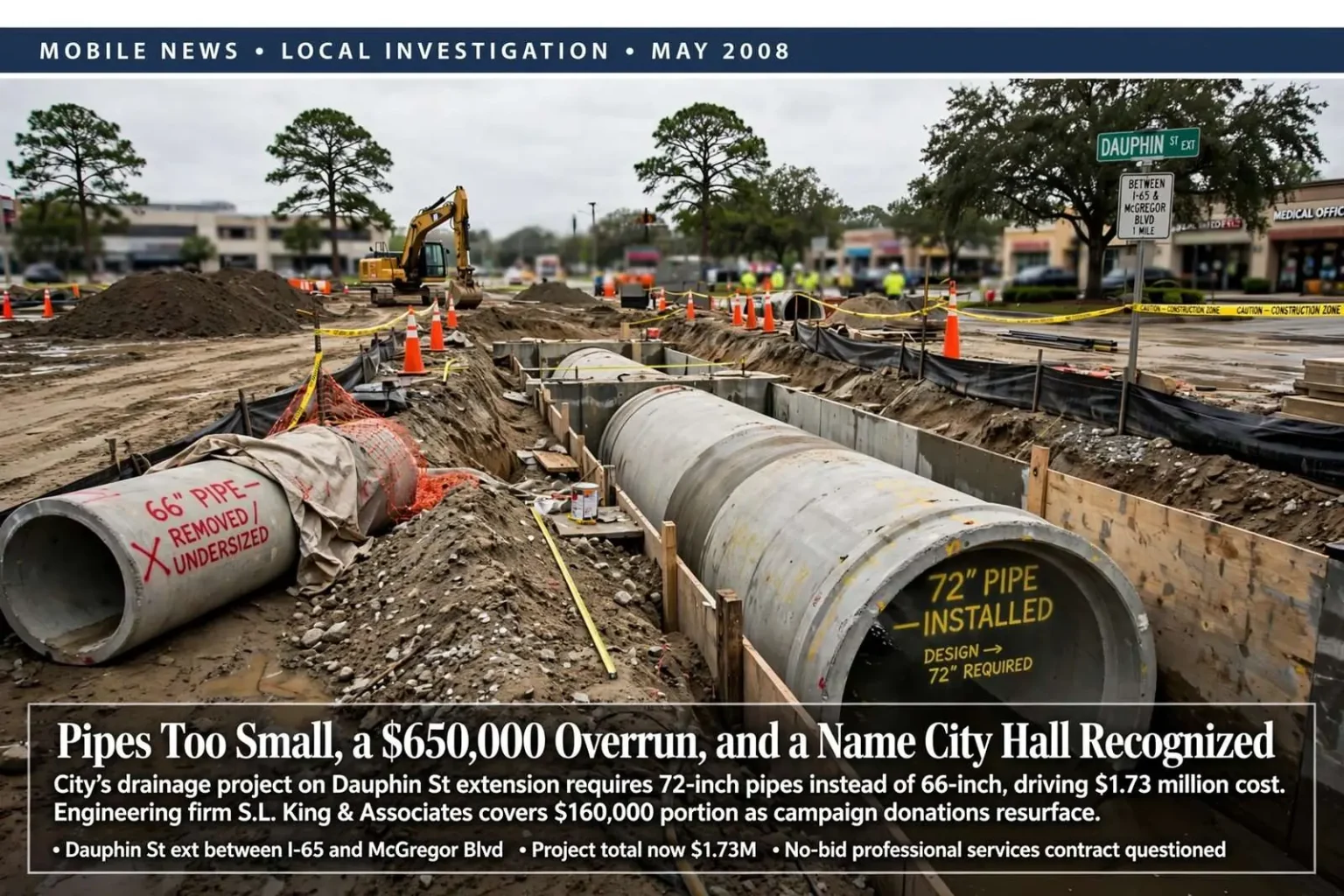
The city of Mobile set out to improve drainage along Dauphin Street extension, between Interstate 65 and McGregor Boulevard, and hired an Atlanta engineering firm to design it. The design called for 66-inch storm water pipes. What the job actually required, it turned out, was 72-inch pipes.
Six inches of diameter, in a project of that scale, is not a rounding error. The mistake pushed the cost of the work up by 650,000 dollars, to 1.73 million dollars. In practical terms, the design error meant that pipes already specified and ordered for a critical drainage corridor had to be upsized — new fabrication, new delivery, new installation costs — because the original calculations underestimated the volume of storm water the corridor would need to carry.
The firm was S. L. King & Associates. It may have been a first-time professional services contractor with the city, but in April 2008 it emerged that the name would have rung a bell at City Hall for reasons having nothing to do with storm water.
The Contributions
Stanley L. King of Atlanta had made a pair of 2,500-dollar contributions to Mayor Sam Jones’s 2005 campaign, the first on May 6, 2005 and the second on May 20, 2005. The two donations, five thousand dollars in all, arrived during the campaign that made Jones the mayor of Mobile. The design contract came later. Nothing in the record established a connection between the two, and the city did not suggest there was one.
Campaign finance records are public documents, and reporters and opposition researchers alike have long made a habit of cross-referencing them with vendor lists. The May 2005 donations fell in the closing stretch of the mayoral race, when contributions carry the most weight and attract the most scrutiny. Stanley L. King was not a Mobile resident or a longtime participant in the city’s political life; his name surfaced only because his firm later appeared in the city’s contracting paperwork — the pattern that always prompts the cross-check.
What made the story land was a structural fact about how cities buy expertise.
Why Professional Services Are Different
Under Alabama law, cities are not required to competitively bid professional services. Legal work, engineering, architecture, marketing and similar contracts can be awarded on the judgment of city officials rather than to the lowest responsible bidder.
The rationale is sensible enough. You do not want a city choosing its bridge engineer the way it chooses its office paper. Competitive bidding is designed for commodities — goods and routine services where specifications can be written precisely and price is the difference between bids. Engineering design is different in kind: the value lies in the judgment, experience and specialized knowledge of the designer, and a low-bid system that ignores qualifications can produce exactly the kind of failure this story describes — or worse ones involving public safety.
But the consequence is that a category of contracts, often substantial ones, is awarded through relationships, and relationships in municipal government are frequently the same relationships that produce campaign contributions. A firm seeking city work cannot lobby the purchasing clerk; it lobbies the administration. The decision-makers who select engineers are the same ones fundraising for their next campaign, and a contribution is the most direct way a professional services firm can put itself in front of them.
A veteran of many local and state campaigns put the matter to the point with a shrug: “The real surprise would have been if you checked the records and there were no contributions from King or anyone connected to the firm.”
That cynicism is itself a kind of civic data. It describes an environment in which the appearance of a donor’s name on a contract surprises nobody, which is precisely the condition that erodes public confidence whether or not any individual transaction was improper. Municipal ethics regimes — disclosure requirements, recusal policies, merit-based selection panels — exist to manage this exact problem, and their absence or weakness shows up in public cynicism long before it shows up in any indictment.
Who Paid for the Mistake
The King firm was reported to be paying about 160,000 dollars toward costs related to the error. City officials indicated that figure represented the expense over and above what the city would have paid had the project been designed correctly from the outset, meaning the city was not out of pocket for work it would have had to buy anyway, but was absorbing the cost of the larger pipes it had always needed.
The distinction mattered to officials explaining the overrun to taxpayers. A design error that forces a contractor to eat the entire cost of a corrected project is rare; the more common outcome is a negotiated share, in which the designer covers the incremental cost of its mistake while the city pays for the scope it ordered. In this case the 160,000-dollar figure represented the firm’s accountability for the delta between a correct design and the one delivered — not a total refund.
City officials said they remained confident in the expertise of the King firm and would consider using it again on future jobs. That vote of confidence, offered while the firm was paying to correct its own error, reflected a practical calculation: the mistake had been caught during construction, before any water ever flowed through the pipes, and the correction was being handled without litigation.
Why Drainage, and Why There
Storm water is not a peripheral concern in Mobile. The city is among the rainiest in the United States, receiving well over sixty inches a year, and its drainage infrastructure carries an unusually heavy burden. Undersized pipes in a corridor like Dauphin Street extension are not an abstraction; they are the difference between a heavy rain and standing water in a commercial district.
The Dauphin Street extension corridor between Interstate 65 and McGregor Boulevard is one of the main east-west arteries in west Mobile, lined with businesses, medical offices and shopping centers that depend on the road staying open and passable through the city’s violent thunderstorms. Mobile’s low elevation, flat topography and clay-heavy soils mean runoff moves slowly and drainage capacity is quickly overwhelmed; when pipes are too small, water ponds on travel lanes, floods parking lots and backs up into buildings. The corridor sits upstream of drainage channels that ultimately carry runoff toward Three Mile Creek and the Mobile River, so capacity problems compound at every pinch point downstream.
The difference between 66-inch and 72-inch pipes is more than the arithmetic of a 9 percent diameter increase. Pipe capacity rises with the cross-sectional area — the square of the radius — so six inches on a large pipe represents a meaningful jump in the volume a line can swallow during a cloudburst. Engineers sizing storm systems for a coastal city in a zone of extreme rainfall typically design for storms far larger than those seen in any given year, and a design that undershoots that standard leaves a corridor exposed for the fifty-year life of the pipe.
Which is why the six inches mattered, and why an error caught during construction rather than after a storm counted, in the end, as reasonably good luck. A undersized pipe discovered in a flood investigation is discovered the hard way — with water in storefronts and insurance claims on the counter. Catching the error while the trench was still open cost money but spared the city the far greater cost of ripping up a finished road.
The Lasting Question
The episode left behind the question that no-bid professional services contracts always leave behind, and that Mobile, like most American cities, has never fully answered: how do you buy specialized judgment without buying it from your friends?
The city’s position was that competence, not politics, drove the selection, and that the firm had made a costly mistake it was helping to pay for. The record showed that the firm’s principal had written two checks to the mayor’s campaign three years earlier. Both things were true at once, which is the ordinary condition of municipal contracting, and the reason people keep asking.
That tension defines the entire category of professional services procurement. Every city must hire engineers it trusts; the most defensible way to find them is a qualifications-based selection process, in which firms are scored on credentials and experience before price or politics enter. Alabama’s framework does not require such a process — it leaves the judgment to officials — and the difference between a disciplined system and an informal one is invisible to the public until something goes wrong.
When something does go wrong, the aftermath is always the same shape: an honest accounting of a technical error, a negotiated payment, and a city hall assuring everyone that the relationship was clean. In the Dauphin Street extension case, the pipes were enlarged, the firm paid its share, and the corridor drains as designed. The five thousand dollars in campaign contributions bought nothing provable — and cost the city nothing provable either. What it cost was the thing that is hardest to measure and easiest to lose: the benefit of the doubt.