Mobile Officials Say McGowin Park Is Built to Avoid the Struggles That Dogged Spanish Fort Town Center
A stronger retail mix, a central location near Interstates 65 and 10 and a rebounding economy will help McGowin Park avoid the troubles that hampered Spanish Fort Town Center, Mobile officials said.
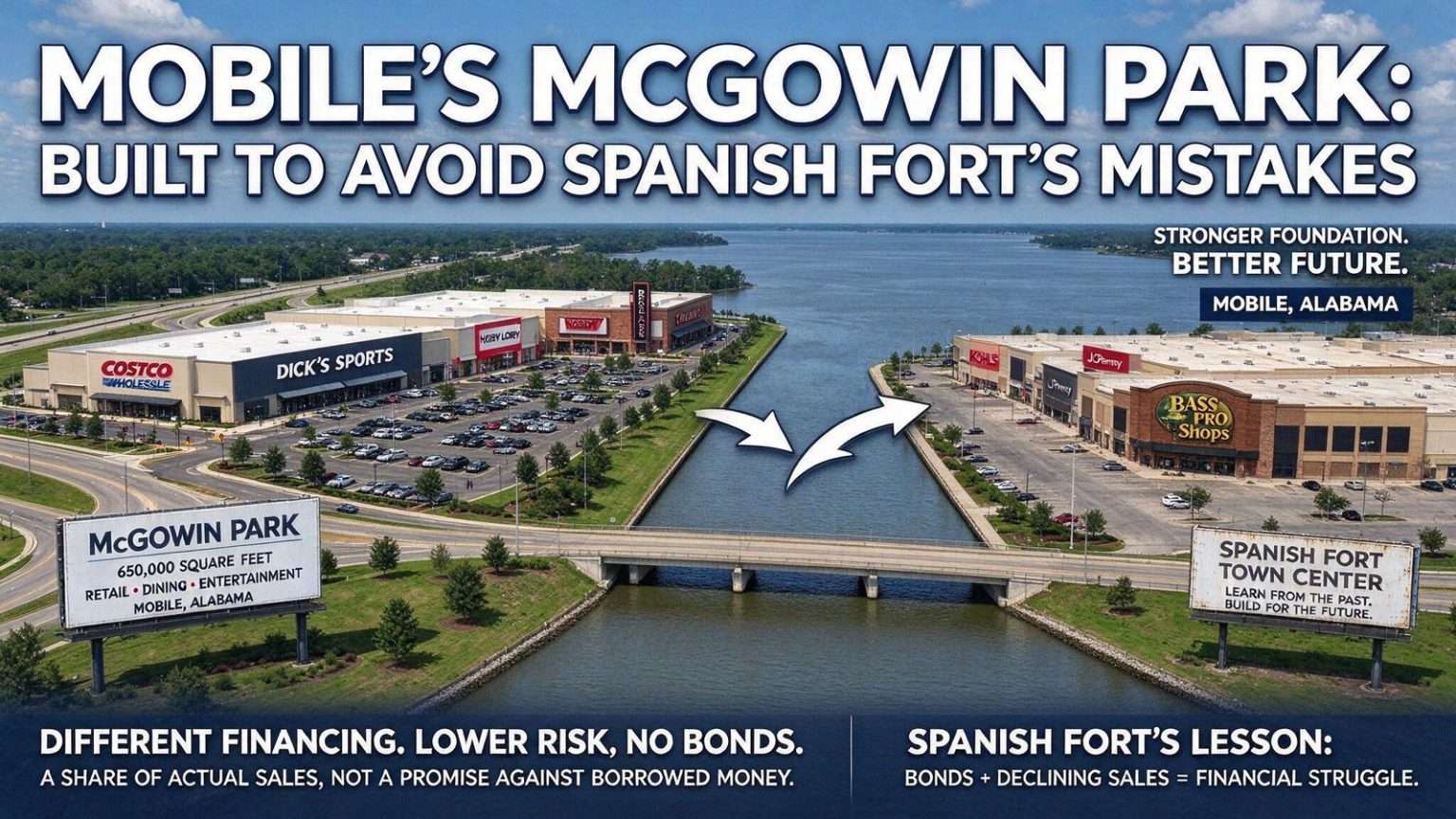
Standing at the site of a future 650,000-square-foot shopping center near Hank Aaron Stadium, Mobile officials argued that the McGowin Park development would not repeat the financial struggles that dogged the Spanish Fort Town Center across the bay. They pointed to a strong retail lineup, a location convenient to Interstates 65 and 10, and an economy on the mend.
“None of us have a crystal ball, but Spanish Fort Center was unfortunately completed before the economy really declined,” Mayor Sandy Stimpson said. “They kind of took it on the chin with the declining economy.”
The comparison was unavoidable. The Eastern Shore shopping center had been the region’s most visible retail gamble of the last decade, and its troubles — empty storefronts, bond payments it could not cover, a lawsuit between its developer and its lender — hung over every incentive deal in the two-county market. Mobile officials, preparing to commit public sales tax dollars of their own, spent as much time explaining how McGowin Park differed from the Spanish Fort project as they did describing what it would contain.
Different financing, different risk
Both projects relied on sales-tax incentives, but the structures differed in a crucial way. For McGowin Park, the city agreed to give 1.4 cents of its 5-cent sales tax on new sales generated within the center to developer The Hutton Co. for 20 years, and the county pledged three-tenths of a cent from its 1-cent tax.
The center was projected to generate about $200 million in annual sales, which would return roughly $1.4 million to the developers under the agreement. Critically, officials noted, there was no borrowing tied to the Mobile project. If the center sold less than projected, the developers would receive less, but the city and county would not be left holding debt — the incentive was a share of actual sales, not a promise against borrowed money.
That distinction was the heart of Mobile’s pitch. Sales-tax rebates rise and fall with the shopping center’s fortunes, which means the public’s exposure is capped at what the site actually produces. A bond issue, by contrast, must be paid in good years and bad, regardless of what happens to retail traffic.
A cautionary tale across the bay
Spanish Fort’s Town Center, by contrast, had been pushed forward through a quasi-governmental cooperative district with the power to borrow for infrastructure. That district borrowed $30.5 million in 2007, and when a 1.5 percent fee on sales fell far short, the development could not cover the roughly $2.6 million in annual debt service on its bonds.
The mechanics compounded the problem. The district’s entire repayment plan rested on a percentage of sales at the center itself, so every disappointing quarter of retail traffic translated directly into missed obligations. The borrowing that made the project possible in a boom became the fixed cost that nearly sank it in a bust.
Anchored by Bass Pro Shops and opened as the recession set in, the Spanish Fort complex never met early projections. Developer Cypress Equities had once forecast first-year sales near $200 million; instead, the center’s sales totaled $54.8 million between March 2010 and February 2011 — barely a quarter of the forecast. A lawsuit filed by Bank of America against Cypress was settled, clearing the way for renewed leasing.
Spanish Fort City Attorney David Conner said the center was positioned to recover, with Cypress “back on the development” and working to fill empty space alongside anchors Bass Pro, Kohl’s and JC Penney.
“It has had some tough times,” Conner said, citing Hurricanes Ivan and Katrina and the downturn. “As population continues to increase and tourism traffic increases, I think you’ll see that center take off in the next few years.”
Conner’s account was a fair summary of the Eastern Shore’s particular misfortunes. The center had been planned before two hurricanes scrambled the region’s economy and before the national financial crisis emptied retail pipelines nationwide. Spanish Fort itself continued to grow in population, and the shopping center sat on one of the busiest highway corridors in south Alabama. The question officials on both sides of the bay debated was whether the center’s problems were bad luck that recovery would cure, or bad structure that recovery could not fix.
Betting on Mobile’s advantages
Mobile officials declined to blame Spanish Fort’s cooperative arrangement, agreeing that outside forces set the project back. They argued McGowin Park held distinct advantages regardless.
County Commissioner Jerry Carl said Eastern Shore congestion frustrated shoppers.
“I have a hard time getting to that center,” he said. “It’s kind of stuck in a hole.”
He predicted summer traffic on I-10 would steer shoppers toward Mobile once the new center opened the following summer. The George Wallace Tunnel and the river bridges funnel Eastern Shore-bound traffic through some of the region’s worst chokepoints, and anyone who has sat in the seasonal backups on the Bayway knows the arithmetic: a shopping trip across the bay can cost an hour of driving on a summer weekend. A center at the junction of I-65 and Airport Boulevard, on the Mobile side, asks far less of the shopper’s patience.
The population argument
Councilman Fred Richardson said McGowin Park would draw from a larger population base.
“There are 33,000 people who live in District 1,” he said. “There is no city in Baldwin County with that many people.”
The comparison was blunt but effective: the council district surrounding the proposed center, by itself, held more residents than any single Baldwin County municipality. Add the neighborhoods of west Mobile, the growth corridors along Airport Boulevard and Schillinger Road, and the daily flow of commuters along I-65, and the catchment area around McGowin Park dwarfed the Eastern Shore’s shopper base — without requiring anyone to cross the bay first.
A deeper anchor mix
Officials also touted a deeper anchor mix, with plans to include Costco, Hobby Lobby, Dick’s Sporting Goods, Petco, Ashley Furniture, Regal Cinemas and the first Southeastern-based Field & Stream store. The lineup was deliberately broad: a warehouse club that draws weekly trips, big-box chains that pull from wide radiuses, a movie theater that fills parking lots at night, and specialty retailers with loyal followings. Developers count on that variety to keep a center busy in every season, and the McGowin Park roster was assembled with the Spanish Fort experience in mind.
When finished, McGowin Park would be larger than both the Town Center and the more successful Eastern Shore Centre, the lifestyle center up Highway 181 whose mix of restaurants and shops had made it the benchmark for retail success on the Eastern Shore.
“That should give everyone a high level of confidence,” one official said of the tax base the project was expected to produce.
What McGowin Park means for the region’s retail map
The site near Hank Aaron Stadium sits in a corridor Mobile has been cultivating for years — the stretch of I-65 between Airport Boulevard and Government Boulevard, where the city’s newest hotels, restaurants and medical offices have clustered. A 650,000-square-foot retail center at that location would push the city’s commercial gravity west and south, toward the growth that has steadily marched down Airport Boulevard and along the interstate.
For decades, Mobile’s retail story was one of leakage: residents driving to the Eastern Shore, to Florida, or to Louisiana for the kinds of stores the city lacked. Each new anchor at McGowin Park represents sales tax that stays in Mobile County — 1.4 cents of which, on the new sales the center generates, flows back to the developer for 20 years while the remaining 3.6 cents stays with the city. The structure only pays if the center sells, which is precisely the point city officials made when they contrasted it with the bond-financed district across the bay.
The Spanish Fort lesson, distilled
The Town Center’s troubles became a case study that municipal lawyers and economic developers across the region now cite. Its cooperative district did what such districts are designed to do — finance infrastructure ahead of development — but it tied repayment to a young center’s sales in a collapsing economy, with hurricanes fresh on the books and a national recession arriving just as the doors opened.
The aftermath included the settled Bank of America lawsuit, a restructured relationship between the district and the development, and years of leasing work to fill the space the original tenants left. Recovery, when it came, followed the path Conner described: population growth along the Highway 181 corridor, tourism traffic returning to the beaches, and a leasing lineup rebuilt around stable anchors.
Mobile officials drew their own conclusions. No borrowing. No debt service tied to the center’s performance. No quasi-governmental district obligated to pay bondholders out of a sales fee that depends on shopper traffic. The rebates to The Hutton Co. flow only when the center’s cash registers do — an arrangement that shifts the downside risk from taxpayers to the developer and its retail partners.
Confidence, with caveats
Nobody on either side of Mobile Bay claimed the future was guaranteed. Stimpson’s “crystal ball” line acknowledged that retail projections have humbled better-financed projects than this one. The Spanish Fort forecast of $200 million in first-year sales had been taken seriously when it was made; the center’s actual performance measured a quarter of it.
But the officials standing on the McGowin Park site argued the differences were structural, not just hopeful. The location sits at the meeting point of two interstates and inside the population center of the region’s largest county. The anchor lineup was chosen to generate trips that repeat weekly rather than annually. The financing leaves the city without debt even if the economy sours again. And the timing, they noted, comes with an economy on the mend rather than one in free fall.
For the shoppers of District 1 and west Mobile, the argument reduces to something simpler: within a year’s time, a center bigger than either Eastern Shore shopping destination, anchored by names they currently drive across the bay to reach, would open on their side of the water. Whether it performs like the Eastern Shore Centre or struggles like the Town Center will be written in the sales figures over the next 20 years — the same figures that will determine what the developers collect and what the city keeps.