Orange Beach Officers Planned a Highway Memorial for Cpl. Mike Stockwell, a Year After His Line-of-Duty Death
One year after Cpl. Mike Stockwell died in a wreck on the Foley Beach Express, Orange Beach officers prepared to dedicate a highway memorial sign near the crash site in September 2014.
Nearly a year after the line-of-duty death of Orange Beach police Cpl. Mike Stockwell, his family, friends and fellow officers prepared to gather in September 2014 for the dedication of a highway memorial sign along the Foley Beach Express. The ceremony would mark the close of a difficult year for a department that lost one of its own on a roadway he had traveled countless times, and for a coastal community that had watched the tributes accumulate since the crash.
Stockwell, 45, of Elberta, died on Sept. 17, 2013, after a sedan driven by a Foley woman collided with his unmarked police sport-utility vehicle. The crash happened at the expressway’s intersection with Baldwin County 12, a crossroads not far from the neighborhoods and commercial corridors of central Baldwin County. Emergency crews responded to the scene, but Stockwell’s injuries proved fatal, and word of the loss moved quickly through law enforcement agencies across Baldwin County and the Gulf Coast.
At the time of his death, Stockwell was working as an investigator with the Orange Beach Police Department, a post that took him throughout south Baldwin County as he built cases and followed leads. He had served the department for years and was remembered warmly by those who worked alongside him — a steady presence on complicated investigations, a mentor to younger officers and a colleague whose personality left a lasting impression on everyone who shared a shift with him.
His death also underscored the realities of police work in a fast-growing coastal county, where an expanding network of highways carries residents and tourists between Interstate 10 and the beach communities. The Foley Beach Express is a tolled four-lane route linking the interstate corridor with Orange Beach and the Fort Morgan peninsula, and it has become one of the region’s busiest links, particularly during summer months when vacation traffic swells Baldwin County’s roads. Intersections along the expressway have long drawn attention from local officials and public safety agencies because of the volume of vehicles passing through them each day.
For Stockwell’s family — including his daughters — and for the officers who worked beside him, the year after the crash brought a series of tributes, from county-level memorials to a trip to the nation’s capital. But the tribute that meant the most locally was still ahead: a permanent marker along the very highway where he died, approved unanimously by a neighboring city’s council and donated by the two men who knew him best.
A sign donated by fellow officers
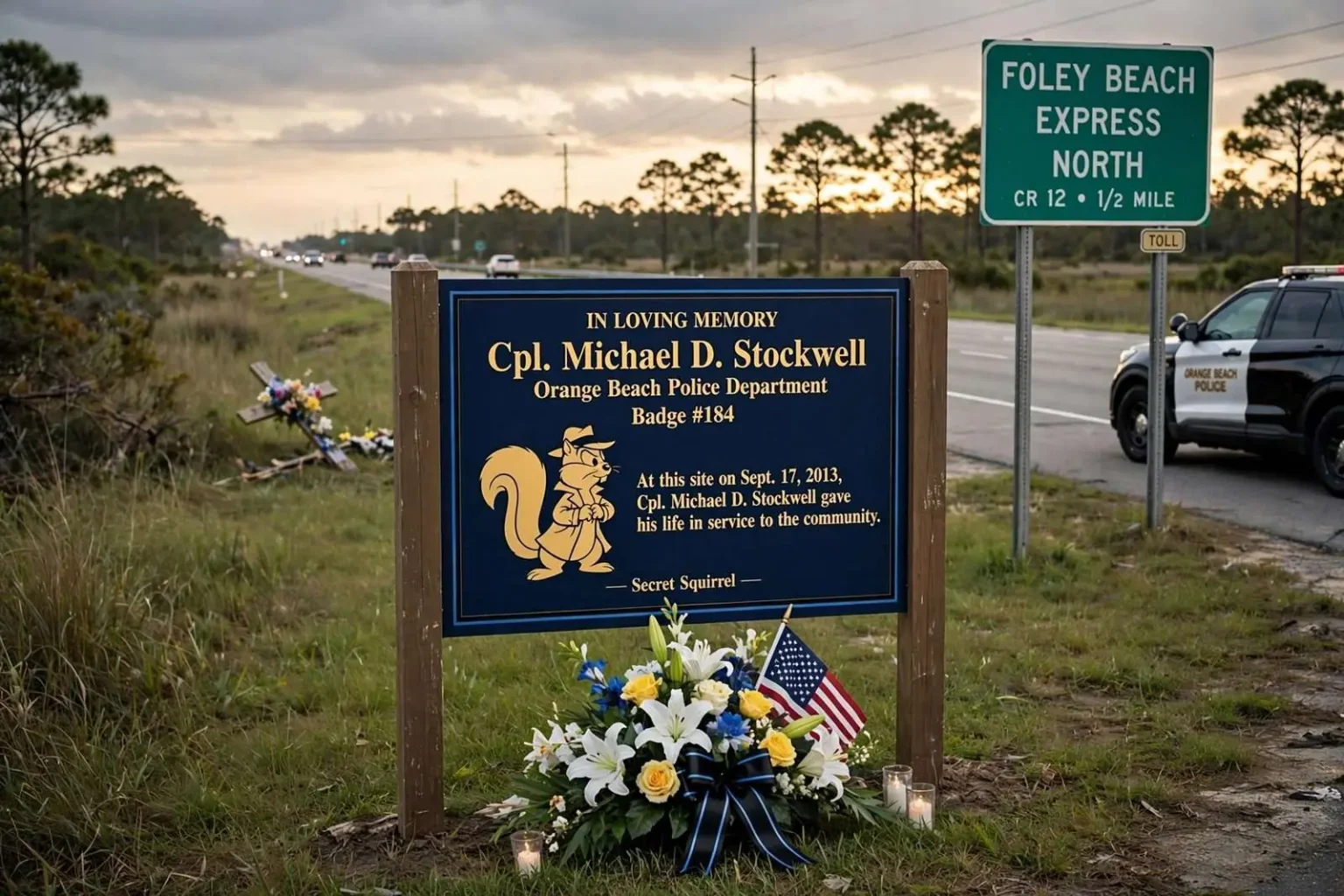
The 18-by-24-inch memorial sign was donated by Orange Beach police Lt. Clif Roberts and Cpl. Scott Beaman, the two officers who had been closest to Stockwell in his final months. It was to be placed off the northbound lanes of the expressway, north of County Road 12, near the spot where a cross already stood at the roadside. The location placed the marker within sight of the intersection where the crash occurred, allowing passing drivers a moment of reflection without distracting traffic on the highway itself.
Because the crash site fell within the Foley city limits, the sign required the approval of the Foley City Council, which unanimously approved its placement at the request of Foley Police Chief David Wilson. The request was a courtesy between neighboring departments, and the council’s action reflected the respect that law enforcement agencies in Baldwin County traditionally show for officers lost in the line of duty, regardless of municipal boundaries.
Roberts thanked the council for its consideration during a work session, appearing before the panel to explain the significance of the marker. “I was Mike’s supervisor at the time of his death and Scott was his partner,” Roberts said. “It’s been real tough for us over the last year. We’re looking for some closure and we think this will be a good way to get it.”
The words captured what many officers in the department had felt since the crash. Supervisors and partners often carry a particular weight after a line-of-duty death, and the men who worked most closely with Stockwell had spent the year balancing grief with the daily demands of police work in a busy beach community. The sign, in their view, offered a way to mark his service permanently, in a place where thousands of drivers would pass it every week.
Remembering ‘Secret Squirrel’
The sign was to read: “At this site on Sept. 17, 2013, Cpl. Michael D. Stockwell gave his life in service to the community.” It would also feature a silhouette of the cartoon character Secret Squirrel alongside Stockwell’s badge number — a nod to a nickname his colleagues clearly cherished.
“That was his saying, the Secret Squirrel,” Beaman recalled with a smile. The nickname spoke to the investigator’s style, and it became one of the details friends and co-workers repeated most often in the months after his death. In a profession where humor helps officers endure difficult work, the cartoon reference became a small emblem of the man behind the badge, and including it on the sign ensured that the marker remembered Stockwell as a person, not only as a casualty.
The choice to include the badge number followed a common tradition in law enforcement memorials, where fallen officers are honored with their shield as a symbol of the oath they took. Combined with the silhouette, the design gave the marker a personal character that standard highway signage rarely carries, and it signaled to anyone who stopped to read it that this was a colleague remembered with affection as much as respect.
Layers of remembrance
The highway sign was one of several tributes that had taken shape since Stockwell’s death. His name had been added to the fallen officer memorial at the Baldwin County Sheriff’s Office satellite station in Robertsdale, joining a roll of officers from across the county who had died serving their communities. The Robertsdale memorial had become a focal point for local law enforcement commemorations, and Stockwell’s name there meant that officers from every agency in the county would pass his memory in the course of their work.
Officers had also traveled to Washington, D.C., where his name was added to the National Law Enforcement Officers Memorial, the nation’s permanent registry of the more than 20,000 officers killed in the line of duty since the earliest days of American policing. The names on that memorial are read aloud each May during National Police Week, when thousands of survivors and fellow officers gather in the capital to honor the fallen.
“We’ve got some closure there and we took his daughters up there,” Roberts said. “The majority of guys couldn’t make it, so we’re trying to do something local.” For the family, the Washington trip offered a national recognition of Stockwell’s sacrifice, but Roberts and Beaman knew that most of the officers who had worked with him could not make the journey. A local marker, visible every day, filled that gap.
The local dedication was arranged to fall on the anniversary of the crash, giving the department and the family a single day of remembrance each year anchored to the date of his death. A special service in Stockwell’s memory was planned for 5:30 p.m. Sept. 17 at the Orange Beach Firing Range, a facility familiar to every officer in the department, followed by the memorial sign dedication at 6:30 p.m. at the site of the accident on the expressway.
Holding the first portion of the observance at the firing range allowed officers to gather away from traffic while still remaining close to the crash site, and the short drive between the two locations let the procession of police vehicles move together along the same stretch of highway where Stockwell had spent so much of his career. Family members, city officials and officers from neighboring agencies were expected at both stops.
A permanent reminder close to home
For the officers who had worked most closely with Stockwell, the roadside marker offered something the earlier tributes in Robertsdale and the nation’s capital could not: a permanent reminder, close to home and visible to everyday travelers, of a colleague who died serving the coastal community he patrolled. The Robertsdale memorial and the Washington wall honor the fallen on a countywide and national scale, but neither is passed daily by the people who knew him.
The sign also joined a broader tradition across Alabama and the Gulf Coast, where communities have marked the sites of line-of-duty deaths with roadside memorials that outlast the news cycle. For a growing beach city like Orange Beach, whose police force protects one of the most visited destinations on the Gulf Coast, the marker stands as a quiet statement about the cost of that work and the department’s commitment to remembering those who pay it.
A year after the crash, the grief within the department had not disappeared — Roberts said as much when he addressed the Foley council — but the dedication gave officers and family members a place to direct it. As travelers continue north and south along the Beach Express, the small sign near County Road 12 will carry Stockwell’s name, his badge number and a cartoon squirrel past everyone who makes the trip, keeping the memory of the investigator who died there part of the landscape he served.