Convicted Felon Draws 10-Year Federal Sentence Over Shotguns Tied to a Mobile Home Invasion
Larry Gene Broadnax, arrested after a 2013 Mobile County home invasion, was sentenced to 10 years in federal prison for possessing shotguns as a convicted felon, with state charges still pending.
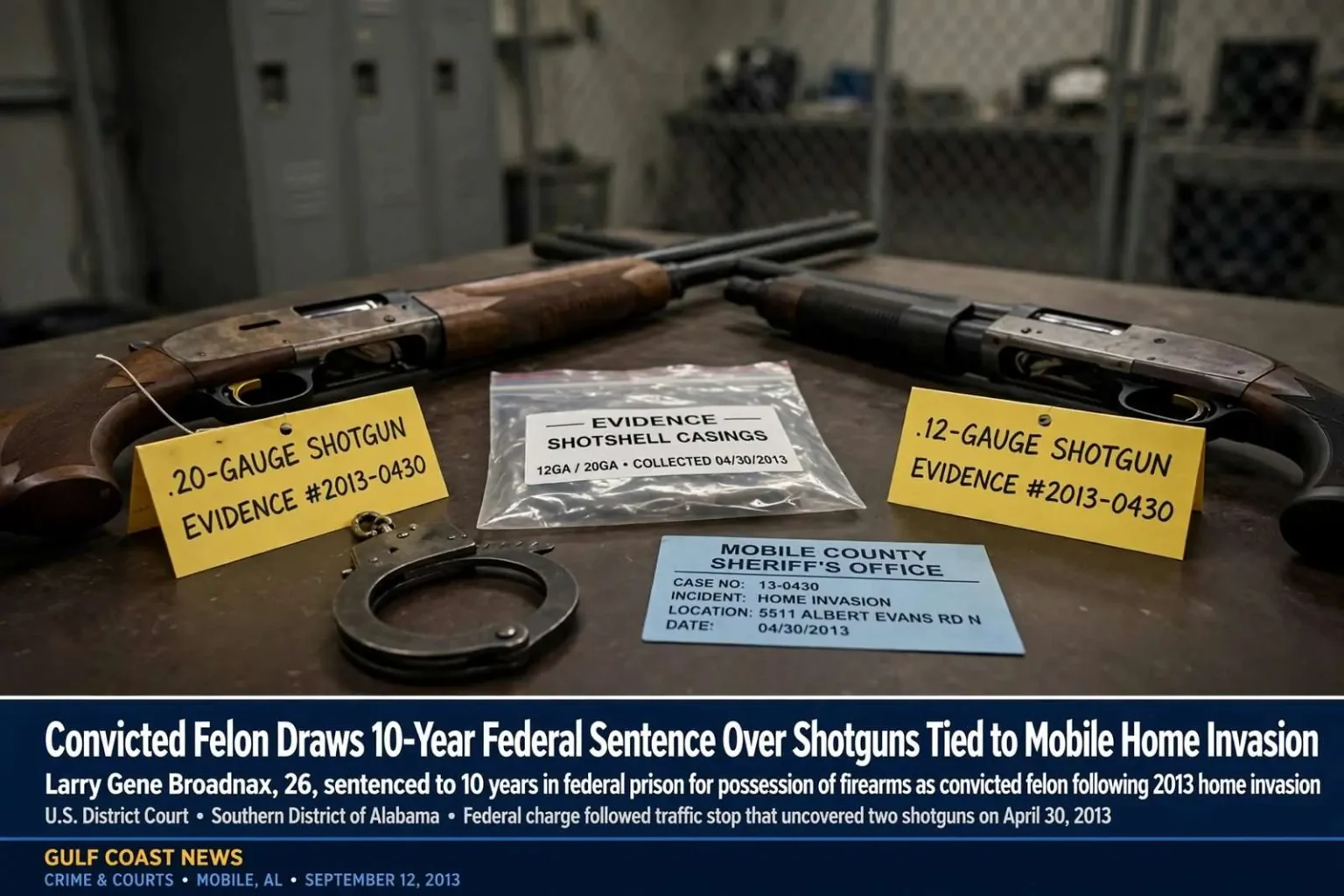
A Mobile man arrested after a 2013 home invasion has been sentenced to 10 years in federal prison for possessing shotguns that authorities say were used during the crime. Larry Gene Broadnax, 26, received the sentence after pleading guilty to being a convicted felon in possession of firearms. His 2010 convictions for first-degree robbery and unlawful distribution of a controlled substance barred him from legally having a gun.
The case illustrates how a single arrest can move through two court systems at once. The home invasion itself fell to Mobile County prosecutors, who handled it as a burglary and assault matter, while the presence of the shotguns put the man who carried them squarely within federal firearms law. That dual track is now a routine feature of weapons prosecutions along the Gulf Coast, where federal and local authorities coordinate to make sure the most serious available charge reaches each defendant.
The traffic stop and the weapons
According to court documents, Broadnax possessed a .20-gauge and a .12-gauge shotgun on April 30, 2013. Mobile County sheriff’s deputies arrested him and three others following a traffic stop during which the shotguns were found. The stop came shortly after reports of a violent intrusion in a residential area west of the city, and what deputies found in the vehicle converted a county investigation into a federal prosecution as well.
Broadnax, along with Jeffery Cook, 28, Demarion Shavers, 19, and Allen Walker, 25, were arrested and charged with first-degree burglary, second-degree assault and third-degree assault, according to earlier reports. Deputies said the four matched descriptions of men who had taken part in a home invasion just after midnight in the 5511 block of Albert Evans Road North, a quiet residential road in the unincorporated area served by the Mobile County Sheriff’s Office rather than city police.
The speed of the arrests reflected a straightforward piece of police work: a description broadcast within minutes of the crime, a vehicle stopped nearby, and weapons recovered before they could be moved or disposed of. In home-invasion cases, where suspects often scatter on foot or by car after the assault, the first hour is frequently decisive, and in this one deputies managed to place all four men in custody almost immediately.
An account of the invasion
The victim told investigators that someone knocked on his front door while another person was visiting. When he answered, he was confronted by three men armed with shotguns who then ransacked the home, police said. Two visitors who had stepped outside were assaulted by the suspects.
The tactic — a knock at the door late at night, followed by a forced entry at gunpoint — has appeared repeatedly in Gulf Coast home-invasion cases, precisely because it defeats the most common defenses a homeowner has. A resident who expects a visitor opens the door, and the armed men behind it are inside before anything can be barred. The shotgun, with its spread of fire and its unmistakable appearance, is the weapon of choice for such confrontations, chosen for intimidation as much as for any tactical advantage.
Federal court records state that one of the individuals involved, not Broadnax, also raped a woman inside the house during the invasion. The gravity of that account underscored why federal prosecutors pursued the firearms charge against a defendant already barred from possessing weapons. The sexual assault remained a matter for the state and county courts handling the burglary and assault charges, but it hung over every stage of the related proceedings as the most serious allegation to emerge from that night.
The distinction between the two prosecutions matters for how the cases were built. Federal prosecutors did not need to prove who pulled a trigger or who entered the house first; they needed only to establish that Broadnax, a convicted felon, possessed the shotguns. The bar is deliberately low because the statute is aimed at a simple proposition: a person with a felony record has forfeited the right to carry a firearm, and violating that rule is itself a serious crime regardless of what else happens.
Broadnax’s own record made the charge straightforward. His 2010 convictions for first-degree robbery and unlawful distribution of a controlled substance fell squarely within the federal definition that strips firearms rights, leaving no defense on the merits of possession. The guilty plea reflected that reality and moved the case directly to sentencing.
Terms of the sentence
Beyond the decade in federal prison, U.S. District Court Judge Ginny Granade ordered Broadnax to serve three years of supervised probation and to undergo substance abuse and mental health treatment. The judge also directed that, should Broadnax be convicted and sentenced in Mobile County Circuit Court, his federal sentence would run at the same time as any state term — a ruling that spared the defendant stacked punishment while ensuring he would serve a substantial sentence either way.
Granade, a veteran of the Southern District of Alabama’s federal bench, has handled many of the district’s major criminal dockets, and supervised-release conditions of the kind she imposed are standard in federal firearms cases. The treatment requirements acknowledge what sentencing courts across the country have recognized in similar prosecutions: defendants in their twenties with drug convictions behind them and violent offenses ahead of them rarely arrive at sentencing without underlying substance abuse and mental health issues that prison alone does not address.
At the time of the federal sentencing, the state charges against Broadnax remained under consideration for indictment by a Mobile County grand jury, leaving open the possibility of additional proceedings in county court. The same held true for his three co-defendants, whose burglary and assault charges were still moving through the county system.
Federal firearms charges as a tool
The case illustrated how federal firearms statutes are often used against defendants with prior felony convictions, allowing prosecutors to secure lengthy sentences even as related state charges work their way through local courts. Because federal law forbids convicted felons from possessing guns, the mere presence of the shotguns, independent of how they were used, was enough to support a substantial prison term.
Prosecutors in the Southern District of Alabama have leaned on the strategy for years, particularly in violent-crime cases where the state courts face crowded dockets and the federal system offers fixed, substantial sentences. The collaboration between the Mobile County Sheriff’s Office and the U.S. Attorney’s Office in cases like this one follows a familiar pattern: local deputies make the arrest and work the underlying crime, then refer the weapons possession for federal prosecution where the sentencing exposure is clearest.
For the victims of the Albert Evans Road home invasion, the federal sentence marked one measure of accountability while the broader state case continued to develop. Investigators had described a violent late-night intrusion, and the outcome in federal court ensured that at least one of the men taken into custody after the traffic stop would spend years behind bars regardless of how the state charges ultimately resolved.
The sentence also carried a message aimed beyond the courtroom. A 10-year term for possession alone — before any count of burglary or assault is counted — puts would-be offenders on notice that carrying a gun with a felony record is not a secondary risk but the primary one. In communities across Mobile County where home invasions and armed robberies have driven fear in recent years, that arithmetic is the central argument federal prosecutors make for keeping such cases on their docket.
What remains unresolved is the fullest accounting of the night itself. The rape, the assaults on the two visitors and the ransacking of the home are matters for the state courts, where the three co-defendants and Broadnax still face the burglary and assault charges. Until those cases conclude, the 10-year federal sentence stands as the first, not the final, consequence of the events on Albert Evans Road North — a decade in prison for the guns, with the rest of the reckoning still to come.
The 10-year term sits near the statutory ceiling for a felon-in-possession conviction, which under federal sentencing law can reach ten years for a defendant with a record like Broadnax’s. That ceiling, once an abstraction, becomes the practical outcome in cases where the possession is tied to a violent event. Defense attorneys in such cases typically argue for sentences at the lower end of the guideline range, pointing to guilty pleas and to the distinction between possessing a weapon and using it; prosecutors counter that the connection to a home invasion places the defendant in the category the law was written for.
Broadnax will serve his term in the federal Bureau of Prisons system, and the three years of supervised release that follow will be enforced by federal probation officers in the Southern District of Alabama. If he completes the treatment conditions and stays clear of further charges, the supervised release can end as scheduled; if not, the same courthouse that sentenced him can return him to custody without a new trial. It is a structure designed to keep the accountability running long after the prison term ends.