Car Dealers’ Cash Lifts Democrat in Mobile County School Board Race Turning on Dodge’s Future
A $5,000 contribution from the local car dealers' PAC boosted Democrat Andrew Davis days before the 2006 election, in a Mobile County school board race shadowed by Superintendent Harold Dodge's contract.
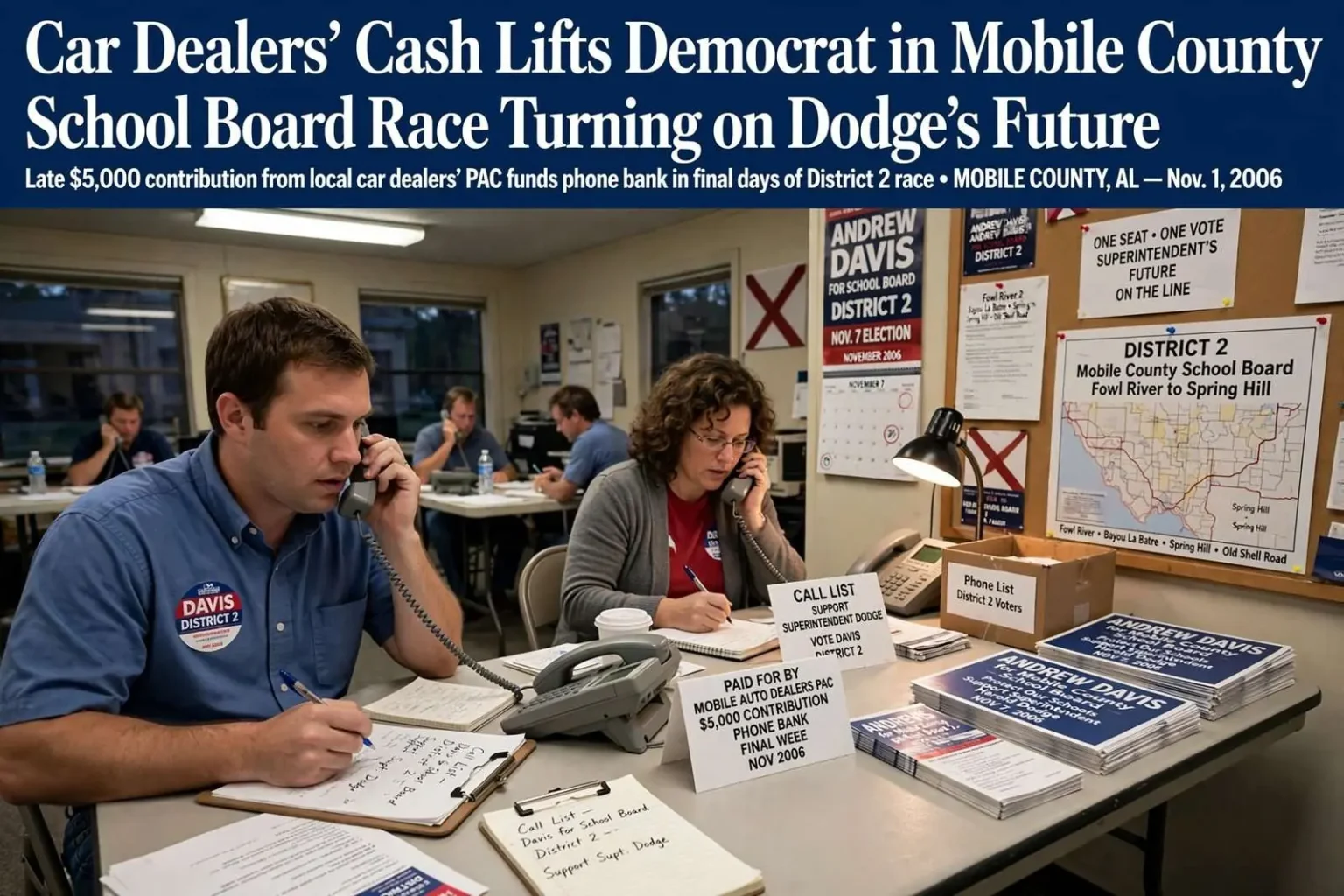
A late infusion of cash boosted the prospects of Democratic school board nominee Andrew Davis in the closing days of the 2006 general election campaign, in a Mobile County race that had quietly become a referendum on the future of Superintendent Harold Dodge. Davis reportedly received a $5,000 contribution from the local car dealers’ political action committee in the final stretch. The money was expected to fund a phone bank in the campaign’s last days, an expensive tool that a challenger without institutional backing could rarely afford.
A phone bank in the final stretch of a local race is a blunt but effective instrument, placing hundreds of reminders in front of likely voters during the only week when many of them are actually paying attention. For a candidate running without a party machine behind him, the contribution represented the difference between ending a campaign quietly and ending it with a message still ringing. School board races rarely draw the funding that legislative or countywide contests attract, which is why a single five-figure-adjacent donation from an industry PAC stood out in the campaign’s closing accounting.
The car dealers’ interest in a school board contest was not hard to explain. The automobile business is among Mobile’s oldest commercial staples, and dealership owners have long been active in the civic and political life of the county, supporting causes and candidates across the spectrum. A contribution to a school board nominee fit a pattern of local business money flowing into races that shape the county’s public institutions.
The district and the message
District 2 of the Mobile County school board covered a long and varied swath of territory, stretching from Fowl River in south Mobile County up to Old Shell Road in Spring Hill. It took in fishing communities, suburban subdivisions and some of the city’s most established neighborhoods. Few districts in the county blended so many Alabamas into one electorate, from the crabbers and boat ramps along the bayou roads at the county’s southern edge to the leafy streets near the old Spring Hill College neighborhood at its northern end.
The message the phone bank was expected to carry was straightforward: Davis supported Superintendent Dodge, and the incumbent did not, or at least would not say that she did. In a campaign with limited money and limited time, that single contrast became the entire argument. Voters who answered their phones in the race’s final days were being asked to think less about the candidates and more about the administrator whose contract the next board would decide.
The Dodge question
Incumbent school board member Judy Stout had taken an officially non-committal position on whether Dodge’s contract should be renewed, but observers read her posture as clearly skeptical. Her previous actions and statements, and perhaps more tellingly the things she declined to say, suggested a lack of enthusiasm for the superintendent. Whether to renew Dodge had become the central, if largely unspoken, issue of the District 2 contest.
Stout had consistently side-stepped the question, a maneuver that critics found evasive and supporters regarded as appropriate restraint from a board member who would eventually have to cast an actual vote. There was substance to both readings. A sitting board member discussing a sitting superintendent’s contract during her own re-election campaign risks turning a personnel decision into a campaign promise, and boards that negotiate contracts through the press rarely end up with the leverage they want. The same restraint, however, left voters without a clear answer to the question the race had come to be about.
Superintendent contracts are among the most consequential decisions a school board makes. In a system the size of Mobile County’s, one of the largest in Alabama, the superintendent sets the tone for tens of thousands of students, thousands of employees and a budget in the hundreds of millions of dollars. Constituencies form around the officeholder quickly, and campaigns for board seats become proxy battles over whether the person in that office stays or goes.
The Mobile County Public School System’s sheer scale amplifies every board decision. With campuses scattered across a county larger than some states, from Citronelle in the north to Dauphin Island at the southern tip, the system is among the largest employers in the region, and its construction projects, bus routes and hiring decisions ripple through local economies. A superintendent who can hold the system’s sprawling constituencies together is a rare commodity, and a superintendent who cannot can dominate a board race without ever appearing on the ballot.
The arithmetic working against Davis
Endorsements and phone banks are prized in any political campaign, but in District 2 they had to overcome a structural obstacle that money alone rarely solves. Stout was running as the Republican nominee and the incumbent in a district estimated to be roughly 70 percent Republican. In a state where straight-ticket voting was common and party identification was hardening, those two facts together represented a formidable barrier. A well-funded phone bank could move a few points. It could not easily move twenty.
The party math in Alabama had been shifting for years by the time the 2006 election arrived. Straight-ticket voting, in which a voter marks a single box to support every nominee of one party, rewarded down-ballot Republicans in districts where the party already led, and school board races sat at the bottom of the ballot where straight-ticket effect was strongest. A Democratic nominee in a district drawn so heavily toward the GOP needed either an unusual candidate or an unusual issue to overcome the default, and even then the ceiling was low.
Even so, the assessment among those watching the race was that Davis was playing the best card in his hand. With limited time and limited resources, a targeted appeal on the one issue where the candidates visibly differed was a rational strategy, and the car dealers’ contribution gave him the means to deliver it. Campaign consultants often note that a challenger’s job is to make the race about something, and Davis’s phone bank aimed to make it about Dodge — the one subject on which the incumbent’s silence itself became the story.
Money on the record
Campaign finance reports for the two candidates were filed on different days as the race closed. Stout’s report was filed Oct. 29, and Davis’s was recorded Nov. 1. The final pre-election reports were not due until Thursday, Nov. 2, meaning voters would get one last look at the money before going to the polls the following Tuesday.
The timing was typical. Alabama’s campaign finance disclosure rules in that era gave the public only a narrow window between the last filing deadline and Election Day, and late contributions of exactly the sort Davis received often surfaced with little time for opponents to respond. Under the rules as they stood in 2006, a contribution arriving in a campaign’s final week could be spent on mail and phones before any report told the public where it came from, and the disclosure would land after the votes were largely cast.
Reformers had long criticized that schedule, arguing that disclosure delayed was disclosure denied, since the point of finance reporting is to inform voters rather than to archive receipts. Defenders of the existing system countered that frequent filings in a campaign’s final days would burden small campaigns without changing outcomes. The debate would continue in Alabama long after this particular race ended, but in 2006 the late-report window remained a standard feature of the state’s campaigns, and candidates in close races planned their final spending around it.
What was really at stake
For voters in Spring Hill and along Fowl River, the ballot said school board. But the substance of the choice was about who would run the school system and in what direction. A race that on its face concerned one seat on a five-member board was, in practice, a vote on a superintendent’s tenure, and both campaigns understood that perfectly well even as one of them declined to say so out loud.
That is how school board politics often works in large county systems. The board’s five members each answer to a district, but the decisions they make together — budgets, construction, and above all the superintendent’s contract — belong to the whole county. A single seat can be the deciding vote on an administration, which is why superintendents’ allies and adversaries alike watch individual board races with the intensity usually reserved for countywide office. In District 2 in 2006, the voters were choosing a board member, but the phone calls landing in their kitchens that final week were really asking about the man in the superintendent’s office.
The geography of the district itself shaped how a phone campaign had to be run. Voters in Fowl River and the southern bayou communities had different daily concerns from voters in Spring Hill, and a list of phone numbers assembled for the final stretch had to speak usefully to both. School board districts in Mobile County were drawn to be geographically sprawling precisely so that each board member answered to a cross-section of the county, and that design forced candidates to build coalitions across communities that shared a school system but little else in daily life.
The car dealers’ committee was one of several organized interests that historically took an active hand in Mobile County political life. Local political action committees built around industries, professions and neighborhoods tracked school board races closely, because board decisions on construction, vocational programs and school siting carried real economic consequences for their members. A five-thousand-dollar contribution to a school board nominee was, by the standards of the era’s local races, a meaningful but not extraordinary commitment — enough to fund a real tool like a phone bank, not enough to purchase a campaign on its own.