A Web Address Prank Turns Sour in Mobile’s Mayoral Campaign
In March 2005 a web address bearing Ann Bedsole's name redirected to an anonymous political gadfly site, and Bess Rich's cell number appeared in the registration. Both denied any part in it.
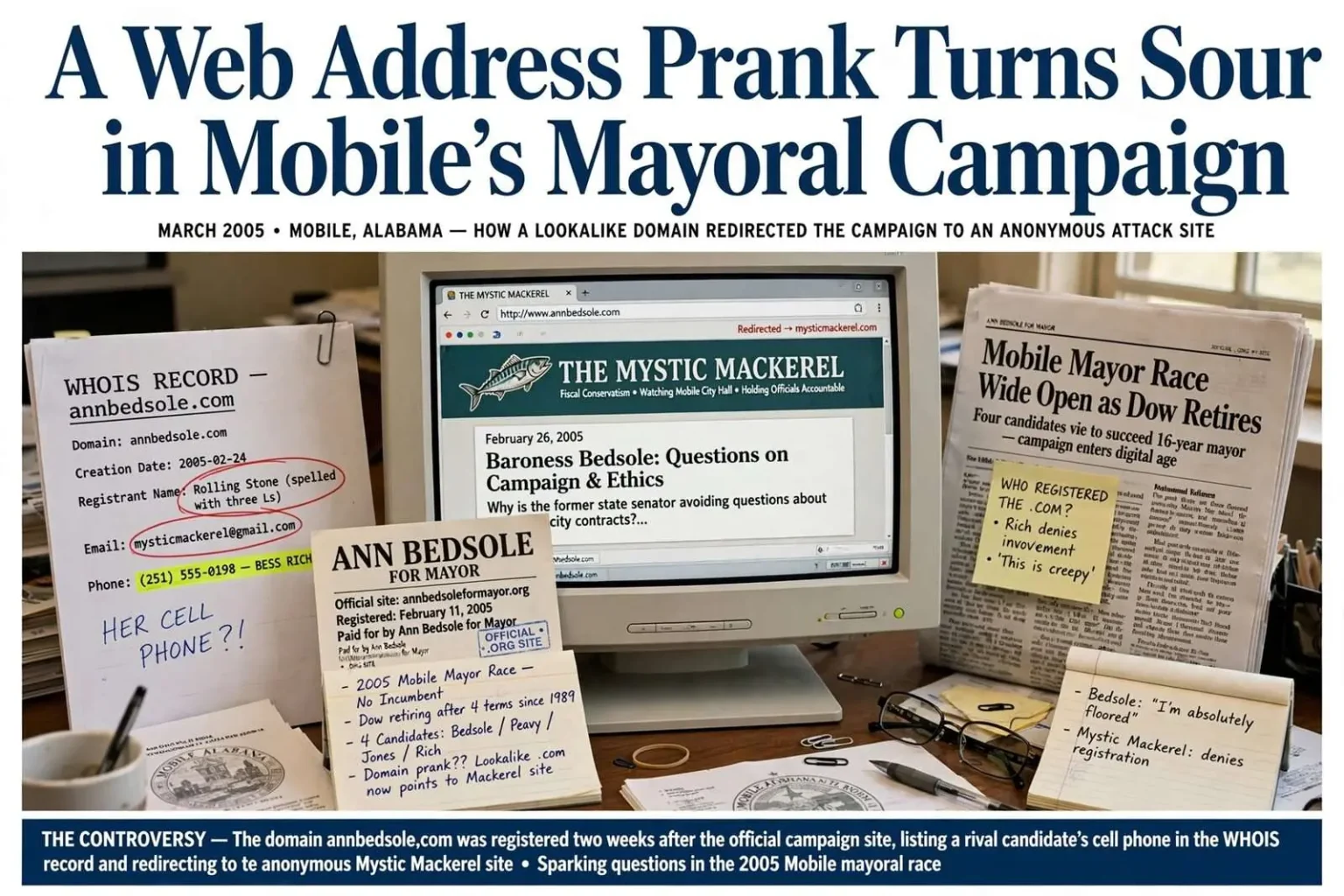
In March 2005, an internet user who typed the domain annbedsole.com into a web browser did not find the campaign of the former state senator then seeking to become mayor of Mobile. Instead, the browser landed on the Mystic Mackerel, an anonymously produced local website devoted to promoting fiscal conservatism in city government and to needling public officials over what it saw as ethical lapses and hypocrisy at City Hall.
The redirect surfaced in the middle of an unusually crowded municipal campaign. Mayor Mike Dow had declined to seek a fifth term, and the field to succeed him included former state Sen. Ann Bedsole, District 7 City Councilman John Peavy, Mobile County Commissioner Sam Jones and former City Councilwoman Bess Rich.
The 2005 race was the widest-open Mobile mayoral contest in a generation. Dow had held the office since 1989 and, after four terms, chose not to run again, leaving a field of four prominent candidates with long records in city and county government — and no incumbent to beat. In a city where elections had historically been settled by face-to-face politics, downtown club meetings and church networks, the appearance of an anonymous website with a taste for opposition research was itself a novelty.
The registration details
Bedsole’s official campaign site, annbedsoleformayor.org, had been registered on Feb. 11. The lookalike domain, annbedsole.com, was registered on Feb. 24 — two weeks later.
Domain registrations require a name and contact information, though registrants can obscure their identity. In this case the name on the record was given as “Rollling Stone,” misspelled with three L’s. The listed address pointed to a large office complex off University Boulevard.
The contact email was a Gmail address using the Mystic Mackerel name. And the contact telephone number was Bess Rich’s cell phone.
That last detail turned a piece of digital mischief into a campaign controversy. A lookalike domain that redirects a candidate’s name to an anonymous attack site is an old trick of online politics; a lookalike domain whose registration record carries a rival candidate’s personal cell number is something else entirely, and it made the question of who registered the domain — and who knew about it — the story of the week.
Rich: ‘This is creepy’
Rich denied any involvement, emphatically and repeatedly. “I know nothing about it,” she said. “I don’t have those computer skills. Someone else is doing this. Who is the Mystic? This is creepy.”
She noted that her cell number circulated widely — it appeared on her business cards, and she held a seat on the Board of Commissioners of the Mobile Area Water and Sewer System in addition to two council terms and a prior mayoral run. “I can’t say my number’s not out there,” she said.
Her public record made the point plausible. A former councilwoman who had run for mayor before, a commissioner of the region’s largest utility, and a fixture of Mobile’s fiscal-conservative politics, Rich met hundreds of people a month, and her cell number followed her onto cards, flyers and correspondence. The rest of the registration record cut the other way, though: the misspelled “Rollling Stone” name, the University Boulevard office complex, and the Mackerel-branded email address all pointed away from her, leaving the phone number as the single thread that tied the record to her name.
The Mackerel disclaims it too
The Mystic Mackerel, which had operated behind a proxy registration service since July 2004 and whose contributors wrote under names such as Mack, Teddy and Mackenzie, also denied a role. “This is news to us,” Mackenzie wrote in reply to an emailed request for comment. “We were not aware of the Bedsole site.”
The site’s own record complicated matters. It had been openly admiring of Rich, describing her as the genuine article among fiscal conservatives and cheering her formal filing the day before. It had been considerably rougher on Dow, on Peavy for what it called shifting positions, and on Bedsole, whom it needled with the nickname “Baroness.” In an entry that February the site had also questioned why so many prospective candidates were conditioning their entry on Dow’s plans, arguing that Mobile deserved a campaign about the city’s future rather than about one man’s intentions.
That record made the Mackerel’s disclaimer harder to weigh. The site had a clear editorial preference in the race, and whoever registered annbedsole.com had pointed Bedsole’s name at that site rather than at any neutral destination. The combination — a lookalike domain, an anonymous site with known favorites, and a registration record laced with contradictions — gave the campaign a mystery it did not need, weeks before qualifying ended.
Domain experts noted the practical mechanics that made such pranks easy. A .com registration costs a few dollars, requires only an online form, and can be completed in minutes by anyone with a credit card. WHOIS records, the public registry of domain ownership, are searchable by anyone, which is how the campaign discovered the registration details in the first place — and why the phone number, once found, could not be un-found.
Bedsole: ‘I’m absolutely floored’
Bedsole’s reaction, as she absorbed the details, was blunt: “I’m absolutely floored.” A former state senator with decades in Alabama politics, she had built her career in an environment where political attacks arrived in newspapers and in person, not through anonymous websites and redirected domain names. Her campaign treated the registration record as evidence rather than curiosity, and the discovery that a rival’s cell number sat inside it ensured the story would not die as a technical footnote.
The candidates’ camps handled the fallout differently. Bedsole’s team pressed the attribution question in conversations with reporters; Rich’s repeated her denials and pointed to how public her number was; and the Peavy and Jones organizations, with no stake in the registration record, watched a rival-vs.-rival controversy absorb attention that would otherwise have gone to the city’s finances and the mayor’s race itself.
In 2005, in a city where political scores were still mostly settled face to face, it landed as something genuinely unsettling. Bedsole and her campaign could not sue an anonymous registrant into disclosure, could not demand a correction from a site with no masthead, and could not trace a Gmail address without legal process. The lookup record was the only evidence, and it pointed simultaneously at her rival’s phone number and at the site her rival publicly praised.
What the episode revealed
The prank exposed how unprotected a candidate’s online identity was in 2005. Campaigns then registered their official domains almost as afterthoughts — a .org here, a committee site there — while every adjacent variant of the candidate’s name (.com, .net, misspellings, hyphenations) remained open for anyone to claim. Political operatives who understood the internet had, for years, harvested such lookalike domains around candidates in larger races; Mobile’s municipal field was simply the first local campaign to discover that the same trick worked on them.
The practical lesson spread quickly among the campaigns: register every variant of your name, your committee’s name, and the obvious misspellings before someone else does. By the next municipal cycle, Mobile campaigns were registering defensive domains as a matter of routine, and the annbedsole.com affair became the cautionary tale local consultants told when explaining why the budget had a line item for “digital assets.”
The anonymity question cut deeper. The Mystic Mackerel had operated since mid-2004 behind proxy services that legally shielded its operators’ identities, a practice then spreading across political websites nationwide. Anonymous criticism of public officials is a tradition as old as pamphlets, but the domain registration gave the Mackerel affair something a pamphlet never had: a public paper trail that could be searched, misread, and weaponized. Whoever registered the lookalike domain had created, deliberately or not, an attribution problem that attached to the site, to Rich, and to the race itself.
How the race unfolded
The campaign continued past the prank, and the field stayed crowded into the summer. Mobile’s municipal elections that year drew one of the heaviest turnouts in recent city history, and the contest ended with Sam Jones, the Mobile County commissioner, defeating the field to succeed Mike Dow as mayor — a result that ended the four-candidate drama and, eventually, the lifetime of the controversy that had briefly dominated the spring.
Bedsole’s campaign ended with the race, and the lookalike domain drifted back to whatever its registrant intended for it. Rich continued on the council and the water board, her denial never tested by any attribution stronger than a phone number on a registration form. The Mackerel kept publishing under its pen names, and its record of praising Rich while needling Bedsole remained part of the circumstantial case — never proven, never disproven.
What survived was the lesson. Mobile’s 2005 mayoral race is remembered for its field of heavyweights and its historic outcome, but the spring’s strangest week belonged to a web address: two weeks between a .org and a .com, a misspelled Rolling Stone, a Gmail account named for a fish, and a cell phone number that turned a small digital prank into the most-discussed mystery of the campaign.