Behind the Scenes: The Volunteers Who Made Mobile’s Distinguished Young Women Finals Run
Nearly 100 local volunteers kept the Distinguished Young Women national finals running smoothly in Mobile in 2014.
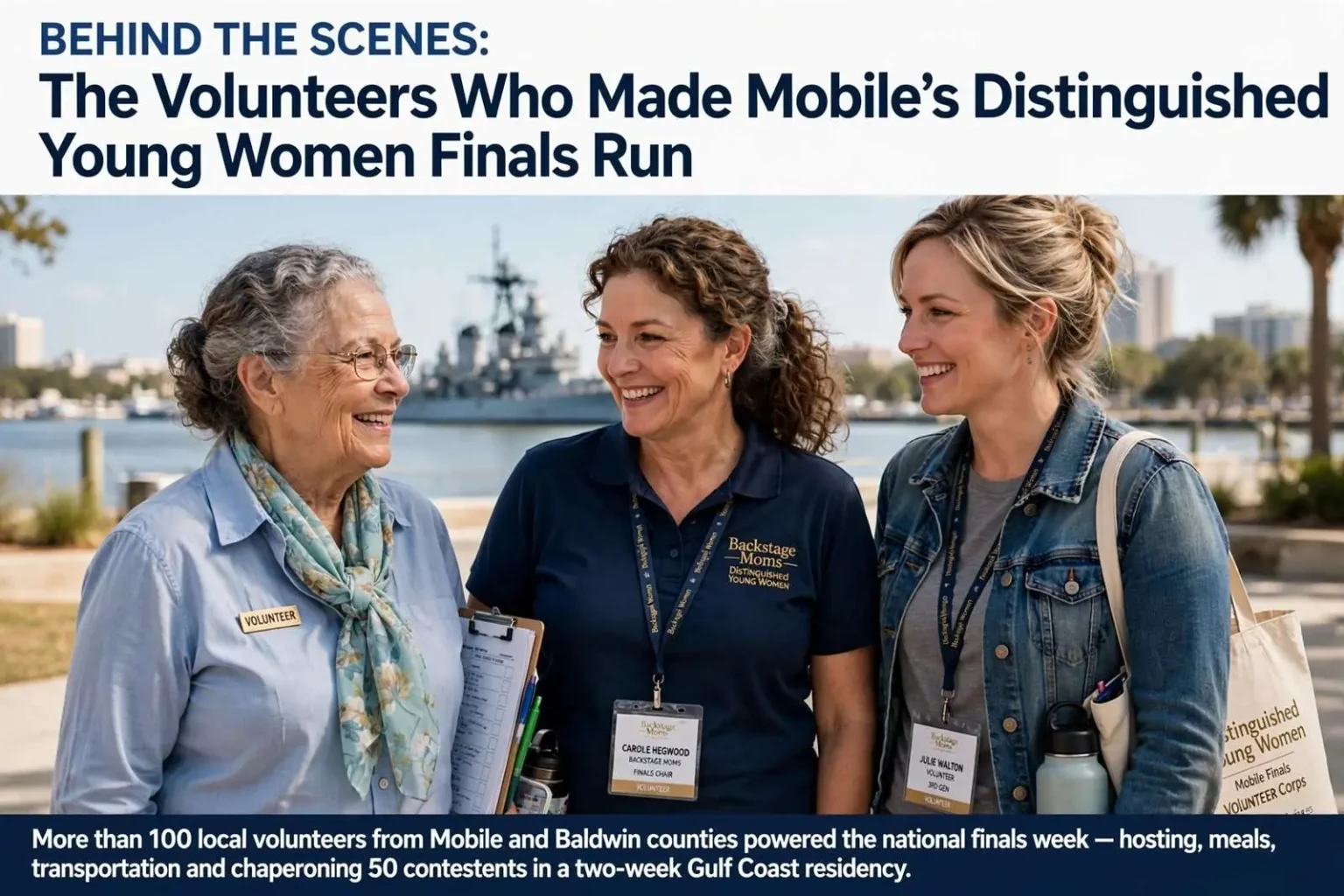
Bringing the Distinguished Young Women national finals to Mobile each year took a small army of local volunteers, even though the national scholarship and recognition program relies on close to 17,000 volunteers nationwide throughout the year. During the intense national finals week held in Mobile, more than 100 of those volunteers, most from Mobile and Baldwin counties, stepped in to keep the event running. The week is the culmination of a program that begins with local programs in towns across the country, and the hometown hosting effort is what turns a competition into a two-week residency for the young women who reach it.
Cassidy Grimes, who served as the national finals chair for the program, said the local volunteer effort covered everything from housing participants with host families to preparing meals, providing transportation, and chaperoning. The logistics load is larger than most visitors ever see: fifty contestants mean fifty host family placements, daily meal planning, a moving schedule of buses and carpools, and chaperone coverage from morning call time to lights out. Grimes’ job as chair was to keep all of it synchronized with the production schedule of the finals themselves, where rehearsals, judging and performances leave little slack in the calendar.
Organizers built out a full schedule of activities for the visiting contestants, including stops at Dauphin Island, the USS Alabama battleship memorial, and Bellingrath Gardens, giving young women from across the country a taste of the Gulf Coast during their stay. The itinerary reads as a tour of the region’s signature attractions — a barrier island beach town, the WWII battleship moored in Mobile Bay, and the celebrated gardens south of the city — and it serves the program’s dual purpose: memorable experiences for the contestants, and ambassadors for Mobile when they go home and talk about the week they spent on the Gulf Coast.
A Packed Week of Logistics
Housing is the piece that shapes everything else. Host families in Mobile and Baldwin counties open their homes to contestants for the length of the competition, and the placements determine carpool routes, meal schedules and the daily rhythm of finals week. For the host families, the week means adjusting households around a guest’s rehearsal calls and event times; for the contestants, it means living with local families rather than in hotels — a structure the program has long preferred because it builds the personal connections that keep families returning to Mobile in later years.
Transportation runs through the middle of the schedule. Moving more than fifty contestants between host homes, rehearsal venues, meals and the finals stage requires coordinated volunteer drivers and chartered buses, and the schedule of activities — Dauphin Island one day, the battleship and gardens on others — has to thread between rehearsal commitments without costing anyone a call time. The chaperones ride along on all of it, keeping roll calls and managing the small emergencies — a lost shoe, a missed meal — that a fifty-person traveling company generates daily.
The meal operation alone is a logistical undertaking. Feeding a traveling company of contestants, staff and volunteers across two weeks means coordinating church halls, community groups and volunteer kitchens across the two-county area, often with dietary needs in the mix. Local organizations that host meals treat the week as one of their annual service projects, and the meals double as gatherings where contestants meet the Mobile families behind the program.
The Backstage Moms
Among the volunteers was Carole Hegwood, known to participants as the head of the Backstage Moms, a group of contestant chaperones who stayed with the girls throughout their time in Mobile to make sure schedules and logistics stayed on track. The Backstage Moms work the backstage side of the production — lining contestants up, keeping them fed and on time, and handling the tears and jitters that a national stage produces — a role that puts them among the few adults who see the whole week from both sides of the curtain.
Hegwood said she valued the scholarship opportunities the program provided contestants regardless of whether they advanced to state or national competition, and had been involved with the organization since 1991 after being encouraged to help with event photography by a college sorority advisor. What began as a camera assignment grew into decades of service, and it reflects how the program’s volunteer base renews itself — one invitation, passed from a sorority advisor to a college student, outlasting entire generations of contestants. The scholarships she cited are the program’s core product: tuition awards distributed at local, state and national levels, available to participants at every stage, not only the winners.
Hegwood family ties to the program ran deep. Her mother, Pat Hegwood, had also volunteered with the organization years earlier, and later returned to help alongside her daughter and granddaughter, Julie Walton. Three generations working the same program is rare in any volunteer organization, and in the Hegwood family’s case it spans the program’s evolution from its Junior Miss era to its current identity — Pat from the earlier years, Carole through the transition, and Julie carrying it into the present.
Pat Hegwood said the experience gave participants who might not otherwise travel widely a chance to build friendships with peers from other states and cultures. The national finals gather young women from small towns and large cities across the country, and the two weeks they spend living with host families and rehearsing together produce the kind of friendships that survive the competition itself — the reason many contestants and their families return to Mobile long after their own competing days end.
What Stood Out Most
Despite the packed schedule and constant logistics, Carole Hegwood said what she remembered most about each year’s group of contestants was not necessarily who won, but which participants took the time to build relationships with the volunteers behind the scenes, greeting them each morning and showing appreciation for their work. After decades of finals weeks, her measure of a class is the way its members treat the people moving their luggage, driving their carpools and running their meals — a standard that says much about what the program has always told its participants it is trying to build.
The observation doubles as an answer to the obvious question about the program’s values. A competition with a stage, a crown and a scholarship ledger could run entirely on ambition; the volunteers who return year after year say the lasting part is the habits the week teaches — the greetings, the thank-yous, the way a contestant notices the person who woke at dawn to drive her. For the Backstage Moms, who see the contestants at their most tired and anxious, that standard is what separates a memorable class from a forgettable one.
A Program Rooted in Mobile
The Distinguished Young Women program, originally founded in Mobile decades earlier as America’s Junior Miss, has long maintained ties to the city, with the national finals continuing to draw contestants, families, and volunteers to the Gulf Coast region each year. The program rebranded from America’s Junior Miss to Distinguished Young Women in the early 2010s, but Mobile has remained its home since the beginning — the only city the national finals have known, and a partner in hosting that dates back more than half a century.
That permanence has made the finals part of Mobile’s summer calendar. Families plan trips around the competition dates, downtown businesses see the influx of contestants and supporters, and the local programs across the country that feed the national finals look to Mobile as the destination their winners are working toward. The city’s civic identity and the program’s identity have grown up together, which is why the volunteer base — 17,000 strong nationally, more than 100 locally in finals week — exists at all: the hosting is treated as a civic duty that families pass down.
The 100-plus local volunteers who run finals week do the work that no television audience sees, and the program’s continued hold on Mobile runs through them — the host families, the drivers, the meal crews, the Backstage Moms, and the chairs like Cassidy Grimes who keep the schedule standing. Each June, the week ends with a new class of national finalists and a city that has, once again, put on the event the way it has for generations: with borrowed bedrooms, packed schedules and a volunteer corps that treats the whole thing as its own annual tradition.
The Volunteer Economy Behind the Stage
The national finals sit at the top of a volunteer pyramid that stretches across the country. The program’s close to 17,000 nationwide volunteers staff the local programs where every contestant begins — the community boards that stage initial competitions, recruit judges and raise the local scholarship money — and the Mobile finals week crew of more than 100 is simply the last link in that chain. Without the local layer, there is no national event; without the Mobile layer, there is no stage for the winners to meet on. The program’s model has always treated those roles as one continuous act of volunteering, which is why participants often become volunteers themselves within a few years of their own competition.
Mobile’s share of that work is concentrated in the two weeks of June when the finals run, but the groundwork lasts all year. Host family recruitment, venue contracts, activity scheduling and chaperone assignments are built between one finals week and the next, and the program’s Mobile staff and volunteers review each June’s logistics to plan the following year. The veterans like Carole Hegwood carry institutional memory that no handbook captures — which routes work, which meal sites scale, and how to read a contestant who is struggling — and passing that memory to new volunteers is part of what the three-generation Hegwood involvement represents.