Semmes Gets Its First Community Playground After Years of Driving Elsewhere
The Semmes Community Playground, a $600,000 park behind the community center on Moffett Road, was set to open with a ribbon-cutting on Feb. 3, 2007, the first of its kind in the western corridor.
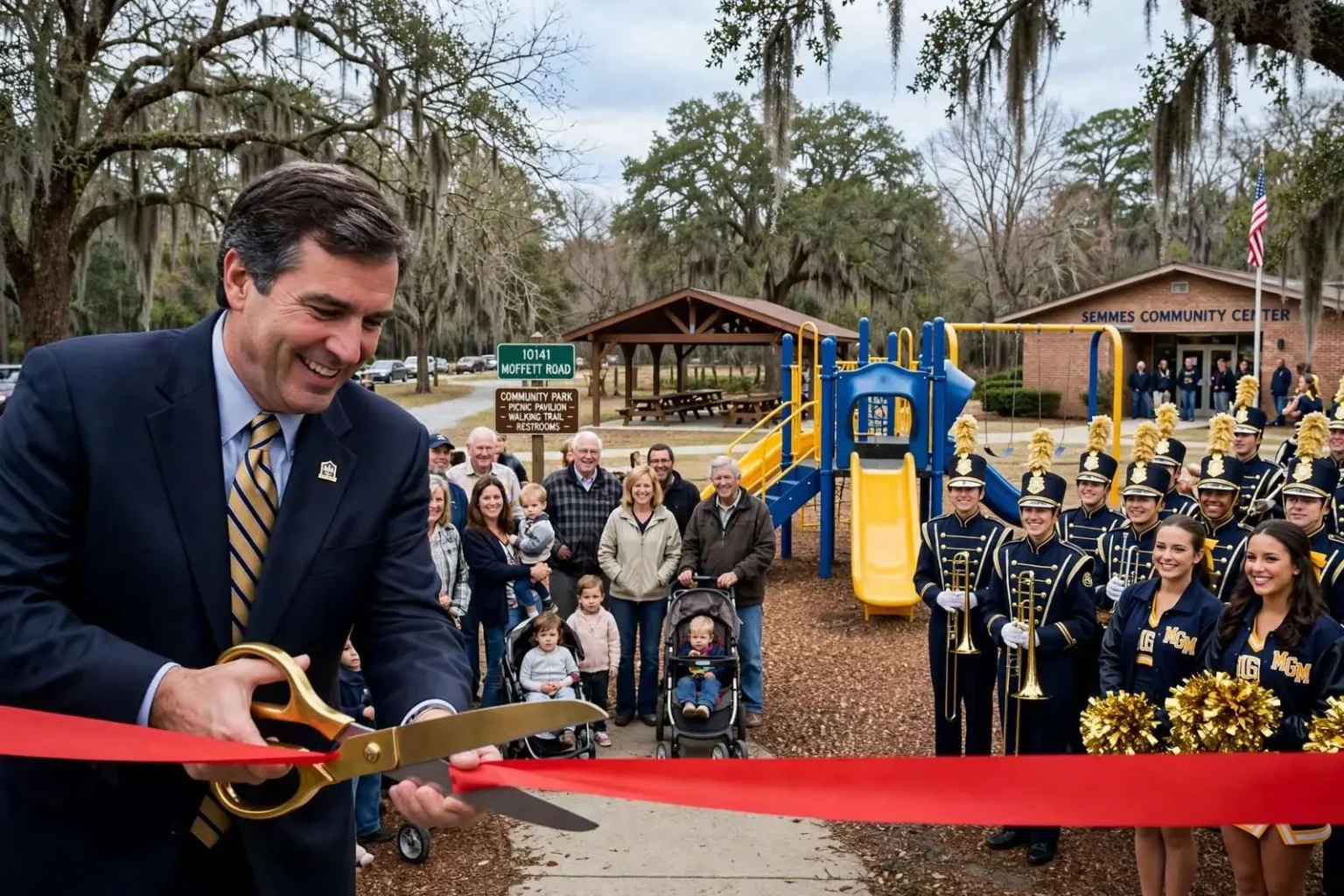
The Semmes Community Playground was scheduled to open with a ribbon-cutting ceremony at 11 a.m. on Saturday, Feb. 3, 2007, Mobile County Commissioner Stephen Nodine announced, giving the fast-growing community in northwest Mobile County its first park of the kind. The playground was located at 10141 Moffett Road, directly behind the Semmes Community Center, and the public was invited to attend.
For a community that had spent years packing the kids into the car and driving to parks in other towns, the opening of a playground of its own was less a ceremony than a small act of self-determination. Nodine, whose commission district included the area, put the project at the center of his case for investing county money in the western corridor.
The first of its kind in the western corridor
For years, Nodine said, the citizens of Semmes and the surrounding areas had been obliged to use other parks, in other communities, for recreational activities. There was no dedicated community park serving the western corridor of Mobile County — a striking gap for a part of the county that had been adding subdivisions, schools and churches steadily for two decades. Families who wanted a playground, a picnic shelter or a ball field found them in west Mobile, in Prichard, or down the roads toward the city.
“Now the citizens of Semmes and northwest Mobile County will have access to their own community park,” Nodine said. “This is a major investment in county resources that ensures a safe and healthy environment for families and especially children.” He said the funding and revitalization of parks and recreational facilities had been a priority for him since taking office — a theme he would repeat across the district as new ball fields, park upgrades and trail projects followed.
The choice of location was deliberate. Placing the playground directly behind the Semmes Community Center on Moffett Road — the old U.S. Highway 98 alignment that serves as the community’s main street — put the park where the community already gathered. A playground across the parking lot from the center’s meetings, senior activities and civic events gets used; one buried at the end of a back road often does not.
What was built
The park covered roughly 10,400 square feet and was constructed at a cost of about $600,000. It included considerably more than swings and slides. The project also delivered picnic pavilions, a walking trail and restroom facilities — the supporting infrastructure that separates a park from a piece of playground equipment dropped in a field.
Those additions matter more than they might appear. A playground with no shade, no restrooms and nowhere for adults to sit is used briefly and abandoned; toddlers have short attention spans and parents have longer afternoons, and neither is well served by concrete and sun. A park with pavilions and a walking trail becomes a place where families spend an afternoon, where a church holds a picnic, where neighbors meet. The walking trail in particular extended the park’s usefulness beyond playground age, giving seniors and stroller-pushing parents a reason to come.
Part of a larger investment
The playground was one piece of a broader package of recreational spending in the Semmes area, which the county totaled at roughly $1.7 million in community improvements. The other components were a $300,000 upgrade to the soccer field at Mary G. Montgomery High School and $800,000 worth of sidewalks in the area.
Read together, the three projects describe a theory of what a growing unincorporated community needs: a place for small children, a place for youth athletics, and safe ways to walk between them and the schools and shops along Moffett Road. Soccer had been booming across west Mobile County in that era, with youth leagues outgrowing the fields available to them, and the Mary G. Montgomery upgrade answered a demand that coaches and parents had pressed for years.
Nodine described the playground and the other park renovations as “quality of life issues,” a phrase that in county government usually signals spending that cannot be justified by economic return alone but is defended on the grounds that people want to live in places worth living in. Commissioners of that era generally reserved the county’s capital budget for roads, bridges and drainage; parks had to be argued for, which is why the Semmes package was framed as an investment in the community’s attractiveness rather than a simple amenity.
A celebration with a marching band
The dedication was arranged as a genuine community event rather than a ceremonial photograph. The Mary G. Montgomery High School marching band and cheerleaders were to be on hand to help with the celebration, and a color guard was to take part in the festivities. The cheerleaders were preparing to compete at a national competition two weeks later, giving the opening the flavor of a send-off as well as a ribbon-cutting.
That lineup said something about the community as well. Mary G. Montgomery — the high school serving much of northwest Mobile County — and its band and spirit groups were the institutions most families in the area had in common, and their presence tied the park to the school life that already anchored weekends in Semmes. A color guard, a marching band and a crowd of families on a Saturday morning was the kind of turnout incorporation-era campaigns would later try to organize; in February 2007 it happened around a playground instead.
County officials planning the event expected the combination of free admission, a Saturday morning slot and the school participants to draw residents from across the western corridor — including the neighboring communities that, until then, had shared Semmes’s lack of a community park and its habit of driving elsewhere for one.
Semmes in 2007
It is worth remembering what Semmes was at the time. It was not yet a city. Incorporation would not come until later, and in 2007 the community along Moffett Road was an unincorporated area of Mobile County, dependent on the county commission for the services a municipality would ordinarily provide — parks, roads, planning and the rest of the local-government toolkit.
That dependence explains a good deal about why the playground mattered and why a county commissioner was the one cutting the ribbon. Residents of Semmes paid county taxes and lived, in effect, at the county’s discretion for parks, roads and recreation. A community park built with county money, on county initiative, was both an amenity and an argument — a demonstration that the western corridor was no longer content to drive into Mobile whenever the children needed a swing set. The park project fed directly into the civic self-confidence that would carry the community through its push for incorporation as Alabama’s newest city in the years that followed.
Semmes’s identity has always been bound up in horticulture. The community grew up around the nurseries that supplied camellias, azaleas and ornamentals to the Gulf South — a heritage commemorated in the area’s garden clubs and its sense of itself as a green, garden-happy corner of the county. A community park with walking trails and shaded pavilions fit that self-image as neatly as any project the county could have built.
Growth outrunning infrastructure
Northwest Mobile County was growing steadily in that period, absorbing families drawn by land, schools and a rural quiet within reach of the city. Lots along Moffett Road and the branching county roads filled with new subdivisions; school enrollment rose with them. The infrastructure of community life — sidewalks, ball fields, a place to walk — took longer to arrive than the subdivisions did, which is the chronic complaint of any fast-growing unincorporated area: the rooftops come first and the parks come later.
The $800,000 sidewalk component of the Semmes package addressed the gap most directly. Children in the new neighborhoods had few safe ways to walk to school, to the community center or to a friend’s house along high-speed Moffett Road, and sidewalk projects were among the most requested items in county commission districts across the suburban fringe. Combined with the soccer field and the playground, the package aimed at the daily movements of families rather than landmark construction.
Commissioners of the era would spend the following years repeating the formula in other unincorporated communities — Theodore, Grand Bay, Irington, Wilmer — as the county tried to keep pace with growth on its edges. But Semmes was first, and its package was the largest single concentration of recreational spending in the western corridor to that point.
In February 2007, some of what the community had been driving elsewhere to find finally arrived at 10141 Moffett Road: 10,400 square feet of playground, a trail to walk, pavilions to sit under, restrooms, and a marching band to open it. The children of northwest Mobile County had a park of their own, and the community had one more reason to believe it could provide for itself.