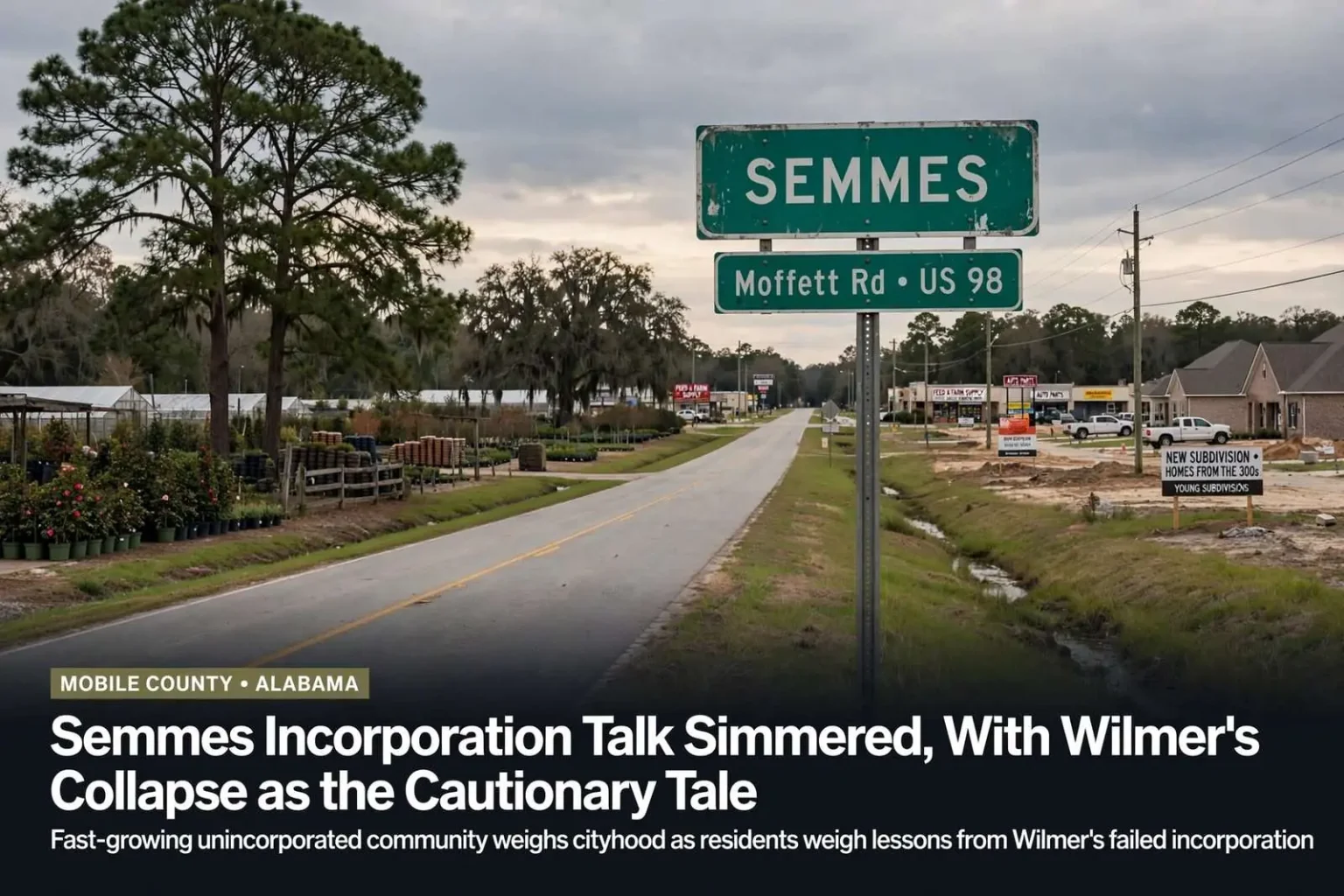
Semmes Incorporation Talk Simmered, With Wilmer’s Collapse as the Cautionary Tale
Leaders in fast-growing west Mobile County kept talking about turning Semmes into a city, with early estimates of 40,000 residents and a $20 million budget, while eyeing the neighboring town that failed.
Talk of turning Semmes into a city continued to simmer among leaders of the fast-growing west Mobile County community, according to newly elected state Rep. Chad Fincher, R-Semmes, who said elected officials were deliberately standing to one side of the debate. Fincher said he and other officeholders had taken no active role, for or against, in the incorporation discussions, but stood ready to assist the community in whichever direction it chose to go.
That neutrality was itself a statement. Incorporation questions divide neighbors, and a legislator who picks a side early inherits the fight. In a community where church pews, nurseries and school bleachers mix people who have farmed west Mobile County for generations with newcomers who arrived with the subdivisions, an official endorsement of cityhood could fracture the very constituency a new city would need to function.
The debate was not academic. Semmes had grown from a rural crossroads into one of the largest unincorporated communities in Alabama, and the question of whether it should govern itself had been raised, studied and shelved more than once. What kept the idea alive was arithmetic: the community had outgrown its status.
The numbers that made it plausible
Preliminary estimates circulating among proponents pegged an incorporated Semmes at a population of as many as 40,000 residents, with a projected annual municipal budget of about $20 million. Those figures explain why the idea kept resurfacing. A town of 40,000 would rank among the larger municipalities in southwest Alabama — bigger than many long-established cities in the region — and a $20 million budget would be enough to field a police department, a municipal court, a public works operation and the planning staff a city needs.
Semmes sat astride Moffett Road in the path of Mobile’s westward suburban expansion, an unincorporated crossroads that had quietly grown into something the size of a small city without any of the powers of one. Moffett Road — U.S. Highway 98 — carried commuters, school buses and nursery trucks through the heart of the community, and the commercial strips along it had filled in steadily as subdivisions spread north and south of the highway.
Residents paid county taxes and relied on the Mobile County Commission and the sheriff’s office for services, while watching the city of Mobile’s limits creep closer. Sheriff’s deputies patrolled one of the largest counties in the state by area, and response times in outlying communities inevitably reflected the size of the territory. Planning and zoning — the power to decide what gets built where — remained with the county, applied through regulations written for a whole county rather than for one fast-changing community.
The growth that reshaped Semmes was part of a pattern visible across the Gulf Coast at the time: families moving out from the city in search of larger lots and newer schools, following roads like Moffett Road and Schillinger Road into what had been farmland a generation earlier. Subdivisions arrived first, then retail, then the traffic that made both a political issue.
What incorporation would have meant
Incorporation would give Semmes its own mayor and council, elected locally; zoning and planning authority over its own growth; the ability to levy and keep municipal sales taxes; standing to negotiate directly with the county and state over roads and drainage; and protection from annexation by neighboring municipalities.
Each item on that list spoke to a specific frustration. Local elected leaders would mean decisions about the community made by people who lived in it. Zoning authority would give residents a say in how densely the remaining land developed — a power the county exercised, but at a distance. A municipal sales tax captured on Moffett Road’s commercial strips would flow into the town’s own treasury instead of being shared countywide. And a chartered city could not be annexed piece by piece by Mobile or any other neighbor, which mattered in a county where the city limits had been moving west for decades.
The ghost of Wilmer
If the promise of incorporation was visible to the east, the peril was visible to the west. Fincher said Semmes residents, intending no disrespect to their neighbors, looked to Wilmer as a negative object lesson in ill-conceived incorporation.
Wilmer, the small town on the western edge of the county, had incorporated without the commercial base needed to sustain municipal services. Lacking the sales tax revenue and business tax base that cities rely on, the town could not pay for the police protection, court operations and basic services its charter promised, and its experiment with municipal government ultimately collapsed, leaving the community to return to unincorporated life under county governance.
The lesson proponents and skeptics alike drew from Wilmer was blunt: a city is a business, and a city without a commercial base is a business without revenue. Semmes, with the busy Moffett Road corridor and a growing retail presence, had the revenue base Wilmer lacked. That difference was the strongest argument cityhood advocates had, and the reason the idea would not die even after earlier efforts stalled.
Wilmer’s experience also shaped the practical questions any Semmes incorporation plan would have to answer before residents voted on it: What services would the new city provide, and in what order? What would police protection cost, and would the town contract with the sheriff’s office or build its own department? What would the property tax rate be — and would a city tax stack on top of the county taxes residents already paid?
How a community becomes a city in Alabama
The mechanics of incorporation in Alabama are deliberate and demanding. Residents of a proposed municipality petition for an election, boundaries are mapped and documented, a census or special census establishes population, and the question goes to a vote of the people living inside the proposed limits. If voters approve, a mayor and council are elected, a charter is adopted, and the new municipality begins the work of levying taxes, hiring staff and taking on the services its charter describes.
That process gives both sides something to argue about. Supporters point out that every step is democratic — no community becomes a city without its residents voting for it. Skeptics counter that once a city exists, its taxes and regulations exist too, and undoing a mistake is far harder than avoiding one. Wilmer was the proof they cited: municipal government, once created, must be fed, and if the revenue is not there, the community pays the price in debt, diminished services or dissolution.
Between those poles sat the practical middle: residents who wanted better roads and local control but worried about a second layer of government, another tax bill and another set of politicians. In a community as civic-minded as Semmes — a place with deep roots, active churches and a celebrated history, including one of the county’s oldest continuously operating school communities — the debate was less about whether growth was coming than about who would manage it.
The nursery heritage that shaped the town
Any discussion of Semmes’ future inevitably ran through its past as a nursery center. For well over a century, the community’s sandy soil and mild climate made it a center for wholesale nurseries that shipped azaleas, camellias and other ornamentals across the South, and the industry gave the town an identity apart from the suburbs spreading toward it. Nursery families owned large tracts of land along Moffett Road and the side roads off it, and their decisions about selling and developing shaped the growth map as much as any regulation.
That heritage complicated the incorporation debate in quiet ways. Landowners weighing whether to sell acreage to developers had a direct interest in who would zone the property and how. A city with its own planning commission could speed or slow development, impose subdivision standards and require the infrastructure — drainage, sidewalks, turn lanes — that county review did not always demand.
The services gap in unincorporated Mobile County
The day-to-day realities behind the debate were visible in any drive through west Mobile County. Unincorporated communities rely on the county for road maintenance, drainage, animal control and planning, and on the sheriff’s office for law enforcement. The Mobile County Commission, with three commissioners dividing a county that stretches from the Mississippi line to the Gulf, must spread road and bridge money across the entire map, and a fast-growing suburb can find its needs queued behind decades-old obligations elsewhere.
Drainage is the perennial example in south Alabama. Heavy Gulf rains overwhelm ditches and culverts in any county, but in a low-lying coastal county the consequences land on homeowners directly, and the fixes are expensive. A municipality with its own public works budget and its own grasp of local trouble spots can respond differently than a county department triaging a countywide list.
Law enforcement tells a similar story. Sheriff’s deputies cover everything outside municipal limits, and residents of unincorporated areas have long compared response times and patrol presence with those of cities that run their own departments. An incorporated Semmes would have had to decide whether to build a police department from scratch — typically the largest single line in a small city’s budget — or to contract with the sheriff’s office for dedicated coverage.
Fire protection, provided in that part of the county by volunteer-based districts funded through fees and taxes, would have continued regardless of the incorporation vote, but a city could choose to invest more, coordinate with the district and plan stations around growth patterns rather than historical ones.
Why officials stayed out of it
Fincher’s insistence that he and other officeholders would take no side reflected more than political caution. Under Alabama law, incorporation proceeds through petitions, elections and courts — not through the legislature — so a state representative’s role is limited to helping with census matters, answering questions and passing along concerns to state agencies. Beyond the legal limits, there was the political reality that an incorporated Semmes would change the district he represented, redrawing its map and reshaping its electorate.
Local officeholders faced the same arithmetic. A new city would create a mayor’s office and council seats that current community leaders might contest, and it would transfer some decisions now made at the county courthouse in downtown Mobile to a new city hall in Semmes. Endorsing that transfer before residents asked for it could cost an official standing on either side of the question.
The result was a debate carried largely by residents themselves — petition organizers, civic club discussions, letters and word of mouth — with elected leaders promising assistance in whatever direction the community chose. Whether that assistance would ultimately take the form of help drafting a charter or help burying the idea was, at the time, the question the community had not yet answered.
What was clear was that the status quo had an expiration date. A community of as many as 40,000 people — a population larger than many Alabama cities — could not remain, indefinitely, a crossroads with no government of its own. Either Semmes would incorporate and take up the burdens and powers of a city, or it would wait for the annexation lines moving west from Mobile to reach it. The ghost of Wilmer stood on one side of that choice; the creeping city limits stood on the other, and every resident of Moffett Road could see them both.