President Bush Was Set to Headline a $750,000 Sessions Fundraiser in Mobile
A June reception at the Arthur R. Outlaw Convention Center, at $1,000 a ticket, aimed to raise $750,000 for Jeff Sessions' 2008 re-election campaign, with the president himself as the draw.
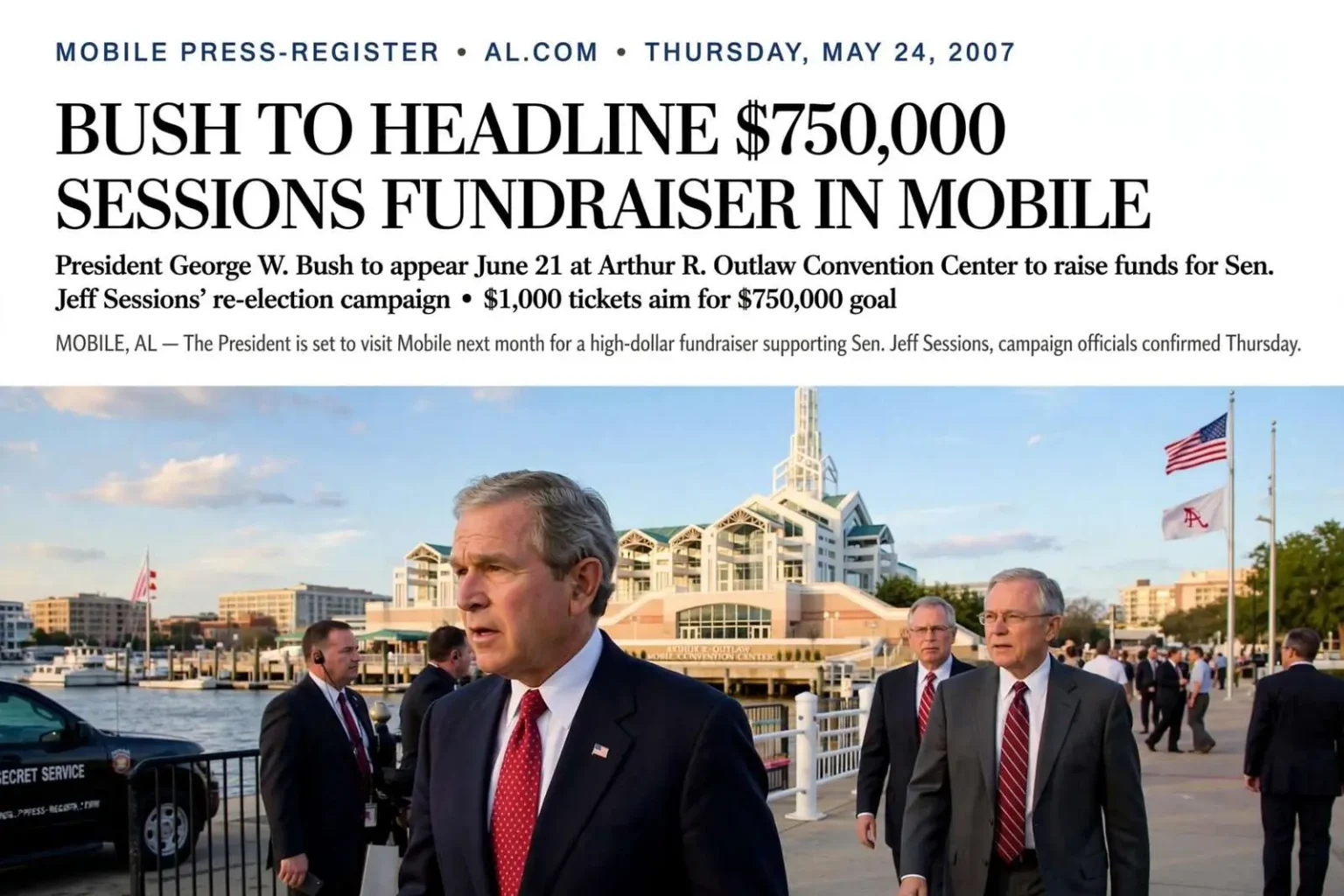
President George W. Bush was scheduled to visit Mobile the following month to headline a fundraiser for U.S. Sen. Jeff Sessions, supporters of the senator confirmed. The reception was set for Thursday, June 21 at the Arthur R. Outlaw Convention Center, “probably in the early evening or late afternoon,” said Sandy Stimpson, Sessions’ state finance chairman.
The visit would put a sitting president on the downtown waterfront for a single evening — a logistical undertaking that brings Secret Service perimeters, closed streets and a national press pool to the convention center’s doors along the Mobile River.
The numbers
The Sessions campaign hoped to raise $750,000 from the event to fuel his 2008 re-election bid. Tickets were priced at $1,000 per person.
A single evening producing three-quarters of a million dollars is the kind of haul that shapes a race before it begins. Money raised that early is not primarily for advertising; it is a signal. A senator who can post a number like that in the spring of the off year is telling prospective challengers, and their potential donors, not to bother.
At $1,000 a ticket, the arithmetic works out to 750 attendees at full price — a substantial crowd even for a presidential appearance, and one that will draw from across south Alabama rather than Mobile alone. Donors from Baldwin County, the Wiregrass and the state’s southwest corner make the drive for the combination of a president and a senator they have supported for years.
Stimpson’s role as state finance chairman places him at the center of that effort. A Mobile businessman with deep ties to the city’s Republican donor community, he was tasked with turning the White House’s appearance into a campaign treasury — the practical work of soliciting tables, tracking commitments and filling the hall.
The White House’s message
The presidential visit followed a trip by Vice President Dick Cheney to Birmingham on Sessions’ behalf. Taken together, Stimpson said, the two appearances were a further “indication that Jeff is held in high regard by the White House.”
The context is worth noting. By mid-2007, President Bush’s national approval ratings had fallen sharply amid the war in Iraq, and in many parts of the country a presidential fundraising visit had become a liability for Republican candidates. Alabama was not one of those places. In a state Bush had carried comfortably twice, the president remained a formidable draw at $1,000 a plate.
The distinction matters for how the event should be read. In swing states, Republican candidates in 2007 were managing their distance from an unpopular second-term president; in Alabama, no such calculation applied. A Bush appearance added prestige and drawing power, and the campaign had every reason to advertise it loudly — which it did, through supporters confirming the visit well in advance.
The senator
Sessions, a former U.S. attorney in Mobile and later Alabama’s attorney general, was first elected to the Senate in 1996, defeating Roger Bedford. He won re-election in 2002 over Democratic nominee Susan Parker, who by 2007 was serving on the state Public Service Commission.
National Journal had ranked him the fifth-most conservative U.S. senator in its March 2007 conservative-liberal rankings. He backed conservative Republican positions on foreign affairs, taxes and social policy, opposed abortion and was among the Senate’s most vocal opponents of illegal immigration, a fight that was reaching its peak that very summer as a bipartisan immigration overhaul moved through the chamber.
The timing of the fundraiser landed in the middle of that debate. The immigration bill — a compromise effort backed by the White House and a bipartisan Senate group — was drawing fierce opposition from conservative voters and talk radio, and Sessions had made himself one of its most persistent critics. His stand put him at odds with his own party’s president on the issue while cementing his standing with the Alabama base, and the June reception would gather that base in one hall with the president whose bill Sessions was fighting.
Sessions served on the Senate Judiciary Committee, and carried a distinction no other member could claim: he was the only senator on that committee to have appeared before it unsuccessfully as a nominee before later becoming one of its members. His 1986 nomination to a federal judgeship had failed in that room.
The judgeship episode shadowed his career in both directions. Senate opponents in 1986 had raised questions about his record on civil rights matters as a U.S. attorney, and the committee’s rejection became a defining chapter — one his supporters regarded as unfair, and one that fueled, two decades later, the narrative of a senator who had proven his critics wrong. Sitting on the committee that once rejected him gave the story its neat symmetry.
The opposition, or the lack of it
Sessions had no announced Democratic opposition. State Agriculture Commissioner Ron Sparks was reportedly taking a hard look at the race, and state Sen. Vivian Figures of Mobile was said to be considering it as well. Either would face the arithmetic that the June reception was designed to advertise.
The absence of a declared challenger at this stage of an off-year is itself information. Potential candidates watch the incumbent’s early fundraising the way generals watch an enemy’s mobilization, and a $750,000 night with a president in attendance raises the cost of entry for everyone deciding whether to run. Sparks, statewide officeholder with name recognition in south Alabama, and Figures, a veteran Mobile legislator, each had routes to a campaign — but a route to $750,000 was another matter.
The event
Event: Reception for Sen. Jeff Sessions with President George W. Bush. Date: Thursday, June 21. Venue: Arthur R. Outlaw Convention Center, Mobile. Tickets: $1,000 per person. Goal: $750,000. Finance chairman: Sandy Stimpson.
The Outlaw Convention Center, named for the former Mobile mayor who championed the city’s riverfront redevelopment, offers the scale the event requires: exhibit halls and ballrooms that can absorb a security perimeter, a processing line for a thousand guests and a stage setup worthy of a presidential visit. Its location on the waterfront puts the event at the symbolic heart of the city’s recent downtown revival.
For Mobile, a sitting president’s visit was an event in itself, bringing motorcades, security perimeters and national press to the downtown waterfront. For the senator, it was a down payment on a race his opponents had not yet entered.
The evening would close with the campaign’s spring argument made in full: a popular-at-home president, a senior senator ranked among the most conservative in Washington, a quarter-million-dollar margin over any likely month of a challenger’s fundraising, and eleven months of runway before the 2008 election. In the economics of Senate races, that combination is how incumbency becomes a fortress — and Mobile was where the fortress got its cornerstone.
What early money buys in a Senate race
The logic of the June event deserves spelling out, because it explains why campaigns stage these evenings so far from Election Day. An incumbent senator’s first campaign finance report of the off year is read carefully in both parties’ Senate committees. A big number deters challengers; a soft number invites them. Every dollar raised in June is therefore worth more than its face value, because it may prevent a challenger from ever materializing — and with it, the millions in outside spending a competitive race would draw to Alabama.
The deterrence dynamic is especially powerful for a senator with Sessions’s profile. His 2002 re-election was never seriously in doubt, and the state’s drift toward the Republican column since then has only widened the incumbent’s structural advantage. Democratic recruiters in 2007 faced the same map their predecessors had: a state that had gone for Bush twice, an incumbent with high name recognition, and a fundraising base that could produce evenings like the one planned for the Outlaw Convention Center.
Stimpson’s finance operation, meanwhile, reflects the way Alabama’s Republican money network actually functions. The state’s donor community is anchored in business leaders — contractors, bankers, manufacturers and retailers — who coordinate through campaigns’ finance committees rather than through any formal structure. A state finance chairman with standing in that community can assemble a six-figure evening on the strength of phone calls, particularly when the guest of honor is the president.
Alabama in the off year
The political climate of 2007 gave the event its particular flavor. The governor’s mansion had returned to Republican hands, the congressional delegation was solidly Republican, and the state’s legislative contests had settled into a long-running struggle over narrow margins. Senate races in Alabama had not been competitive in the general election in years — the real contests, when they occurred at all, happened in primaries.
Sessions himself occupied a comfortable position in that landscape. His Senate career had been built on the Judiciary Committee’s terrain — judges, crime, immigration — issues that translate directly to the conservative voters of south Alabama. His opposition to the summer’s immigration compromise was the purest expression of the brand: a senator from Mobile standing against the legislation his own party’s White House wanted, in defense of the enforcement-first position his constituents demanded.
That the president would appear at a $1,000-a-plate reception for a senator actively working against the administration’s top domestic priority of the moment says something about how Alabama politics operated. Party loyalty ran deep in both directions, and a fundraising visit was never going to be hostage to a single legislative fight. The greeting on the convention center stage would be warm; the disagreement over the immigration bill would remain somewhere offstage.
For the guests, the evening offered the rare combination of a presidential appearance and a senator’s re-election kickoff in their own city. For the campaign, it offered a treasury and a deterrent. And for the potential opponents still deciding — the agriculture commissioner reported to be studying the race, the Mobile state senator said to be considering it — the message of June 21 would be written in the only language campaigns speak: three-quarters of a million dollars, raised in a single evening, months before anyone had filed to run against it.