Saraland Fire Rescue Lands a $54,526 Federal Grant for Operations and Safety
The Department of Homeland Security agreed to release $54,526 to the Saraland Fire Rescue Department in late 2006 under the Assistance to Firefighters Grants Program, money earmarked for operations and safety.
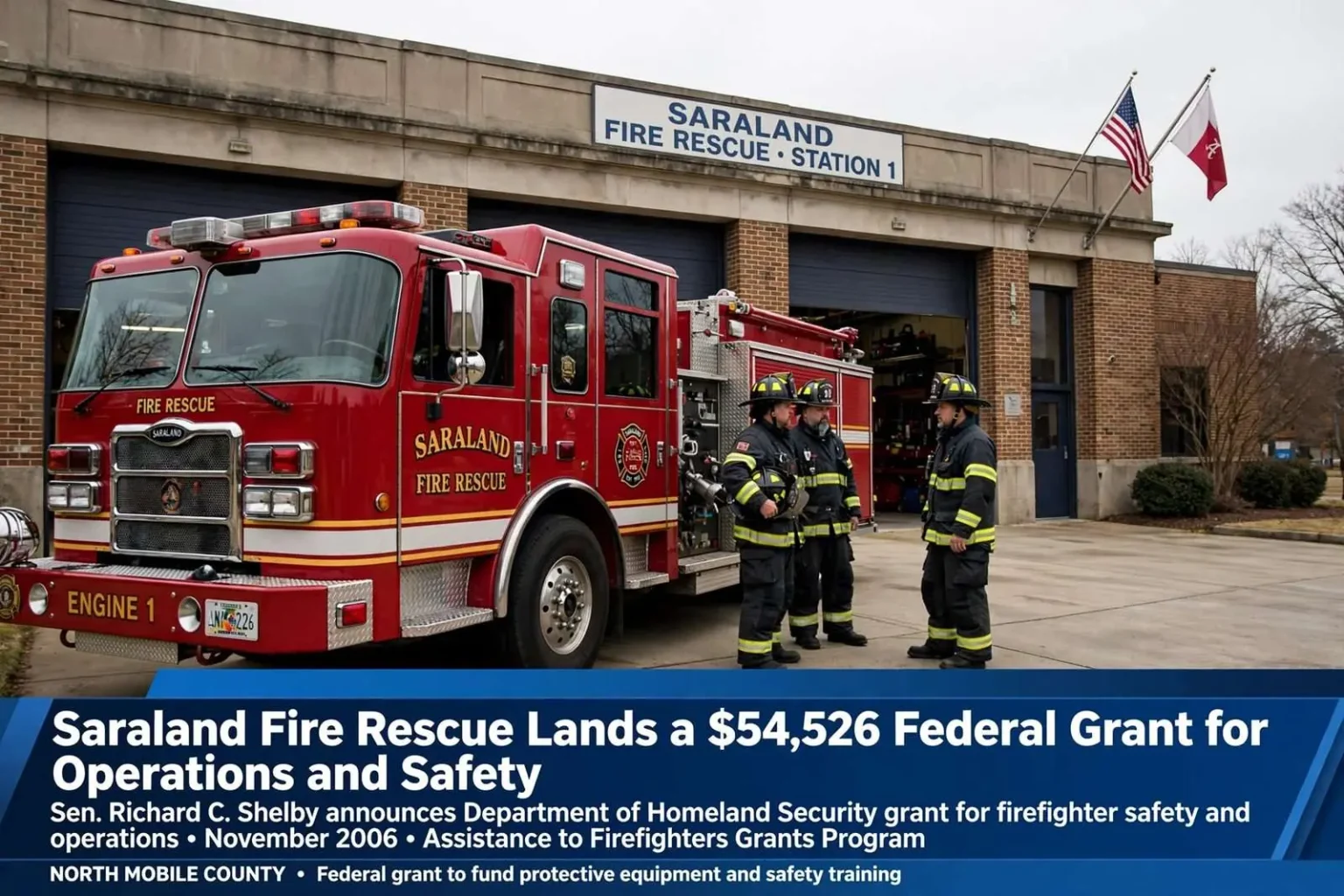
The Saraland Fire Rescue Department was set to receive $54,526 from the Department of Homeland Security, U.S. Sen. Richard C. Shelby announced at the end of November 2006, with the money earmarked for operations and firefighter safety.
Shelby, a member of the Senate Appropriations Committee, said the funding came through the Assistance to Firefighters Grants Program, the federal government’s principal channel for putting equipment and training dollars directly into the hands of local fire departments. For a growing city in north Mobile County, the award represented real purchasing power at the station house — the kind of money that buys gear, not paperwork.
What the grant was for
“It is essential that Alabama’s first responders have the tools and training necessary to safely protect our communities,” Shelby said. “The Saraland Fire Rescue Department will use this funding for operations and safety. This grant is evidence of our nation’s continued commitment to our first responders.”
The Assistance to Firefighters program allowed departments to spend awards on a range of needs, including fire operations and response capability, firefighter safety programs and protective equipment, emergency medical services, and firefighting vehicles. That flexibility was deliberate: a volunteer department in the Black Belt and a paid career department in a suburb face different deficits, and Congress chose to let local chiefs — rather than federal program officers — identify which gap mattered most.
The funds were administered by the Department of Homeland Security’s Office for Domestic Preparedness, and the program distributed $750 million in direct federal assistance to firefighters nationwide that year. Saraland’s share was one entry in a very long list, but for the department receiving it, the list was beside the point.
Why This Mattered in North Mobile County
A grant of $54,526 will not sound like much against a $750 million national program, but scale is everything in municipal fire service. For a department the size of Saraland’s, that sum could mean a set of self-contained breathing apparatus, a batch of turnout gear, thermal imaging equipment or a meaningful share of a vehicle purchase — each item a direct improvement in the odds that firefighters go home at the end of a shift.
The economics of protective equipment make the point plainly. A single self-contained breathing apparatus, the air pack a firefighter carries into a burning structure, costs thousands of dollars. Modern turnout gear — coat, pants, boots, gloves, hood and helmet — runs to several thousand more per firefighter, and it must be replaced on a fixed service-life schedule whether or not a city has budgeted for it.
Saraland in 2006 was a growing community in north Mobile County, still a few years away from establishing its own school system and continuing to absorb residential growth along the Interstate 65 corridor. New subdivisions meant more structures to protect, longer response maps and a tax base that was expanding but not yet mature.
Its fire department covered a mixed territory of neighborhoods, commercial strips and highway, and like most departments in the region it competed for federal money against thousands of applicants nationwide. Growth of that kind is the quiet argument in every fire department’s budget request: every new roof is a new call, sooner or later, and equipment bought for a smaller town does not stretch to cover a larger one.
How the Program Worked
The Assistance to Firefighters Grants Program, created in 2001, was designed to be peer-reviewed rather than politically allocated. Departments submitted applications describing their needs, and panels of active firefighters and fire officers scored them. That structure meant an award of this kind reflected a department’s own documented case — its age of equipment, its call volume, its staffing — rather than simply a congressional earmark, even though members of Congress routinely announced the results in their districts, as Shelby did here.
Shelby’s position on the Appropriations Committee gave Alabama’s departments an attentive advocate. Grant announcements like this one became a regular feature of his office’s output, and north Mobile County municipalities had learned to watch for them. The money flowed through DHS, but the vetting ran through working firefighters who understood what a worn-out air pack means on a fireground.
The program was also, in the mid-2000s, one of the more visible ways in which the post-2001 homeland security apparatus reached ordinary communities. The same federal budget that bought Coast Guard patrol aircraft and funded port security along Mobile Bay also paid for air packs at a fire station in Saraland. First responders were the stated first line of defense against any disaster, natural or otherwise, and Congress funded them accordingly.
The pipeline was long — applications, scoring panels, awards, reimbursement paperwork — and the sums arriving at the far end were modest in federal terms. But they arrived, and they arrived in a form municipal budgets rarely produce on their own: unrestricted capital for a function that generates no revenue and never stops costing.
The Broader Picture
Fire departments across Mobile, Baldwin and Washington counties, many of them volunteer or partly volunteer, leaned heavily on this program throughout the decade. Equipment ages, standards tighten, and the cost of outfitting a single firefighter to modern specifications runs into the thousands of dollars. For small departments operating on municipal budgets stretched thin, federal grants were often the only route to replacing gear that had passed its service life.
The region’s geography explains the dependence. South Alabama is laced with rural roads, volunteer districts and small towns that field fire protection with a handful of trucks and whatever grant cycles provide. A department that misses one grant cycle can spend a decade behind on gear, and the gap is measured not in convenience but in the safety of the people inside the buildings and the crews going into them.
Saraland’s award also fit the arc of the city’s own development. Within a few years the city would break away from the Mobile County public school system to form its own, a step that reflected both its growing tax base and its determination to control its own services. Fire protection was part of the same story: a community building itself into a full-service city needed departments — schools, police, fire — sized to the city it was becoming rather than the town it had been.
The late-2006 announcement was one small entry in that larger ledger, and a reminder that homeland security policy, for all its talk of national threats and strategic infrastructure, is ultimately delivered by the men and women who answer the call at two in the morning in a town of a few thousand people. The federal government’s share of their equipment, in Saraland’s case that year, came to $54,526 — enough to matter, in a profession where the difference between old gear and new is occasionally the difference between a close call and a funeral.
For the department’s firefighters, the announcement confirmed what chiefs across the country had learned about the program: the federal commitment was real, repeatable and worth the effort of writing the application every year. For the city’s residents, the practical meaning was simpler. The trucks would roll with crews better equipped than they had been the year before, which is the entire point of the exercise.
What the Money Actually Bought
Federal grant categories like this one translate into a fairly predictable shopping list for a department of Saraland’s size. Operations funding typically went to the consumables and the small-but-costly inventory that municipal budgets chronically underfund: hoses, nozzles, radios, extrication tools, cascade systems for refilling air cylinders and the testing that keeps all of it certified. Safety money went to the gear individual firefighters wear, which follows national standards that are updated regularly and are not optional.
Vehicles were the long-shot category. A pumper or tanker costs hundreds of thousands of dollars, far more than a single award of this size, but grant money could be applied toward a share of a purchase or matched with city capital-campaign funds. Departments often spent years assembling the financing for one apparatus, and a federal award in a given year could be the difference between ordering a truck and waiting another cycle.
The award also carried weight beyond the equipment itself. Insurance services and fire-suppression ratings take into account a department’s equipment, water supply, staffing and training, and those ratings feed directly into the property insurance premiums every homeowner in the city pays. Equipment purchases funded by grants, in other words, pay dividends on residents’ insurance bills for years — an argument fire chiefs have made to city councils for as long as ratings have existed.
Training dollars, another eligible use, mattered as much as hardware in a growing city. New subdivisions, interstate commerce and industrial neighbors each bring different hazards, and keeping a roster current on everything from vehicle extrication to hazardous-materials response costs time and tuition. Departments that can train without scrimping are departments that make fewer mistakes on scene.
None of this is glamorous, which is precisely why the federal program existed. Local councils fund trucks and stations — visible things voters recognize. Air packs, hoses and coursework are invisible until the night they are needed, and a grant program that put $54,526 behind them filled a gap no other funding source reliably touched. That was the quiet logic behind the announcement that November, and it was the logic Saraland’s department took to the bank.