Peavy Enters Election Week With $13,800 in Campaign Account
John Peavy's mayoral campaign spent $154,284 in the final reporting period and entered the last days before Mobile's Aug. 23 election with just $13,803.72 remaining on hand.
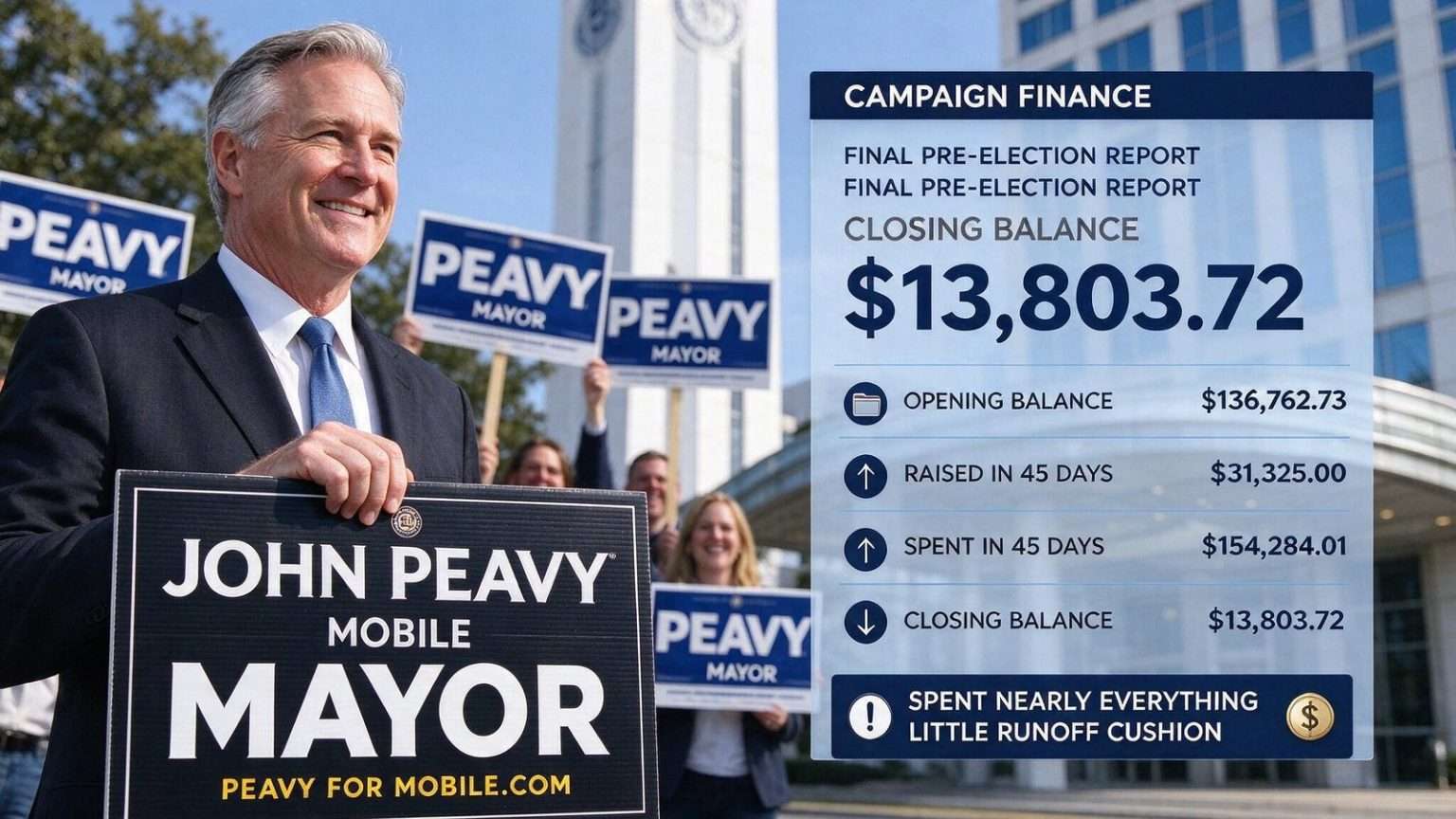
City Councilman John Peavy went into the final days of Mobile’s mayoral election having spent nearly everything he had, according to his last pre-election campaign finance report, which showed $13,803.72 remaining in his campaign account.
The Numbers
Peavy’s filing covered the closing 45 days of the campaign:
Opening balance: $136,762.73. Raised during the period: $31,325. Spent during the period: $154,284.01. Closing balance: $13,803.72.
The arithmetic described a campaign making its stand on Aug. 23. With a runoff scheduled for Sept. 13 in the event no candidate cleared fifty percent — an outcome most observers considered likely in a four-way race — a closing balance under $14,000 left little cushion for a second campaign, and would place a premium on the campaign’s ability to raise money quickly if it advanced.
The spending pace tells its own story. Peavy’s committee out-raised its outlays nowhere near even terms during the period, burning through roughly five dollars for every one it took in as it financed a final television, radio and direct-mail push. Campaign finance filings in the final stretch of a race frequently look like this — the ledger of a campaign choosing to spend everything it can on the only date that matters first — but they leave the future unfunded by design.
Where the Money Went
The dominant expense was a single vendor. The Peavy campaign reported paying Strategy Inc. $121,751, plus additional payments of $10,903.93, $3,500 and $3,000 to the same firm.
Other expenditures included $5,500 to The Kitchens Group, $5,072.34 to ABC Signs and $680 to One Media.
Concentrating that much of a budget with one consulting and media firm was not unusual for a campaign of this size, but it left the report with an unmistakable profile: a late, heavy advertising push aimed at moving votes in the final weeks. Strategy Inc.’s payments accounted for the overwhelming majority of the $154,284.01 spent during the period, with the smaller payments covering yard signs, supplemental media buys and consulting support as Election Day approached.
The pattern — a dominant media consultant, secondary spending on signage and printing — is the standard architecture of a serious Mobile mayoral campaign. What distinguished Peavy’s report was the proportion: with more than $130,000 of the period’s spending routed through one firm, the final weeks were effectively one sustained advertising campaign conducted at full throttle.
Where the Money Came From
Peavy’s contributor list leaned heavily on political action committees and the construction, real estate and business community — a pattern consistent with a candidate who ran a construction company and represented a west Mobile council district.
Among PAC contributions were $6,500 from Bridge PAC, $5,000 from the Alabama Realtors PAC, $2,500 from ABPAC, $2,000 from Capitol PAC, $1,000 each from Mobile Auto PAC and Southern States PBA-PAC, and $500 from The Committee For Good Government.
Business donors included Coastal Builders, Mobile Lumber & Building Materials, Southern Earth Sciences, Budweiser-Busch Distributing, Ward International Trucks, Frank A. Dagley & Associates, Romie Perez Construction and Sales, Adventure Specialties and The Copeland Agency.
The mix reflects the base a west Mobile councilman builds over years in office. Development and real estate interests weigh in heavily on Mobile mayoral races because zoning, annexation and infrastructure decisions flow through City Hall, and a candidate whose own career is in construction enters the race with those relationships already formed. PAC money, meanwhile, arrives from groups representing realtors, automobile dealers, police associations and general business interests — organizations that give across races and expect access regardless of who wins.
Individual contributors of $1,000 included Timothy James, Herman and Helen Neese, and Mark Upton. Others giving during the period were Ronnie Barrett, Milton Bolling III, Warner and Barbara Britton, George Copeland, Frank Dees, Robert Drew, John Dukes, Stanley Galle Jr., Herb Harvet, Patrick Hicks, Charles Holtz, Stephanie McKinnell, James Miller, Thomas and Kellie Myers, D.M. Owen, Richard Rowan, James Rutland III, T.S. Sawyer, Craig M. Smith Sr., Christopher and Nancy Springer, Frank Summersell and Steven Woolley.
The individual list is the kind a long-serving councilman accumulates: builders, business owners and longtime friends whose names appear across multiple cycles of Mobile campaign finance reports. In a 45-day sprint, however, individual giving is usually the slowest category to refill — which is precisely the problem a campaign carrying $13,803.72 into a likely runoff faces.
The Candidate
Peavy, 51, represented District 7 on the Mobile City Council. He faced former state Sen. Ann Bedsole, Mobile County Commissioner Sam Jones and former City Councilwoman Bess Rich in the Aug. 23 municipal election, with all four seeking to succeed Mayor Mike Dow, who was not running for a fifth term.
The field made history on several fronts. Bedsole’s candidacy marked the first serious mayoral campaign by a woman in Mobile in decades, and the race was widely viewed as the most wide-open mayoral contest the city had staged in a generation. Dow’s retirement after four terms left no incumbent on the ballot, drawing a field of established officeholders rather than a scramble of long shots.
Peavy’s path ran through west Mobile and through the city’s Black neighborhoods, where he needed to consolidate a base large enough to force the Sept. 13 runoff and then expand it. His District 7 seat gave him a geographic anchor, and his construction business gave him the business-community ties his contributor list displayed, but the mathematics of a four-way race meant no campaign could afford to write off any part of the city.
The campaign had also been shadowed in its final weeks by an ethics complaint filed against Peavy over a city drainage contract — an allegation he called meritless and answered with a defamation suit of his own.
The complaint landed at the worst possible moment for a campaign trying to close strong, and Peavy’s response was unusually aggressive for a municipal race. Rather than ignore the filing or issue a single denial, he sued, accusing his accusers of defamation and putting the dispute before the public on his own terms. Ethics complaints in Mobile politics tend to surface in the closing weeks of contested races, and voters had seen enough of them to discount some — but a candidate defending himself in two forums at once while trying to fund a runoff faced a complicated final stretch.
Why Cash on Hand Matters
In municipal elections decided by a runoff, the money left over on the night of the first vote is often as important as the money spent before it. A campaign that reaches the runoff with an empty account must raise a new war chest in a matter of days, typically by turning to donors who have already given and to lenders willing to gamble on the outcome.
Alabama law caps individual contributions to municipal candidates, which makes the refilling job slower than it might otherwise be. A campaign cannot simply find one benefactor to fund the runoff; it must go back to the PACs, the business donors and the individual givers who built the first account, many of whom by late August have already given their limit and committed their enthusiasm to the race.
The dynamics of a Mobile runoff compound the problem. Turnout drops sharply from the first round, favoring whichever campaign can identify its voters and drag them back to the polls — an expensive proposition that favors television and mail budgets over shoestrings. A candidate with $13,803.72 and twelve days to the runoff would have to decide immediately what could be bought with what remained: a modest television presence, a concentrated mail program, or a ground operation substituting shoe leather for dollars.
Peavy’s final pre-election report made the arithmetic of that challenge plain, and set the terms of whatever fight would follow.
The filing also offered the last public window into the campaign’s finances before the vote. Under Mobile’s campaign disclosure rules, the pre-election report is the document reporters, opponents and voters scrutinize for signs of strength, and its signals travel fast: donors read them when deciding whether a campaign deserves a late check, and insiders read them for the classic tell of a candidacy that is either consolidating or fading.
For Peavy, the report’s message was double-edged. The $154,284.01 spent in 45 days demonstrated that he had the donor network and the professional operation of a first-tier candidate in a four-way race. The $13,803.72 left over demonstrated how completely that operation had been deployed. Whether the bet — everything on Aug. 23, nothing in reserve — proved wise depended on a result no report could predict.
Whatever the outcome, the document stands as a snapshot of a Mobile campaign in its final, all-in moment: a councilman betting his entire account on a single Tuesday in August, backed by the contractors and PACs of west Mobile, against three better-known rivals, with a runoff and an empty ledger waiting on the other side of the count.