The Woman Who Walks Dauphin Island’s Beaches Every Day, Looking Down
Leslie Norris drives from Semmes to Dauphin Island nearly every day for work, then comes back on weekends to shell. Twelve years in, she has found two Johnstone's junonias, the rare state shell most collectors never see.
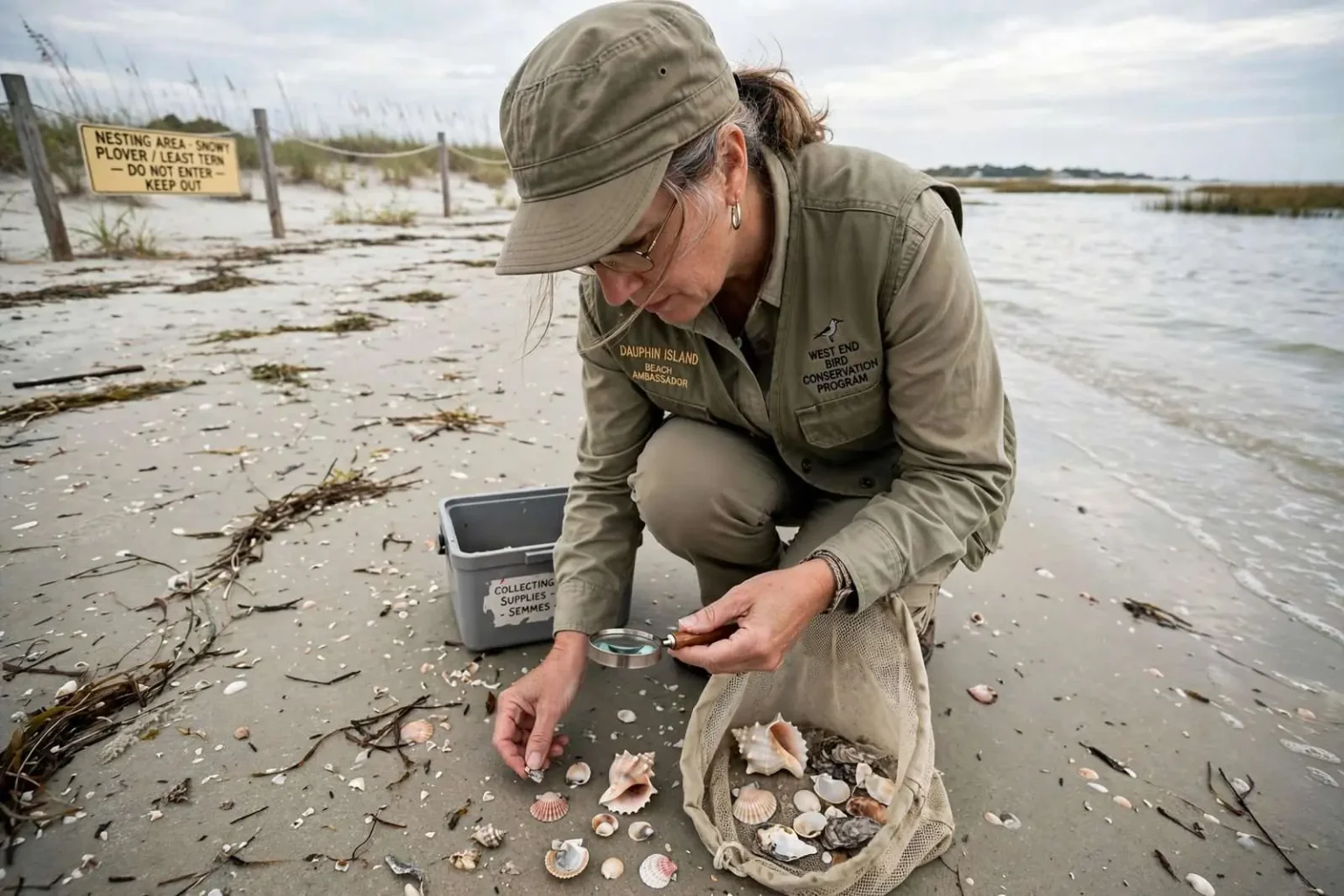
Most people go to the beach to sit down. Leslie Norris goes to the beach to look down. Norris makes the drive from Semmes to Dauphin Island nearly every day of the week for her work as a beach ambassador for the Town of Dauphin Island and as supervisor of the West End Bird Conservation Program. Then, on weekends, she comes back for an entirely different reason.
“I’m not like most people who go to the beach to relax,” she says. “I’m there all day long. The only reason I come back is to shell.”
Twelve Years of Collecting
Norris has been a shell collector for about twelve years, and in that time she has accumulated a quantity she declines to specify precisely. “I have more shells than I’d like to admit,” she says. The interest took hold when she started working on the beach and realized how much variety was underfoot. A friend’s mother, part of a shell collecting group in Mobile, taught her the names. Norris, who has always been drawn to marine science, found the identification work as rewarding as the finding.
Dauphin Island, a barrier island at the mouth of Mobile Bay, sits at the intersection of Gulf of Mexico currents and the outflow from the Mobile-Tensaw Delta. This geography creates one of the most productive shelling grounds on the northern Gulf Coast. The island’s fourteen miles of shoreline receive a constant deposition of shells from both the Gulf side and the bay side, with seasonal storms and tidal shifts regularly turning over new material.
The Island Has Two Very Different Beaches
Anyone who has shelled Dauphin Island seriously learns quickly that the east end and the west end are not the same hunting ground. The east end is where the small shells are. Norris hunts wentletraps here, her personal favorites, some so tiny she has to wear reading glasses to spot them. Sand dollars here can be no larger than a pencil eraser. The west end produces the larger specimens. The jetties on the east end intercept the bigger shells before they can reach shore, which leaves the west end with the heavier finds.
“There’s not very much that you can’t find on the island,” she says. Scallops, lightning whelks and fighting conchs are among the most common finds. The lightning whelk, Busycon sinistrum, is the state shell of Texas but abundant in Alabama waters, distinguished by its rare left-handed spiral. Fighting conchs, Strombus alatus, are actually herbivores despite their aggressive name, common in the seagrass beds around the island’s perimeter.
Reading the Waterline
Experienced shellers can usually tell within minutes whether a day will be productive, and Norris reads the edge of the water to do it. “A lot of times, that will tell you what you’re going to find. If every time the wave hits, you see a line of shells, you know it’s going to be a good day.” She looks for the wrack line, the debris deposited at high tide, and the texture of the sand itself. Coarse sand with visible shell hash indicates recent turnover. Fine, packed sand suggests the beach has been picked over.
The best shelling on Dauphin Island typically follows a cold front or a tropical system that churns the Gulf bottom. Winter months bring northerly winds that push water out of Mobile Bay, exposing bay-side flats rich in oyster drills, ark shells, and the occasional horse conch. Spring tides around the full and new moons create extreme low tides that reveal sandbars normally submerged. Summer mornings before the crowds arrive offer the cleanest pickings on the Gulf beaches.
Norris’s work as a beach ambassador for the Town of Dauphin Island puts her on the sand in an official capacity. The role involves monitoring nesting shorebirds, particularly least terns and snowy plovers, which nest in shallow scrapes on the open beach from April through August. She marks off nesting areas with symbolic fencing and signage, educates visitors about giving the birds space, and reports predation or disturbance to the Alabama Department of Conservation and Natural Resources. The West End Bird Conservation Program, which she supervises, coordinates with Audubon Alabama and the U.S. Fish and Wildlife Service on population surveys and habitat management.
The island’s designation as a Globally Important Bird Area by the National Audubon Society reflects its significance as a stopover for migratory birds crossing the Gulf of Mexico. Each spring, millions of songbirds, raptors, and shorebirds make landfall here after the 600-mile trans-Gulf flight from the Yucatan Peninsula. Fall brings the reverse migration. Norris’s daily presence on the beach gives her a front-row seat to this spectacle, and her shelling knowledge overlaps with birding knowledge. She knows which tide lines concentrate the invertebrates that fuel migrating shorebirds, and she knows the shell deposits that indicate productive foraging habitat.
A Community of Shellers
Dauphin Island has a small but dedicated community of serious shell collectors. The Alabama Shell Club, based in Mobile, holds regular meetings and an annual show that draws exhibitors from across the Gulf South. Norris has attended but prefers the solitary rhythm of her own walks. She knows the other regulars by sight if not by name: the retiree who walks the west end at dawn with a UV flashlight looking for fluorescing shells, the family that combs the Audubon Sanctuary trails after storms, the photographer who documents each find before returning it to the water.
There is an unwritten etiquette among serious shellers. Live mollusks are returned to the water. Rare specimens are photographed and left. The best pieces are often traded or gifted rather than sold. Norris has given away countless shells to children she meets on the beach, to teachers for classroom collections, to researchers studying Gulf biodiversity. Her own collection, stored in labeled boxes in her Semmes home, is organized by family and location.
She can tell you which storm brought in a particular junonia, which cold front scattered the paper nautilus shells, which king tide exposed the bed of fossilized shark teeth near the Cadillac Square pier.
The Science Underfoot
What Norris does casually is what malacologists do systematically. The Dauphin Island Sea Lab, the state’s marine research and education center located on the island’s east end, conducts regular benthic surveys documenting mollusk diversity in Mobile Bay and the Mississippi Sound. Their long-term datasets track changes in species composition linked to salinity shifts, hypoxia events, and freshwater inflow from the Mobile River system. The lab’s public outreach programs include guided beach walks where educators point out the same species Norris knows by heart: the Atlantic giant cockle, the sawtooth pen shell, the calico scallop, the lettered olive.
Climate change and coastal development add urgency to this documentation. Rising sea levels and increased storm intensity reshape the island’s beaches year to year. The 2020 hurricane season, which brought five named storms to the northern Gulf, rearranged vast amounts of sand and shell material. Hurricane Sally’s slow crawl across the island in September 2020 deposited windrows of shells several feet deep in places, a bonanza for collectors but also a reminder of the coast’s volatility. The ongoing beach renourishment projects, which pump offshore sand onto eroding shorelines, bring up ancient shell beds from the continental shelf, mixing Pleistocene fossils with modern specimens in ways that confound dating but delight collectors.
Shells as a Way of Knowing
For Norris, the shells are not trophies. They are a record. Each walk adds to a mental map of the island’s rhythms: where the wentletraps concentrate after a north wind, how the lightning whelk egg cases — long strings of coin-sized capsules — appear in spring, why the fighting conchs cluster near the pass at certain tides. She has watched the same stretches of beach transform across seasons, across years, across storms. The shells tell her what the water is doing, what the currents are carrying, what the Gulf is giving up.
She drives back to Semmes at the end of each day with sand in her shoes and a cooler of her best finds in the trunk. The next morning, she will make the drive again. The beach will be different. The tide will have turned. There will be new things to look down at.
“It never gets old,” she says. “Every day the beach is new.”
The relationship between a sheller and the shore is built on patience and return. No single walk reveals everything. The beach gives up its secrets on its own schedule, governed by wind and current and the slow geology of the Gulf floor. Norris understands this. She has twelve years of mornings and evenings, of bent backs and squinted eyes, of shells slipped into pockets and carried home to be named and numbered and placed in their boxes. The collection grows. The knowledge deepens. The beach remains, indifferent and inexhaustible, waiting for the next tide.