Fifty States, One Stage: Mobile Welcomed the America’s Junior Miss National Finals
Contestants from every state arrived in Mobile for the 49th annual America's Junior Miss national finals, competing for $121,000 in scholarships and spending two weeks in the city that has hosted the program since 1958.
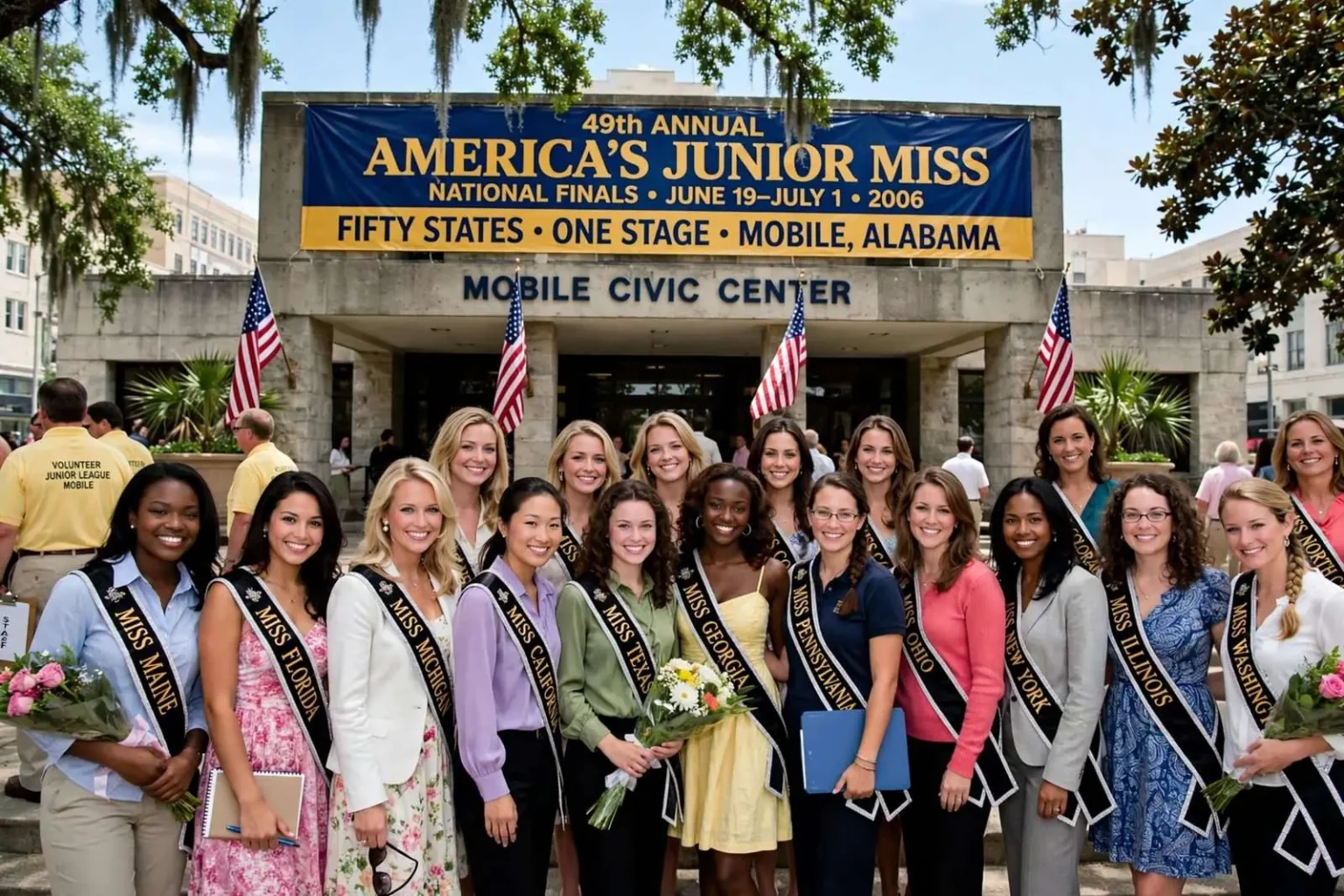
Fifty young women, one from every state, arrived in Mobile on Monday, June 19, 2006, for the 49th annual national finals of America’s Junior Miss — the scholarship program that has called the city home since its founding in 1958. The contestants would remain in Mobile through July 1, rehearsing for the finals and moving through a schedule of community events that had become as much a part of the program as the competition itself.
At stake was a share of $121,000 in college scholarships and the title of America’s Junior Miss 2006.
The prize money mattered, but so did what the title carried with it. The winner spent a year traveling as the program’s national representative, speaking to civic groups and school audiences — a platform that past winners had used as a springboard into careers in law, medicine, broadcasting and public service. For the 50 who arrived in Mobile, even the week itself paid dividends: interview practice, stage experience and a network of fellow finalists who would go on to the same universities and professions.
For nearly two weeks, the city played host to an event that had become a summer fixture of downtown Mobile — a competition whose finalists filled hotels, appeared at civic clubs and marched through a public schedule that made the program as much a community festival as a contest. Generations of local families planned their June around it.
A Program Built on Scholarships
America’s Junior Miss was, at the time, the oldest and largest scholarship program in the country for college-bound high school seniors. Headquartered in Mobile, it had awarded $87.7 million in scholarships at the local, state and national levels since 1958, and more than 700,000 young women had taken part at some level. Roughly 17,000 volunteers supported state and local programs across the country.
Those numbers describe an institution that operated less like a pageant than like a nationwide scholarship pipeline. Each spring, thousands of high school seniors competed in local programs; winners advanced to state finals; state winners came to Mobile each summer. Along the way, cash-for-college followed them at every level, funded by local sponsors, civic clubs and donors in hundreds of communities. The 50 who reached Mobile were the final winners of a funnel that had begun months earlier in high school gyms and civic auditoriums across the country.
The 2006 class reflected the program’s academic emphasis. The young women arriving in Mobile listed college plans that included Harvard, Yale, Stanford, Dartmouth, Northwestern and dozens of flagship state universities.
The competition rewarded scholastic achievement, interview performance, talent and fitness rather than pageant conventions — a distinction the organization guarded carefully. There was no swimsuit competition, and judges scored a private interview with the same weight as the on-stage events. The program’s defenders pointed to that structure whenever the pageant comparison surfaced: this was a scholarship contest that happened to culminate on a stage, not a beauty contest that happened to give out scholarships.
Two Weeks in Mobile
The itinerary was designed to put the contestants in front of the city, and the city in front of the contestants.
A welcome breakfast was held at Bellingrath Gardens. There was lunch with the Mobile Kiwanis Club and, later, with the Lions Club. The contestants shared a luau with residents of the Gordon Oaks retirement community and attended a Mobile BayBears game.
Each stop doubled as an introduction to the place the program had called home for nearly five decades. Bellingrath Gardens, the 65-acre estate gardens along the Fowl River south of the city, has long been among the Gulf Coast’s signature attractions, and a breakfast among its blooms set the tone for a visit steeped in local tradition. The BayBears game placed the finalists in the stands at Hank Aaron Stadium alongside the season-ticket crowd, waving to sections that knew the program by heart.
On Thursday, June 22, the program staged its “Day of Caring,” sponsored by the Junior League of Mobile, sending contestants to volunteer at the Dearborn YMCA, a United Cerebral Palsy summer camp and a Habitat for Humanity build site.
The service day was the itinerary’s moral center. Whatever the stage nights would bring, the program’s public identity rested on the idea that its finalists represented something more than performance — and sending the 50 state representatives into YMCA gyms, a summer camp and a construction site gave the city a look at the contestants doing the work the scholarships were meant to underwrite.
There was a meet-and-greet at Colonial Mall Bel Air and, in a nod to local custom, an oyster-eating contest at Wintzell’s Oyster House.
Wintzell’s, the landmark oyster house on Dauphin Street whose walls are papered with founder J. Oliver Wintzell’s “wisdom,” gave the visitors a taste of downtown Mobile’s dining culture — and a photo opportunity that generations of contestants had passed through before them. The oyster-eating contest was the kind of local ritual the program wore as a badge: refined on stage, unafraid of a little Gulf Coast mess off it.
The Competition Itself
The competition itself ran across three nights: preliminaries on June 28 and 29, with the 49th annual national finals on Friday, June 30.
The Mobile Civic Center, the downtown arena that had hosted the finals for decades, gave the program a stage commensurate with its history. Preliminary nights whittled the field and set the running order for Saturday’s finale, with judges scoring the same categories — scholastic, interview, talent and fitness — that had carried each contestant from her local program to the national stage. By the time the finals arrived, the 50 state winners had been rehearsing together for more than a week, and the Civic Center audience knew them by state and by name.
For the host city, the economics were as familiar as the choreography. Fifty contestants traveling with family members, a national staff, state chaperones and two weeks of rehearsals filled hotel rooms and restaurants in the middle of the summer season — a modest but reliable jolt for downtown businesses that had learned to expect the program’s annual return.
The City’s Investment
Mobile’s civic and business establishment underwrote the event. The City of Mobile, Mobile County and the Mitchell Company served as major sponsors, with category sponsorships from Alabama Power, Encore Rehabilitation, Mobile Gas, Regions Bank and Wintzell’s.
The relationship was long-standing and mutual. For the city, the finals brought two weeks of national visibility, hotel bookings and a televised showcase; for the program, Mobile provided a permanent institutional home, a volunteer base and a venue in the Mobile Civic Center.
That mutual investment is what kept a national program anchored in a city of Mobile’s size rather than drifting to a larger market. The volunteer base alone — the same civic clubs, junior leagues and families who hosted the contestants’ itinerary — could not have been rebuilt from nothing in a new city. In return, Mobile received an annual claim to national attention and a program whose alumnae carried the city’s name into careers across the country.
Generations of Mobilians grew up watching the finals each summer.
That familiarity was part of the program’s social contract. Local families attended as a June tradition the way others attended minor league baseball or Fourth of July fireworks; students from area schools filled seats on the preliminary nights; and the contestants became, for two weeks, recognizable figures around town — the state winner from Montana ordering at the same lunch counters as everyone else. A program that had spent decades building that kind of rootedness did not measure its value only in hotel nights.
What Became of It
The program continued in Mobile for several more years before rebranding as Distinguished Young Women in 2010, a change intended to emphasize its scholarship-and-achievement mission and shed the pageant associations that clung to the older name. The national finals remained in Mobile, still run from the same headquarters, still ending each summer with 50 young women on a stage downtown.
The 2006 class, arriving that June for the 49th finals, sat almost exactly at the midpoint of that history — half a century after the first Junior Miss competition, and a few years before the name they competed under passed into the city’s memory.
Seen from the present, the 2006 finals mark the hinge between the program’s two identities: the last stretch of the Junior Miss era, with its mid-century rituals intact — the civic lunches, the oyster contest, the Bellingrath breakfast — and the beginning of the rebranded institution that followed. What did not change was the structure underneath: a scholarship program, judged on achievement, hosted by a city that had spent half a century learning how to put on the show.