Third-Party Talk and Courthouse Upsets: More Super Tuesday Winners and Losers
In a second round of post-primary analysis, the area's political observers weighed a possible third-party fall campaign and a Mobile County courthouse shake-up, and named winners in an unpredictable year.
In a second round of post-Super Tuesday analysis, the area’s political observers turned to the wilder possibilities of a volatile election year and to several results closer to home. As before, their comments are offered without attribution except where a contributor asked to be identified. The panel, a rotating collection of retired journalists, party figures and longtime watchers of Alabama politics, had earned its following precisely because its members spoke candidly about a season that kept defying prediction.
Super Tuesday had handed the nation a primary map unlike any in recent memory, and Alabama voters had gone to the polls amid a campaign that upended nearly every assumption about how nominations were won. The local observers who had spent careers sizing up state and county races found themselves, like everyone else, unsure what the rules even were anymore.
A Wide-Open Fall?
One retired Alabama political journalist, writing candidly, mused that the year was so unpredictable that a third-party candidate might yet emerge in November — perhaps Donald Trump himself if denied the nomination, or a traditional Republican alternative if Trump prevailed. The possibility was not idle: the Republican contest had exposed deep fissures within the party, and history offered examples, from John Anderson in 1980 to Ross Perot in 1992, of independent candidacies that reshaped general elections.
He walked through the constitutional thicket that could follow a splintered field. An election in which no candidate won a majority of electoral votes would be thrown to the U.S. House of Representatives, where each state delegation casts a single vote — a scenario that could produce a president who had lost the popular contest, and a vice president chosen by a Senate whose composition that year remained genuinely uncertain. Add a divided Supreme Court and a public in no mood to accept a contested outcome, and the ingredients for a constitutional crisis were all on the table. It was, he acknowledged, the sort of speculation only a fool would commit to firmly.
The exercise said as much about the mood of the moment as about the law. Observers who had covered decades of Alabama elections — races governed by predictable geographies and predictable coalitions — found themselves treating scenarios once confined to law school hypotheticals as live possibilities.
The Courthouse Shake-Up
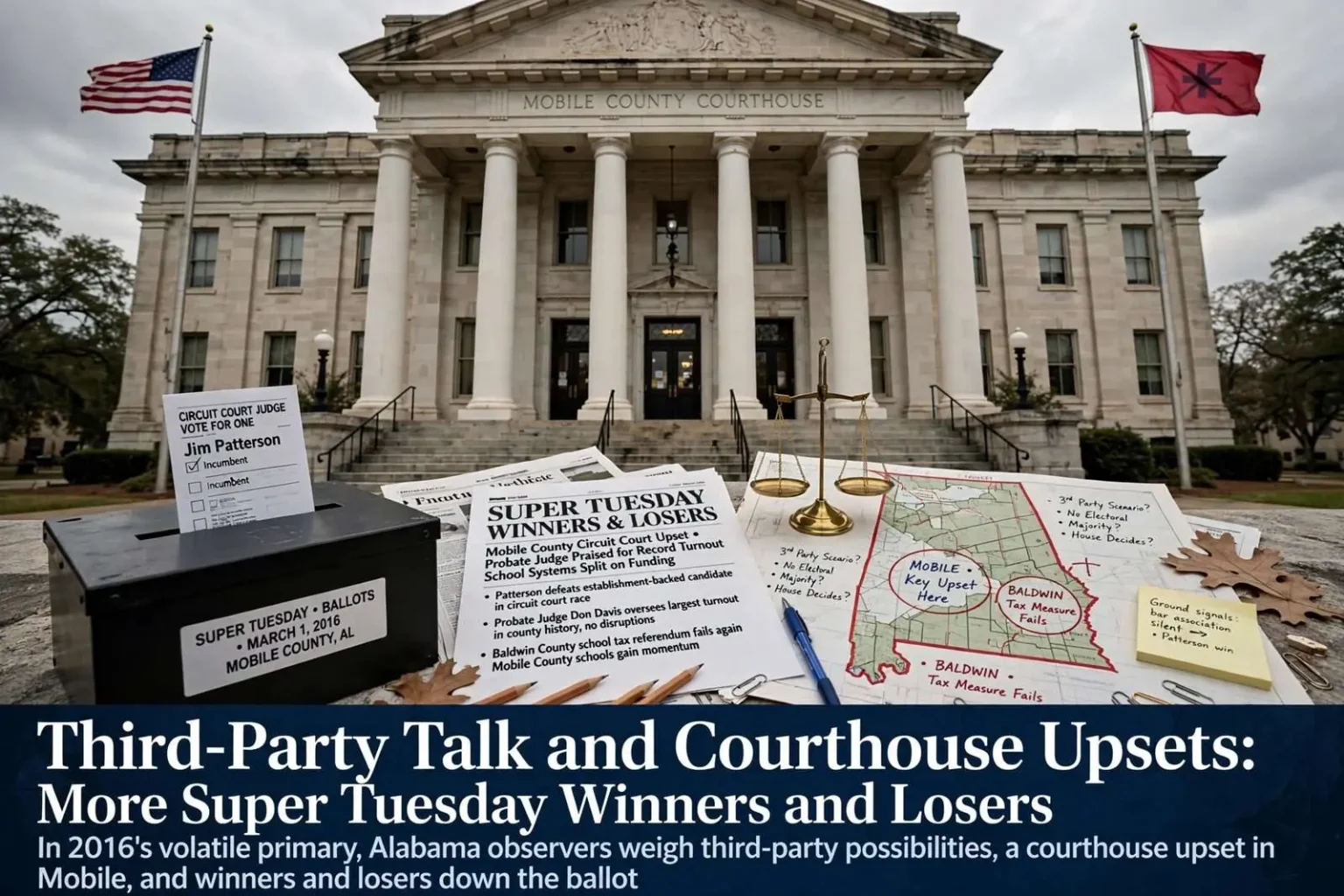
Much of the panel’s attention returned to the Mobile County circuit court race, the down-ballot contest that had produced the year’s biggest local surprise. Several observers framed Jim Patterson’s victory as a defeat for a legal establishment that had, by one account, effectively chosen most judicial appointments in the county for a decade. The telling sign, one noted, was the defense bar’s conspicuous refusal to line up behind the establishment’s candidate — a quiet stand that, in this reading, helped decide the race.
In a courthouse town like Mobile, where trial lawyers and insurance defense firms clash daily before the very judges they campaign for and against, the silence of a powerful bar faction speaks loudly. When lawyers decline to endorse or fund the anointed candidate, the absence registers with other lawyers, with donors, and eventually with voters attentive to courthouse politics. The panel’s consensus was that the establishment’s machinery had run smoothly for years precisely because no one had tested it; Patterson’s campaign had tested it and found it weaker than advertised.
The implications reached beyond a single seat. Circuit court judges in Alabama handle the state’s major civil and felony dockets, and the assignment of cases — which judge hears which lawsuit — can shape outcomes in everything from personal injury litigation to the commercial disputes that course through the Port City’s economy. A new judge who owed his seat to an insurgent coalition rather than the traditional screening process promised to alter the courthouse’s internal balance of power.
Probate Judge Don Davis drew praise as a winner for administering what was described as one of the largest primary turnouts in state history without the complaints or problems that had shadowed recent elections. Mobile County’s electorate is among the largest in Alabama, and conducting a smooth election at record volume — across hundreds of precincts, with long lines reported around the state — was no small administrative feat. Elections offices that had stumbled in previous cycles, drawing litigation and recriminations, had left little margin for error, and Davis’ operation cleared the bar.
The praise carried a practical point as well: in a year when the legitimacy of election administration had become a national talking point, a flawless count in Alabama’s second-largest county mattered beyond the courthouse. Davis, whose probate office also handles marriage licenses, adoptions, guardianships and the recording of deeds, emerged from the primary with his administrative reputation burnished.
A Tale of Two School Systems
The contrast between Mobile and Baldwin counties again featured prominently in the panel’s discussion. With Baldwin reeling from another defeat at the polls on a tax issue, observers argued that the Mobile County school system had seized the higher ground, running advertising touting its improvements while its neighbor scrambled to close a budget gap. Whatever the underlying reasons, the panel judged Mobile County schools a clear winner of the moment.
The two systems sit across Mobile Bay from one another but inhabit different fiscal worlds. Baldwin County, one of the fastest-growing counties in the state, has repeatedly seen property tax and sales tax referendums aimed at school funding go down to defeat, leaving the system to manage swelling enrollment — particularly along the fast-growing Highway 181 and Foley corridors — without commensurate revenue. Mobile County, the state’s largest school system, had invested in publicizing its academic gains, magnet programs and graduation improvements, projecting confidence at precisely the moment its cross-bay neighbor was announcing cuts.
The public relations battle carried real consequences. School funding in Alabama depends heavily on local support, and a system that cannot pass a tax referendum must compete for state dollars and grants with a story about how well it uses what it has. Mobile’s advertising push — unusual for a school system — was aimed at taxpayers and parents alike, and the panel read it as a savvy piece of positioning that left Baldwin County defending its finances instead of promoting its classrooms.
Winners and Losers in the Coverage
One observer counted the local alternative press among the night’s losers, arguing that it had staked out strong positions against several candidates who nonetheless prevailed. The comment reflected a recurring theme in the panel’s analysis: that endorsements and opposition alike carried real political risk in a season when voters seemed determined to defy the usual playbook. Publications that had built credibility on picking winners found their judgment publicly repudiated at the ballot box, a humbling result in a media environment already under strain.
The broader lesson, several panelists agreed, was that 2016’s voters were not reading from the same script as the people who editorialized about them. Down-ballot races that would once have been settled by bar associations, business groups and newspaper endorsements were instead swayed by currents the old gatekeepers barely registered until the results came in.
Reading the Mood
Threaded through the responses was a shared sense that 2016 was rewriting the rules. Observers who had spent careers predicting Alabama outcomes admitted uncertainty about where the year was heading, both nationally and in the down-ballot races that would shape county government and the local bench for years to come. For all the uncertainty, the panel agreed on one practical point: the results had reshuffled the local balance of power in ways that would echo through the coming year.
The judicial upset alone promised to alter how cases were assigned and how the county’s legal community organized itself, while the widening gap between the Mobile and Baldwin school systems set up a fresh round of debates over funding, consolidation and the push for new city schools across the bay. In the background, the third-party speculation lingered as a reminder that the year’s biggest surprises might not be over.
The panel’s own limitations were part of the story. Members who had correctly called county races for decades described a season in which ground-level signals — yard sign counts, fish fry turnouts, bar association silence — contradicted the traditional indicators, and the ground-level signals proved right. Several admitted they would weight those informal measures more heavily in future cycles, a small but real shift in how south Alabama politics gets read.
Whatever the final verdicts, the observers agreed the primary had given south Alabama plenty to watch. A courthouse establishment staggered, a probate judge validated, a school system ascendant and a national contest still unresolved — for a panel that had seen dozens of election cycles, 2016 was shaping up as one they would be explaining for years.