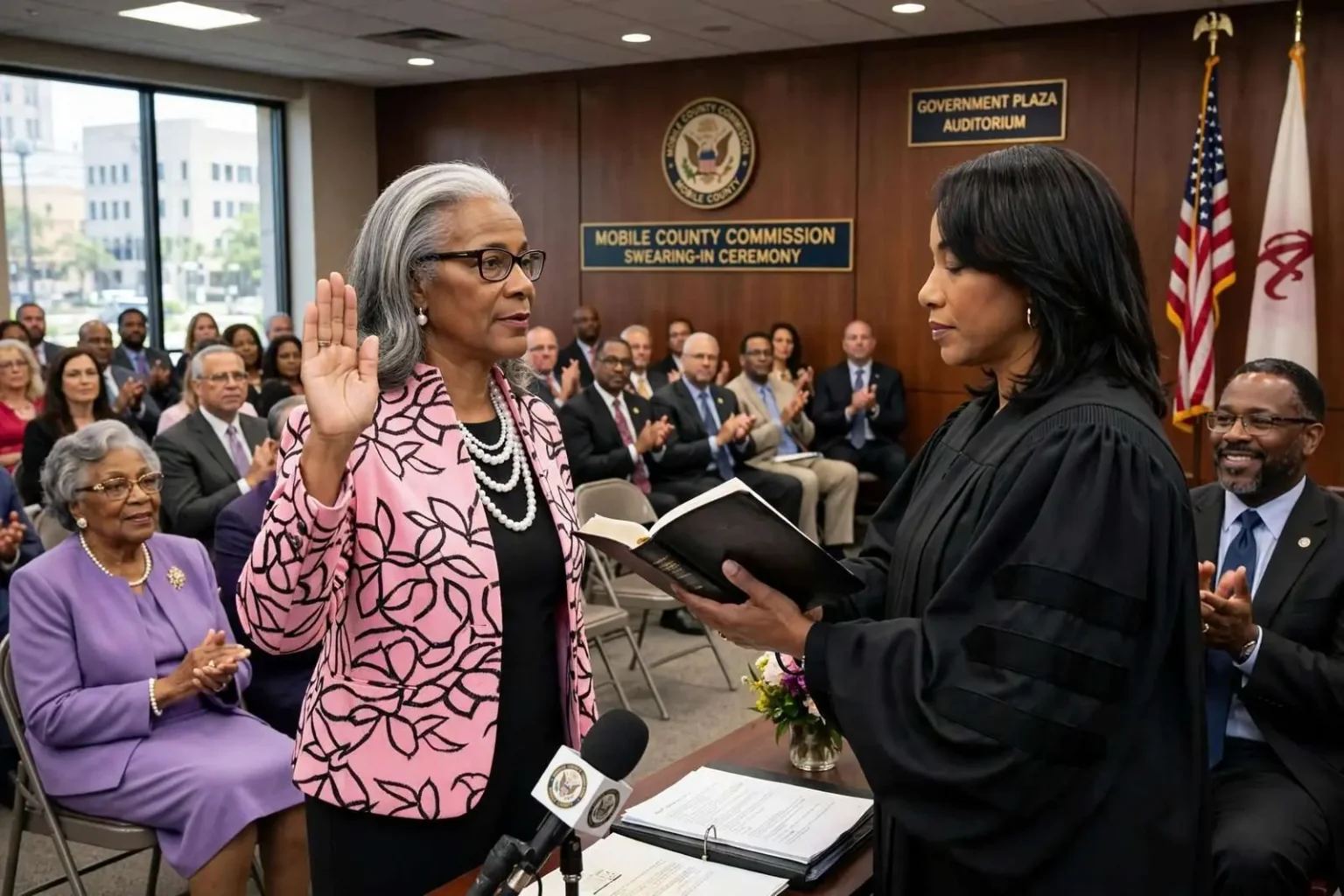
Dismissing suggestions that she might be “too nice, too meek” to press the interests of District 1, Merceria Ludgood took the oath of office as a Mobile County commissioner, restoring the three-member body to full strength after months of vacancy and legal wrangling.
“Some of you have said I may be too nice, too meek (for this), but don’t be fooled,” Ludgood told the crowd gathered in the auditorium at Government Plaza in downtown Mobile. Her legal training and her experience in advancing an argument, she suggested, would serve her well in the political arena.
With her mother, Della, and her husband, federal defender Carlos Williams, in the audience, Ludgood received a standing ovation as she accepted the oath from U.S. Magistrate Judge Sonja Bivins. “It’s finally dawned on me that this is a really big deal,” she said.
A seat contested twice over
The path to the swearing-in had been unusually tangled. The District 1 seat came open when Sam Jones left the commission to become mayor of Mobile. Gov. Bob Riley appointed Juan Chastang, a former Mobile police officer, to fill it — but federal authorities declared the appointment invalid under the Voting Rights Act, removing Chastang from office and forcing him to seek the post by election instead.
Ludgood, a former assistant county attorney, won the Democratic nomination by defeating three opponents without a runoff, then beat Chastang, the Republican nominee, in the special election earlier that month.
The sequence meant District 1 had been represented for the better part of a year by an officeholder the voters had not chosen — first by appointment, then through the legal challenge that unwound it. By the time Ludgood raised her hand at Government Plaza, the seat had effectively been contested twice: once by appointment and litigation, and once at the ballot box.
What the campaign taught her
She said the campaign taught her at least two things: voters wanted assurance they would not be forgotten once the election was over, and they wanted the kind of communication with the commission that would help them in their own efforts to improve their neighborhoods.
Ludgood credited her father with instilling in her a belief in “a day’s work for a day’s pay” and the wisdom of always “looking for the good in others.” Her mission between then and her re-election bid the following year, she said, was to confirm her supporters in their original enthusiasm.
“When we go back (to seek re-election) I want you to say, ‘See, I told you she would do us a good job,'” she said, before adding that she was “ready to go to work.”
A crowded room
The ceremony drew a broad cross-section of local officialdom. Among those on hand were Mobile Mayor Sam Jones, whom Ludgood called her “political mentor”; fellow commissioners Mike Dean and Stephen Nodine; Circuit Judge Rick Stout; District Judge Charlie McKnight; Juvenile Circuit Judge Edmond Naman; County Treasurer Al Sessions; County Revenue Commissioner Marilyn Wood; Satsuma City Councilman Mark Barlow; Prichard Mayor Ron Davis; Mobile City Council President Reggie Copeland; Mobile City Councilmen Fred Richardson and John Williams; Sheriff Sam Cochran; state Reps. Yvonne Kennedy and James Buskey; and Saraland Mayor Ken Williams.
Also attending were lobbyist and former state Rep. Beth Marietta Lyons; former state senator and county commissioner Gary Tanner; former Juvenile Circuit Judge Pam Millsaps; former state Rep. Bill Clark; and presiding Municipal Judge Holmes Whiddon.
The guest list mapped the breadth of District 1 itself — mayors of the smaller municipalities that ring the county’s urban core, city and county officeholders, judges and legislators whose districts overlap the neighborhoods the commissioner would represent. The turnout of fellow officeholders also reflected the seat’s unusual history: nearly everyone in the room had watched the appointment, the litigation and the election that followed.
What came next
The commission Ludgood joined faced a heavy agenda: the incentive package and bond issue tied to the ThyssenKrupp steel complex in north Mobile County, continued hurricane recovery in the south end of the county, and the long fight over how to relieve the Interstate 10 bottleneck at the Wallace Tunnel.
Each item touched District 1 differently. The steel complex — one of the largest industrial investments in the state’s history — was reshaping the county’s northern communities with construction traffic, new jobs and the infrastructure demands that follow both. Hurricane recovery remained an unfinished project in the county’s southern end, where storm damage had compounded the ordinary strains on roads, drainage and housing. And the Wallace Tunnel debate went to the daily experience of every Mobile commuter, including the residents of the district’s urban core who lived closest to the downtown bottleneck.
County commissioners in Mobile also carry responsibilities that reach past roads and drainage, into the budgets of the sheriff’s office, the health department, the court system and the county’s various boards. A commissioner’s vote helps set property tax rates and capital spending, which makes the office one of the most consequential countywide positions even though only one-third of the county’s voters choose each seat.
The district she inherited
District 1 covered much of Mobile’s urban core and its historically underserved neighborhoods, and Ludgood’s central promise — that residents would not be forgotten between elections — spoke directly to a district that had spent much of the year without a commissioner it had chosen.
The legacy of that year was practical as much as symbolic. Constituency work — paving requests, drainage complaints, senior programs, community center questions — accumulated while the seat’s status was contested, and a new commissioner inherits all of it. Ludgood’s background as an assistant county attorney gave her an unusual head start: she had spent 17 years inside the government she was joining, advising commissioners on exactly the questions she would now decide.
Her swearing-in also completed a chapter in Alabama election law. The federal ruling that voided the Chastang appointment reinforced a principle with roots in the civil rights era — that changes to county officeholders in covered jurisdictions must account for the Voting Rights Act — and the special election that followed gave District 1 the one thing it had not had since the vacancy opened: a commissioner of its own choosing.
She would go on to serve on the commission for years afterward, becoming one of its most durable figures — and, in time, its president — while the “too nice, too meek” line from her first day followed her as an answer rather than a question.
The meaning of an oath ceremony
Swearing-in ceremonies for county office are ordinarily brief, procedural affairs. This one had the weight of an ending — of a dispute that had occupied courthouses and headlines for more than a year — and the size of the crowd reflected how many people had taken sides along the way.
Government Plaza, the downtown complex that houses both city and county government, has hosted its share of contested political moments, but few seats in Mobile County government have arrived at it by a road as circuitous as District 1’s. An appointment by a governor, a federal administrative ruling, an ouster, a special election and a general contest all stood behind the moment when a magistrate judge administered the oath.
That Judge Sonja Bivins — then a U.S. magistrate judge — administered it added its own resonance, placing a federal officer at the center of a ceremony made necessary by a federal ruling. The choice of officiant underscored how thoroughly the seat’s resolution had run through the federal system.
Between the election and the next one
Ludgood’s remarks framed the short runway ahead of her precisely: a re-election bid the following year, with a constituency she had asked to judge her on results. Her promise to make supporters say “I told you she would do us a good job” converted the campaign’s reassurance into a measurable standard — visible work in the district, answered calls, and a commissioner present in the neighborhoods rather than only at Government Plaza.
That standard would be tested quickly. The commission’s agenda gave her little time to ease in: votes on the steel complex’s incentives and bonds, recovery spending in the south end, and the county’s position on the I-10 bottleneck all awaited a full three-member body. Restoring the commission to full strength mattered procedurally for exactly that reason — a two-member commission could transact business, but a three-member body restores the full range of coalitions and the missing district’s voice.
For District 1’s residents, the practical change was simpler. The neighborhoods of Mobile’s urban core had their own advocate at the table again — one elected by them, vowing not to forget them, and starting a career that would make her one of the defining figures in modern Mobile County government.