Riley’s Runoff Endorsement Angers, Pleases and Puzzles Coastal Republicans
Gov. Bob Riley's decision to back Randy McKinney over Trip Pittman in a Republican runoff broke an unwritten rule and left Mobile and Baldwin Republicans debating what it cost the party.
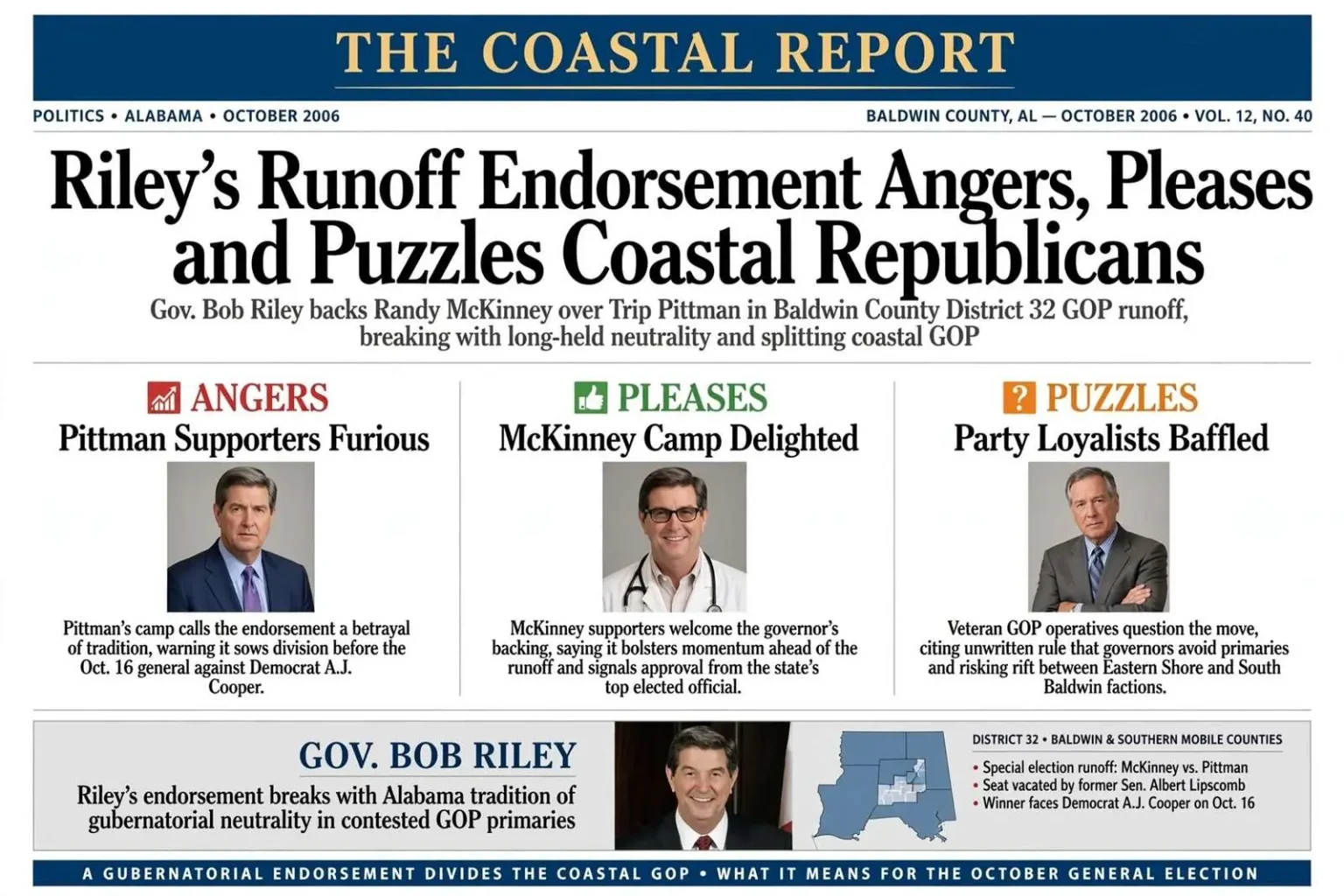
Gov. Bob Riley variously angered, pleased and puzzled Republicans across Mobile and Baldwin counties with his endorsement of Randy McKinney over Trip Pittman in the GOP runoff for Baldwin County’s District 32 state Senate seat. The move, coming in the final days before the runoff, broke with a long-standing custom in Alabama politics that governors stay out of contested primaries, and it set off three distinct reactions that traced the fault lines inside the coastal GOP.
McKinney’s camp was naturally delighted to have the state party’s most prominent figure so publicly in its corner in the days before the election. For a candidate in a tight runoff, a gubernatorial endorsement is worth more than any advertisement: it signals to rank-and-file Republicans that the state’s top elected official believes one candidate is the better choice, and it tends to dominate the local news cycle in a way a mailer never can.
Pittman’s supporters were furious that a sitting governor would take sides between two Republicans with no obvious reason — a move they feared would sow division heading into the Oct. 16 general election against Democratic nominee A.J. Cooper, an experienced and capable candidate. Whatever grievance the runoff left behind, they argued, would follow the winning nominee into the fall campaign, handing ammunition to a Democratic opponent in a district Republicans could not afford to lose.
Three camps, one endorsement
The third camp was simply baffled. Longtime party loyalists and professional operatives viewed the decision as dubious politics. Pittman, after all, was not proposing to align himself with the Democratic Senate leadership faction the governor had spent years fighting. The upside of backing McKinney seemed not to outweigh the sour taste left behind — a point that would matter in a county where Republican turnout in the runoff would effectively decide who held the seat, given the district’s heavily GOP makeup.
So why would a seasoned politician cut against conventional wisdom? Among the more intriguing theories circulating in the days before the vote was that the endorsement had less to do with either candidate than with former state Sen. Albert Lipscomb. Lipscomb, a Magnolia Springs farmer who had held the District 32 seat before resigning it, was eliminated in the first-round primary and promptly endorsed Pittman. Several sources pointed to the governor’s displeasure with Lipscomb as a major factor in his unusual intervention.
One veteran Republican with ties to Riley said the governor never uses profanity — with one exception. The remark, delivered half in jest, captured how personal the Lipscomb history had become inside the administration, and how far some insiders believed Riley was willing to go to keep Lipscomb’s preferred candidate out of the Senate seat.
‘It is an unwritten rule’
The reaction split roughly along the lines of who each observer had supported.
“I am not sure there is a rift in the Baldwin County GOP,” a political consultant said. “It is more disappointment in Riley getting involved in a primary. While Riley may be liked and respected in Baldwin, the voters don’t want to be ‘told’ who to vote for.” He noted that Riley had shown “almost zero coattails” in 2006 despite winning re-election with 58 percent — a reminder, in his view, that a governor’s endorsement rarely moves as many votes as it is presumed to.
A veteran Republican was more pointed: “It is an unwritten rule that an incumbent does not endorse candidates in the primary. It will make it awkward for the governor if Pittman wins and it makes the primary battle more divisive within the party.” The warning carried a practical edge: a governor who picked a loser in a primary would have to work with that loser’s running mate-turned-nominee for years, and a governor who picked a winner would carry the resentment of the losing camp into every future county fight.
A Baldwin GOP official said the endorsement widened an existing fault line: “The rift this endorsement has created is significant and unfortunately it also provides a further rift and animosity between the Eastern Shore GOP and South Baldwin GOP which was substantial prior to the endorsement.” Baldwin County’s Republican organization has long been split geographically — the fast-growing Eastern Shore communities of Fairhope, Daphne and Spanish Fort on one side, and the more rural South Baldwin towns of Foley, Gulf Shores and Magnolia Springs on the other — and local operatives said the McKinney-Pittman race had drawn strength from both sides of that divide before Riley’s entry sharpened it.
A Mobile attorney warned of lasting damage, arguing that a governor who manufactures a primary grudge does not simply make enemies for a season; he rearranges the alliances that will govern county politics for years. In Baldwin County, where one party dominates every office from probate judge to county commissioner, primary fights are the real elections, and the personal debts created inside them are not forgiven on Election Day.
Why the seat mattered
The runoff grew out of a special election to fill the District 32 seat in the Alabama Senate, a district that runs across most of Baldwin County and reaches into southern Mobile County. The seat had been associated with Lipscomb, the Magnolia Springs lawmaker whose departure had triggered the special election, and his attempt to reclaim it ended when voters eliminated him in the first round of the primary. His immediate endorsement of Pittman — a Fowl River-area businessman and former Baldwin County commissioner — turned him into a decisive factor in the runoff.
McKinney, meanwhile, carried his own credentials into the race. A Daphne physician and former two-term Baldwin County commissioner, Randy McKinney had built his campaign around his service on the commission and his ties to the Eastern Shore’s rapidly growing communities. The race between the two men had been framed by local Republican activists as a contest between South Baldwin’s rural roots and the Eastern Shore’s growth-machine politics, and Riley’s endorsement was read through that same geography.
What the general election looked like
Whoever emerged from the runoff would face A.J. Cooper in the Oct. 16 general election. Cooper, the Democratic nominee, was regarded even by many Republicans as an experienced and capable candidate — a point that made the intra-party squabbling more consequential, because a distracted or demoralized GOP coalition in Baldwin could not be assumed to coast to victory as it usually did. County Democrats, long marginalized in Baldwin elections, saw the runoff bitterness as their opening to make the general competitive.
The larger stakes extended beyond one Senate seat. Riley was midway through his second term as governor, having won re-election in 2006 with 58 percent of the vote, and was pushing a legislative agenda that depended on cooperative Senate allies. A Baldwin County senator aligned with the administration would strengthen his hand in Montgomery; one with an independent base and a grudge would not. That calculus, operatives in both camps said, was exactly why observers expected a governor to stay neutral — and why the decision to break that neutrality drew such scrutiny.
The unwritten rules of Alabama primaries
Alabama governors historically have treated party primaries with caution, intervening only when a seat was seen as pivotal to their agenda or when a personal enemy was on the ballot. The custom has a logic: a primary endorsement spends political capital on a race the governor cannot control the outcome of, while the general election offers no comparable certainty of gratitude. In this case, insiders said, both forces were present — McKinney was seen as sympathetic to the administration, and Lipscomb, whose runoff endorsement had gone the other way, was seen as a genuine antagonist.
Whether the gamble would pay off would be answered twice: once at the runoff polls, and again on Oct. 16, when the surviving nominee faced Cooper with a fractured party watching. Pittman went on to win the runoff and then the general election, taking the District 32 seat and holding it through subsequent terms, while the McKinney camp carried its disappointment quietly into county politics. The episode became a case study in Baldwin Republican circles for what a gubernatorial endorsement can do — and what it cannot undo.
Political scientists who study Alabama’s one-party counties often note the paradox that made the episode so instructive: in a county where the general election is nearly a formality, the primary is where accountability lives, and outside interference in a primary strikes voters as a denial of the only vote that truly counts. That perception, several Baldwin operatives said, explained why a popular governor’s endorsement produced more irritation than enthusiasm even among Republicans inclined to agree with his choice. A statewide official who wins 58 percent of the vote in November cannot transfer that popularity into a county primary, because primary voters are precisely the voters most invested in making up their own minds.
For the party officials left to pick up the pieces, the lesson was procedural as much as personal: the Baldwin County GOP would spend the following months working to bridge the Eastern Shore–South Baldwin divide that the endorsement had widened, and operatives on both sides agreed that the next contested primary in the county would be fought, in part, over who had the governor’s blessing — and who resented it.