Mobile, Baldwin School Leaders Press State Lawmakers on Classroom Technology Funding
Mobile and Baldwin County school officials met with state lawmakers to push for renewed technology funding after years without state support.
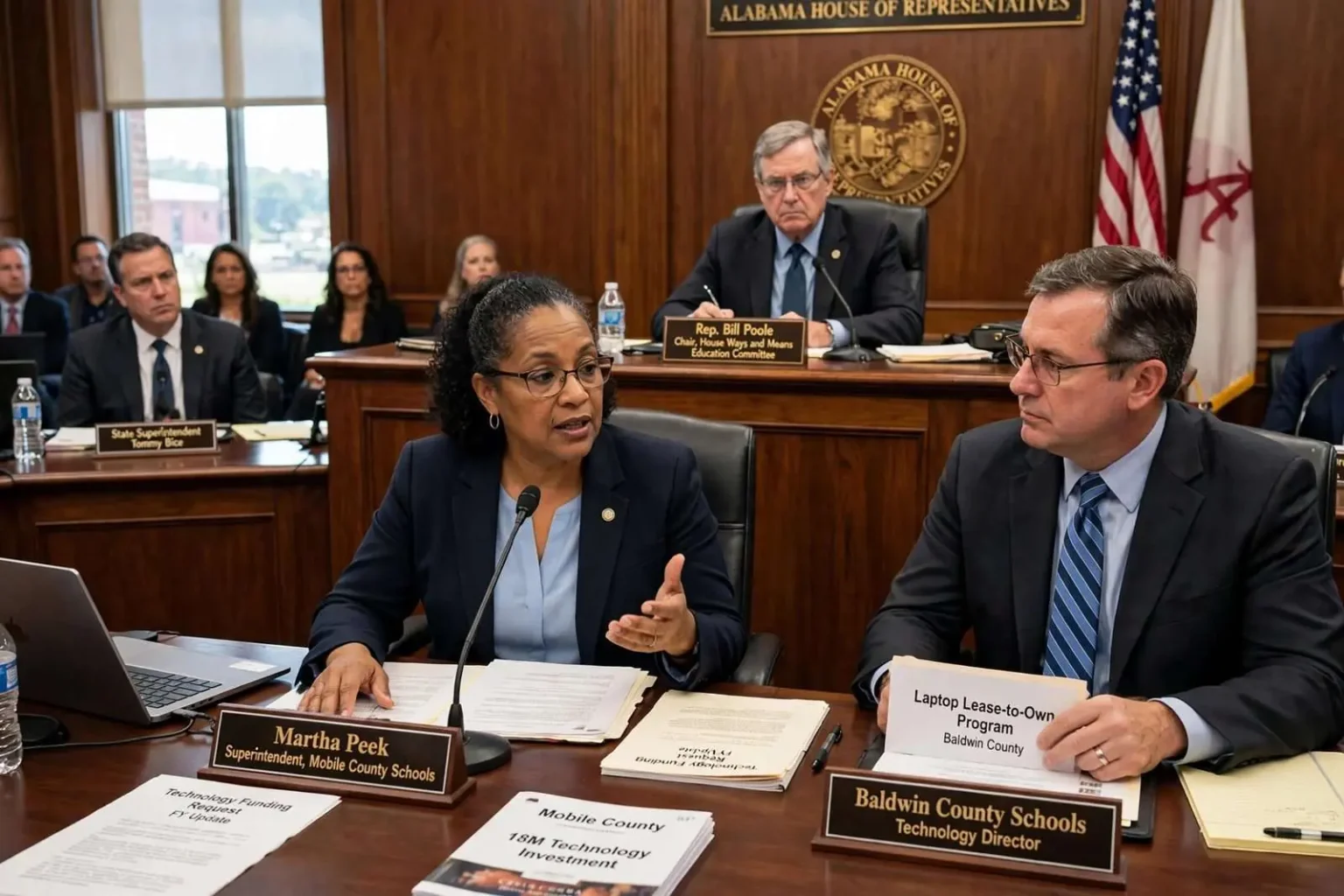
Leaders from the Mobile County and Baldwin County school systems traveled to Montgomery in late July to meet face to face with the Alabama House Ways and Means Education Committee, laying out the mounting cost of keeping classroom technology current in an era when digital learning has become central to daily instruction. The session gave state lawmakers a firsthand look at how differently districts across Alabama are handling the shift toward computers and internet-based learning, and it highlighted the gaps that remain between systems with robust local funding and those struggling to keep pace. For Mobile-area residents, the hearing offered a rare window into the financial machinery behind the tablets, laptops and online coursework that have quietly become part of the everyday school experience.
The hearing was convened by the committee that writes the state education budget, a panel whose decisions shape how every dollar in the Education Trust Fund is distributed to Alabama’s more than 130 local school systems. Committee members heard from superintendents, technology directors and state officials about the scale of the investment now required simply to keep schools connected, and about what happens in districts where that investment has been impossible to sustain.
Mobile County Schools Superintendent Martha Peek was among those who addressed the committee, which is chaired by state Rep. Bill Poole of Tuscaloosa. Mobile-area legislators James Buskey and Jamie Ison also sat on the panel, giving the county’s delegation a direct stake in the testimony. State Superintendent Tommy Bice joined the discussion, along with a representative from the governor’s office and technology officials from the Baldwin County and Shelby County school systems, underscoring how widely funding models and technology strategies vary from one district to the next.
The testimony came at a moment when Alabama’s public schools are testing how far digital instruction can stretch. Online and virtual course offerings have expanded across the state, end-of-year assessments have moved toward computer-based administration, and districts increasingly treat broadband access and device availability as core instructional needs rather than luxuries. But the hearing made clear that no two Alabama districts have reached that point the same way, or at the same cost.
Two Districts, Two Very Different Models
Mobile County has leaned on a bring-your-own-device model, in which roughly seven out of ten students supply their own tablets or laptops while the district covers the rest. The approach spreads the expense across thousands of families and allows the system to stretch its technology budget further, but it also means the district must maintain an inventory of loaner devices for students whose families cannot afford to buy or maintain equipment of their own. Officials said managing that balance has become a persistent operational challenge, particularly in schools serving lower-income neighborhoods.
Baldwin County, by contrast, has issued a laptop to every student in grades 4 and up through a lease-to-own partnership, requiring families to pay a modest insurance fee and accept responsibility for a deductible if a device is damaged outside of warranty coverage. The initiative, which Baldwin leaders have promoted as a way to put computing power in the hands of every student regardless of family income, has been closely watched across the state as one of the most aggressive device programs in Alabama. It has also required the county system to negotiate pricing, insurance terms and replacement cycles with vendors in ways that a traditional textbook adoption never demanded.
Both approaches carry costs well beyond the devices themselves, and that message was a recurring theme of the hearing. School officials explained that expanding digital learning requires broadband upgrades, additional wireless access points, expanded server capacity and dedicated technology staff on top of the hardware that families and districts already provide. A laptop that sits in a classroom without reliable wireless coverage or bandwidth to spare, they noted, delivers little instructional value.
Those infrastructure demands fall hardest on older buildings, which were designed decades before anyone imagined a school wing might host hundreds of devices connecting to the network at once. Retrofitting campuses for high-capacity wireless and modern fiber connections has become one of the largest unbudgeted expenses many Alabama systems face, and it rarely shows up in the public debate in the same way that new buildings or athletic facilities do.
Millions Invested, and the Job Is Never Done
Mobile County alone has invested close to eighteen million dollars in technology infrastructure since the mid-2000s, aided significantly by federal E-Rate matching grants, yet officials told the committee that the job is never finished as technology requirements keep shifting. The E-Rate program, administered by the Federal Communications Commission, provides discounts that help schools and libraries pay for telecommunications and internet access, and it has long been a critical supplement for Alabama districts whose local tax bases cannot absorb the full cost of network upgrades on their own.
The stakes of that sustained investment were illustrated by a recent Mobile County milestone: the district became the only school system in Alabama to administer its spring ACT testing entirely online, doing so across roughly 30,000 students. Officials said the feat would have been impossible without years of steady spending on bandwidth, devices and technical support, and it served as proof of concept that the district’s infrastructure can handle demanding, high-stakes digital workloads when it matters most.
The online administration of the ACT also carried practical benefits that resonated with committee members. Results are returned faster than with paper testing, scheduling is more flexible, and students complete the exam on the same kind of device they use for daily coursework. But districts that lack Mobile County’s infrastructure cannot replicate the approach, a point that underscored the widening divide between systems that have invested consistently and those that have not had the resources to do so.
The demands are only growing. With ten additional Mobile County schools joining the district’s device program this fall and a new virtual school option preparing to launch, Peek told lawmakers that current technology needs in Mobile County alone run in the range of twelve million dollars, with more investment likely required in coming years. The virtual school, which will let students take courses entirely online while remaining enrolled in the district, adds its own costs in licensing, staffing and support that do not disappear once the program is up and running.
Baldwin County officials described a similar trajectory. The lease-to-own device program shifts a portion of hardware costs to families, but the system still carries the network, support and replacement burdens that come with putting tens of thousands of laptops into circulation across one of the fastest-growing counties in Alabama. New schools and rapidly expanding enrollment mean the county’s technology footprint grows every year, even when the per-student model holds steady.
Shelby County’s technology leaders added a third perspective, describing how one of the state’s wealthiest and fastest-growing suburban systems has structured its own investments. Their participation drove home the hearing’s central point: whether a district is wealthy or struggling, urban or rural, the underlying technological needs are remarkably similar, and no district has found a way to meet them without sustained outside help.
A Funding Gap That Has Widened Since 2008
The issue that hung over the entire discussion was the absence of state support. Officials noted that state lawmakers have not allocated dedicated technology funding to Alabama’s public schools since 2008, leaving districts to rely almost entirely on local budgets, competitive grants and family contributions to keep pace with classroom technology demands. In the years since, the cost of devices, bandwidth and digital curricula has only climbed, while the instructional expectations placed on schools have expanded dramatically.
That gap hits districts unevenly. Systems anchored to strong commercial tax bases, like those in parts of the Huntsville, Shelby County and Baldwin County areas, can fund substantial technology programs locally. Rural systems and urban districts with limited property and sales tax revenue have far less flexibility, which means a student’s access to digital learning can depend heavily on geography. School leaders argued that the state’s reliance on local effort has effectively created a two-tier system of technology access.
School leaders left the meeting hoping the Legislature might establish a dependable, ongoing funding stream for classroom technology, whether calculated per student or per teacher, to help offset these costs statewide. A predictable allocation, they argued, would let districts plan multi-year device refresh cycles and network upgrades instead of lurching from one grant opportunity to the next. Recurring funds would also make it easier for systems to borrow for infrastructure projects or negotiate long-term leases with vendors, both of which are difficult to justify against one-time money.
Committee members asked pointed questions about how such a funding stream would be structured and how districts would be held accountable for the results. Lawmakers in recent years have pushed to tie state dollars to measurable outcomes, and any new technology allocation would likely come with expectations about digital literacy, online course availability and student performance on computer-based assessments. Peek and the other superintendents indicated their systems could document the instructional gains tied to prior investments, pointing to Mobile County’s online ACT administration as evidence.
The timing of the discussion matters for Mobile-area families in concrete ways. The district’s twelve million dollar current-need estimate covers the band of spending required to keep the existing device program, virtual school and online testing infrastructure operating at the level students now expect. Without new state support, those costs would compete directly with classroom staffing, transportation and building maintenance in the county’s local budget, forcing trade-offs that residents ultimately feel in other parts of the school operation.
Baldwin County parents, meanwhile, continue to shoulder the insurance fees and deductibles built into the lease-to-own program, a cost-sharing arrangement the district has defended as the only realistic way to put a laptop in every student’s hands. Local officials noted that even a well-designed family contribution model depends on underlying district investment in networks and support staff, which is precisely the layer of spending that has gone unfunded by the state for years.
Education advocates who track the issue say Alabama is not alone in facing the problem, but the state’s decision to leave technology funding entirely to local effort has made the disparities sharper than in states that distribute dedicated digital learning aid. Congress’s periodic reauthorizations of the E-Rate program have helped with connectivity, but E-Rate dollars cannot pay for devices, software or the technology staff districts need to run everything, leaving a persistent funding hole at the center of the operation.
For now, the July hearing stands as the most public reckoning yet on the subject in Montgomery. Peek, the Baldwin and Shelby County technology officials, Bice and the governor’s office representative all left lawmakers with the same broad conclusion: digital learning is no longer optional in Alabama classrooms, the costs are real and recurring, and the current patchwork of local dollars, federal discounts and family fees cannot sustain it indefinitely. Whether the Legislature responds with a dedicated funding stream in its next budget cycle will determine whether districts like Mobile and Baldwin can keep building on the progress they described, or whether the state’s technology gaps will continue to grow in the years ahead.
For residents of Mobile and Baldwin counties, the hearing was also a reminder of how much has changed in a decade. A school system that now tests 30,000 students online in a single spring, and a county that has issued laptops to every student in grades 4 and up, were both unthinkable when the state last funded classroom technology in 2008. The superintendents’ message to the committee was that the next decade will demand the same steady commitment, and that the state has a choice about whether it will share in that cost or leave it entirely to local taxpayers and families once again.