Mobile Adopts New Stormwater Rules Under State Consent Decree
Mobile's City Council approved revised stormwater rules days after a consent decree with state environmental regulators.
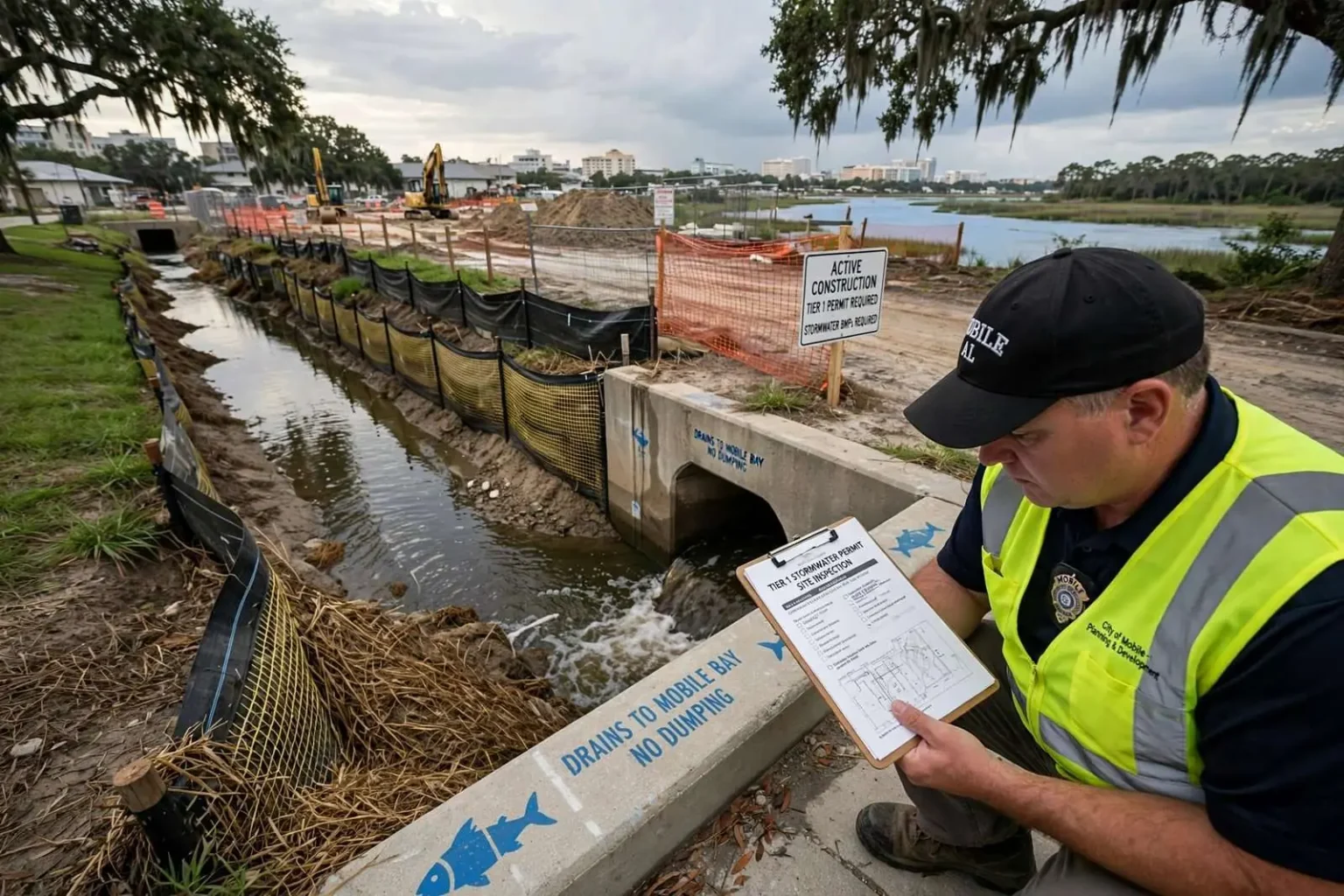
The Mobile City Council unanimously approved a revised stormwater management ordinance this week, capping off an agreement reached just days earlier with state environmental regulators over how the city manages runoff and pollution in its waterways. The vote aligned the city’s development rules with the terms of a consent decree worked out with the Alabama Department of Environmental Management, and it changed in practical terms how construction projects across the city will be reviewed and policed.
Stormwater is one of the most consequential and least visible environmental issues facing a coastal city like Mobile. Rain that once soaked into forest and marsh now sheets off rooftops, parking lots and streets, picking up sediment, oil, fertilizer and debris on its way into the ditches, creeks and rivers that drain toward Mobile Bay. How well a city manages that runoff determines not only the clarity of its waterways but the frequency of its street flooding and the health of the bay’s fisheries — concerns that touch every neighborhood from Spring Hill to Africatown.
The ordinance passed without discussion from council members, but its practical significance for builders and developers was substantial. What had been a one-size-fits-all permit system now distinguishes between small projects with modest runoff and large sites with the potential to move serious volumes of mud and pollution during construction.
New tiers for land disturbance permits
Previously, all land disturbance permits were grouped into a single category regardless of project size. Under the new rules, developments under one acre fall into a Tier 2 category that keeps the same requirements as before, while projects larger than an acre now fall under Tier 1, requiring developers to submit detailed plans and letters of credit to the city before breaking ground.
Dianne Irby, the city’s director of Planning and Development, said the split ensures the city collects proper best-management-practice reports from developers working on larger sites, which are more likely to generate significant stormwater runoff during construction. “It’s to ensure we have best management practices in place to make sure we minimize stormwater in those developments,” Irby said.
The tiered approach mirrors the structure of the federal Clean Water Act’s construction stormwater rules, which key requirements to acreage for the same reason Mobile’s ordinance does: the environmental footprint of a half-acre lot and a fifty-acre clearing are simply not comparable. A large site stripped of vegetation can shed tons of sediment in a single heavy rain, smothering stream beds and clogging the city’s drainage system far downstream. Requiring engineered plans and financial guarantees before work begins gives the city leverage to ensure sites are stabilized properly rather than cleaned up after the damage is done.
The ordinance also requires commercial and industrial facilities considered “high-risk” to submit similar management plans as part of a broader illicit discharge detection and prevention program. That provision shifts attention from construction sites to the businesses that operate permanently in the city — auto shops, industrial yards, restaurants and other facilities where pollutants can enter storm drains a little at a time, day after day, in ways no single inspection would catch.
Part of a broader deal with state regulators
The ordinance update stems from a consent decree the city reached with the Alabama Department of Environmental Management on June 30, resolving a dispute over the city’s compliance with stormwater management requirements. As part of that decree, the city agreed to pay a $135,000 fine, payable over three years, a significant reduction from the $475,000 penalty the city had initially faced last year for failing to comply with an earlier consent decree governing its stormwater system.
Consent decrees occupy a particular place in environmental enforcement. They are negotiated agreements, filed and enforceable, in which a regulated party commits to specific corrective actions on a schedule in exchange for resolving alleged violations. For Mobile, the June 30 decree meant the revised ordinance was not optional housekeeping — it was a deliverable, one piece of a larger set of obligations the city accepted to bring its stormwater program back into compliance and to avoid the larger penalty that had been on the table.
The fine’s installment structure — $135,000 spread over three years — reflected both the severity of the lapse and the city’s fiscal realities. A municipality cannot simply print money for penalties; every dollar paid to the state is a dollar not spent on drainage maintenance, and regulators have often structured payments over time for exactly that reason. The negotiated reduction from $475,000, meanwhile, signaled that the state viewed the city’s renewed commitments, including the ordinance overhaul, as worth more than the maximum fine.
The decree also requires the city to make continuing investments in its stormwater program — the kind of obligations that typically include upgraded mapping and tracking of the drainage system, routine inspections of construction and industrial sites, monitoring of waterways, and public education about runoff. Those commitments matter more to residents than the fine itself: they are the mechanism by which the ordinance on paper becomes cleaner creeks in practice.
Why stormwater rules matter in Mobile
Mobile’s geography makes it unusually exposed to the consequences of poorly managed runoff. The city sits at the head of Mobile Bay, into which the Mobile, Tensaw, Spanish and other rivers drain a vast watershed, and its own terrain — low, flat and laced with creeks — means rainwater accumulates quickly and lingers. Heavy thunderstorms routinely flood streets in low-lying neighborhoods, and every blocked drain and sediment-clogged ditch makes those events worse.
The waterways that thread through the city — Three Mile Creek, Eightmile Creek, One Mile Creek and their tributaries — carry the city’s runoff directly toward the delta and the bay. Sediment from construction sites clouds the water and buries aquatic habitat; bacteria and nutrients wash off lawns, failing septic systems and aging infrastructure; and petroleum products drip from the region’s roads into the same channels. The bay’s seafood industry and the tourism economy along the Eastern Shore both depend on that water staying clean enough to support it.
For decades, federal rules have required mid-sized and large cities to operate stormwater management programs under permits administered by the state — programs that must include construction site controls, industrial inspections, detection of illicit discharges and public outreach. Mobile’s revised ordinance is the city-level machinery that makes those requirements enforceable, translating federal and state expectations into permit conditions a local builder actually encounters.
What changes for developers and builders
For anyone planning a project in Mobile, the practical differences begin at the permit counter. A development of less than an acre moves through the Tier 2 process much as before, with the standard erosion controls and permit conditions that have applied for years. A project above the one-acre threshold enters the Tier 1 track, where the city expects a full stormwater pollution prevention plan — engineered drawings showing how sediment basins, silt fencing, stabilized entrances and staged clearing will keep runoff on site — backed by a letter of credit that gives the city recourse if the controls are never built or never maintained.
Builders familiar with the process will recognize the logic. Best management practices are only as good as their enforcement, and enforcement is only as good as the paper trail behind it. By requiring detailed plans up front, the city can inspect against a specific, approved design rather than generic standards; by requiring financial security, it ensures that finishing the job properly is cheaper than abandoning it. Developers who already build to modern standards will find the requirements familiar — the federal construction stormwater permit has demanded similar controls for years — while smaller operators who have treated erosion control as an afterthought will find the margin for error narrower.
The high-risk facility provisions extend the same philosophy to permanent businesses. Facilities flagged for the program will be expected to document how they keep pollutants out of storm drains, and to allow the inspections that verify it. For businesses near creeks or the bay shoreline, the scrutiny is proportionate to the risk their location poses.
The road back to compliance
With the ordinance adopted, the city’s task shifts to implementation — training inspectors, processing Tier 1 submittals, mapping outfalls for the illicit discharge program and documenting everything for ADEM’s review. Consent decrees are measured by completed milestones, not good intentions, and the next test of the June 30 agreement will be whether the program Mobile promised is the program Mobile actually runs.
For residents, the stakes are concrete even when the paperwork is not. Cleaner construction sites mean fewer muddied creeks after summer storms; a working illicit discharge program means fewer mysterious sheens on neighborhood ditches; and a city in compliance with its permit is a city spending its drainage dollars on maintenance instead of penalties. The council’s unanimous vote reflected how little controversy attaches to those goals — and how much of the region’s environmental future depends on the unglamorous work of managing rainwater well.
The revised stormwater ordinance, adopted in the same week as the consent decree that produced it, now stands as the operating manual for how Mobile grows without washing its pollution into the bay — a document that will shape every significant construction site in the city for years to come.