Mobile Murder Suspect Sentenced to 15 Years on Federal Gun Charge
A 21-year-old already facing a state murder charge received a 15-year mandatory federal sentence for illegal gun possession.
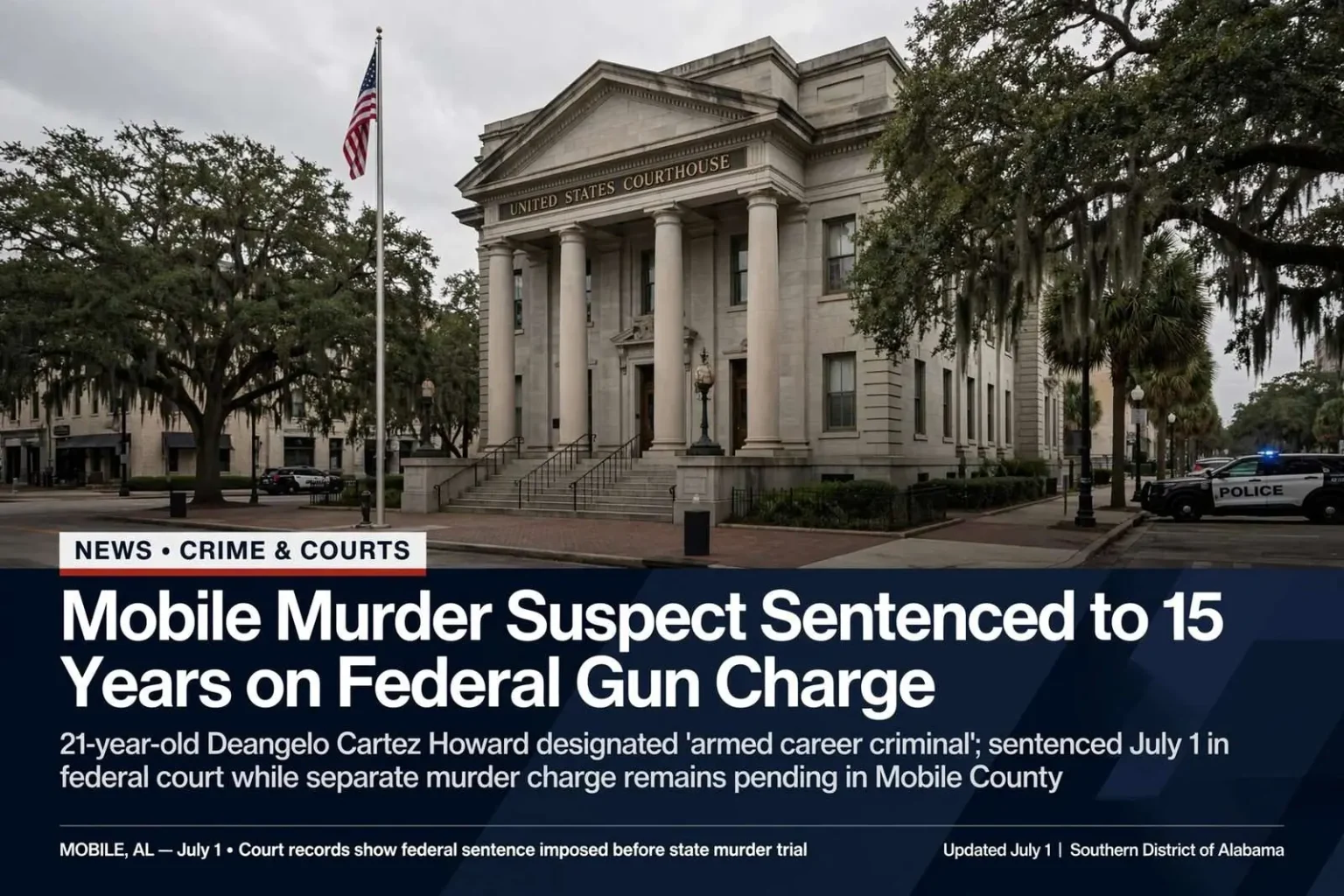
A 21-year-old Mobile man already facing a state murder charge has been sentenced to 15 years in federal prison after being convicted of illegally possessing a firearm, according to court records. The sentence — imposed before the murder case has even reached trial — shows how federal weapons prosecutions can outrun state proceedings when a defendant’s record and the circumstances of an arrest line up in a particular way.
Labeled an Armed Career Criminal
Deangelo Cartez Howard was designated an “armed career criminal” following his federal conviction for being a felon in possession of a firearm, a classification that made his 15-year sentence mandatory under federal law. The designation stems from the Armed Career Criminal Act, the federal statute that imposes a fifteen-year minimum prison term on defendants with prior serious drug or violent felony convictions who are caught with a gun. Chief U.S. District Court Judge William H. Steele handed down the sentence on July 1, closing the federal chapter of a case that began with an ordinary call to police in midtown Mobile.
According to Howard’s plea agreement, the case began on March 7, 2013, when he was staying at a female friend’s house on Mohawk Street in midtown Mobile. The woman discovered he had brought a bag of bullets into her home and called police — a decision that set in motion both his arrest and the federal case that followed. Officers arrived and arrested Howard on a series of outstanding warrants, including charges of murder, attempted murder and robbery, connecting him to serious violence that predated the call.
Members of the Gulf Coast Regional Fugitive Task Force, working with the woman’s help, searched the residence and recovered the bullets along with a .38-caliber pistol, evidence that formed the basis of the federal firearms charge. Because Howard had two prior felony convictions for second-degree robbery, the recovered weapon converted what might have been a state weapons case into a federal prosecution carrying a mandatory fifteen years.
The Federal Firearm Case Explained
Federal law prohibits anyone with a felony conviction from possessing a firearm, and prosecutors in the Southern District of Alabama treat those cases as a core part of their violent-crime docket. Most felon-in-possession convictions allow a judge wide sentencing discretion, but the Armed Career Criminal Act removes that discretion when the defendant has a qualifying history, as Howard did with two second-degree robbery convictions already on his record. The statute’s mandatory structure is why the July 1 sentence was effectively predetermined once the conviction was entered, regardless of arguments his defense might have offered at sentencing.
The investigative work behind the case also illustrates how fugitive-apprehension teams operate. The Gulf Coast Regional Fugitive Task Force, built around U.S. Marshals Service partnerships with local police departments across the region, exists to locate and arrest suspects facing outstanding warrants, and its members frequently assist local officers in searches that produce evidence for later prosecution. In this case, the task force’s search of the Mohawk Street residence — conducted with the homeowner’s cooperation — yielded both the ammunition the woman had discovered and the pistol that became the centerpiece of the federal charge.
Facing Separate Murder Charges
Beyond the federal case, Howard is scheduled to appear in Mobile County Circuit Court to be arraigned on the murder and related charges stemming from a January 24, 2013 shooting at Luscher Park on North Dog River Drive, where authorities say Howard shot and killed 22-year-old Bernard Hall. The park, located in a residential area of west Mobile, was the scene of the gunfire that tied Howard and two others to Hall’s death.
Two other individuals, 17-year-old Javonte Mitchell and 23-year-old Christopher Turner, have also been charged in connection with that killing, making the Luscher Park case a multi-defendant prosecution in which each defendant’s role will be sorted out through the state courts. Prosecutors typically handle such cases by trying defendants separately or negotiating resolutions with some in exchange for testimony, and the sequence of those proceedings will determine how long the case takes to reach its conclusion.
Court records show Howard’s prior felony convictions for second-degree robbery were what qualified him for the armed career criminal designation once he was found with the firearm, and he was on probation at the time of his arrest on the federal gun charge — a status that added another layer of legal jeopardy. A probation violation is now effectively a formality once the federal sentence is served or runs concurrently, and the state charges remain pending regardless of the federal outcome.
How Federal and State Cases Interact
It is common for a defendant facing serious state charges to be prosecuted federally first, and the practice serves several purposes. A federal conviction on a weapons charge removes the defendant from the community for a guaranteed term while the state case is prepared, and it ensures that even if the murder prosecution encounters problems, the defendant serves substantial time for the conduct that put a gun in his hands. The arrangement also reflects coordination between the District Attorney’s Office, the U.S. Attorney’s Office and the task force agencies that investigate together across jurisdictional lines.
For the family of Bernard Hall, the federal sentence does not conclude the prosecution of the man accused in the January shooting — it precedes it. Howard will return to Mobile County Circuit Court for arraignment on the murder charge, and the case against Mitchell and Turner will proceed in parallel through the state system.
The Broader Enforcement Picture
The case illustrates how federal firearms charges function as a backstop for state systems. When a person with a violent record is caught with a gun, prosecutors can choose the forum that guarantees the most certain punishment, and the Armed Career Criminal Act’s mandatory minimum exists precisely to keep repeat violent offenders armed with pistols off the street for long, fixed terms. In Mobile, the pattern repeats regularly: local officers make the initial arrest, the task force or federal prosecutors take the weapons case, and a defendant already suspected of violence is locked into a federal sentence while state charges move at their own pace.
The tip that started this case — a woman who found a bag of bullets in her home and called police — is also the kind of civilian cooperation law enforcement officials consistently say matters most. Recovering a .38-caliber pistol and connecting it to a fugitive with murder warrants required both her call and her willingness to help the task force search the residence, and without that combination the weapon might never have surfaced before it was used again.
What Comes Next
With sentencing complete, Howard will begin serving his fifteen-year term in federal custody while his Mobile County murder case proceeds toward arraignment and, eventually, trial in state court. The two prosecutions will run on separate tracks — separate courthouses, separate judges, separate sets of attorneys — with the federal sentence already fixed and the state case still to be decided by a Mobile County jury.
For Mobile’s law enforcement community, the July 1 sentencing before Judge Steele represents the working model in miniature: outstanding warrants executed by patrol officers, a fugitive task force search that recovered the weapon, a federal conviction that guarantees time, and a state murder prosecution still to come. Mitchell and Turner await their own days in court on the Luscher Park charges, and Hall’s family now has the first of what may be several sentences in the case — fifteen years imposed not for the shooting at the park, but for the gun found in a midtown house because one woman decided to call the police.
The Armed Career Criminal Designation in Practice
The armed career criminal label carries real weight inside the federal system, where it functions as a sentencing shortcut for defendants whose records already establish a pattern of serious violence. To qualify, a defendant must have at least three prior convictions — or, under the statute’s structure, a qualifying set of serious drug or violent felony convictions — and second-degree robbery counts as a violent felony in most applications. Once the designation attaches, the court has no room to consider a defendant’s youth, cooperation or circumstances; the fifteen years is the floor, and Judge Steele’s July 1 sentence reflected exactly that structure.
Federal prosecutors in south Alabama have made these cases a priority because they remove the most dangerous repeat offenders for the longest guaranteed terms available. A state weapons conviction for a felon found with a pistol might resolve in a few years or less; the same facts charged federally with the armed career criminal enhancement produce a sentence that virtually no defendant serves only a fraction of. The difference explains why the Mohawk Street arrest — a bag of bullets and a .38-caliber pistol — ended in a fifteen-year federal term.
Luscher Park and the January Shooting
The shooting that still awaits Howard in state court occurred at Luscher Park on North Dog River Drive, a neighborhood park in west Mobile where the January 24, 2013 gunfire killed Bernard Hall, a 22-year-old Mobile man. The case against Howard, Mitchell and Turner will be one of the more closely watched multi-defendant prosecutions in Mobile County Circuit Court, and the involvement of a defendant who was 17 at the time raises additional considerations under Alabama law for how the charges and any potential proceedings are handled.
Multi-defendant murder prosecutions require prosecutors to establish each participant’s role, and the presence of a co-defendant already serving a federal sentence can reshape the negotiations — cooperation agreements, severance motions and trial sequencing all become live questions. The District Attorney’s Office has not indicated how it will sequence the trials, but Howard’s federal conviction gives the state case a defendant who is guaranteed to be in custody and available for every proceeding to come.
The Community Dimension
Gun violence cases that thread through both the federal courthouse and Mobile County Circuit Court highlight the network of agencies working the same streets from different directions: Mobile patrol officers, the Gulf Coast Regional Fugitive Task Force, the U.S. Attorney’s Office, the District Attorney’s Office and the state courts. Each case that moves through that pipeline — like Howard’s, from a 911 call to a fifteen-year federal sentence in a matter of months — is held up by officials as proof that the coordination works, and that cooperation from residents remains the thread that starts it.
For the neighborhoods affected — midtown, where the weapon was recovered, and the area around Luscher Park, where Hall was killed — the sentences and charges mark one case among many, but residents and investigators alike point to the same lesson: a single call about something as small as a bag of bullets can take an armed, wanted man off the street before the next shooting happens.