‘Dolly Parton’ Bridge Repairs Ahead of Schedule, Early July Reopening Expected
State transportation officials say repairs to a damaged I-65 bridge near Mobile are running well ahead of schedule and could finish by July 5.
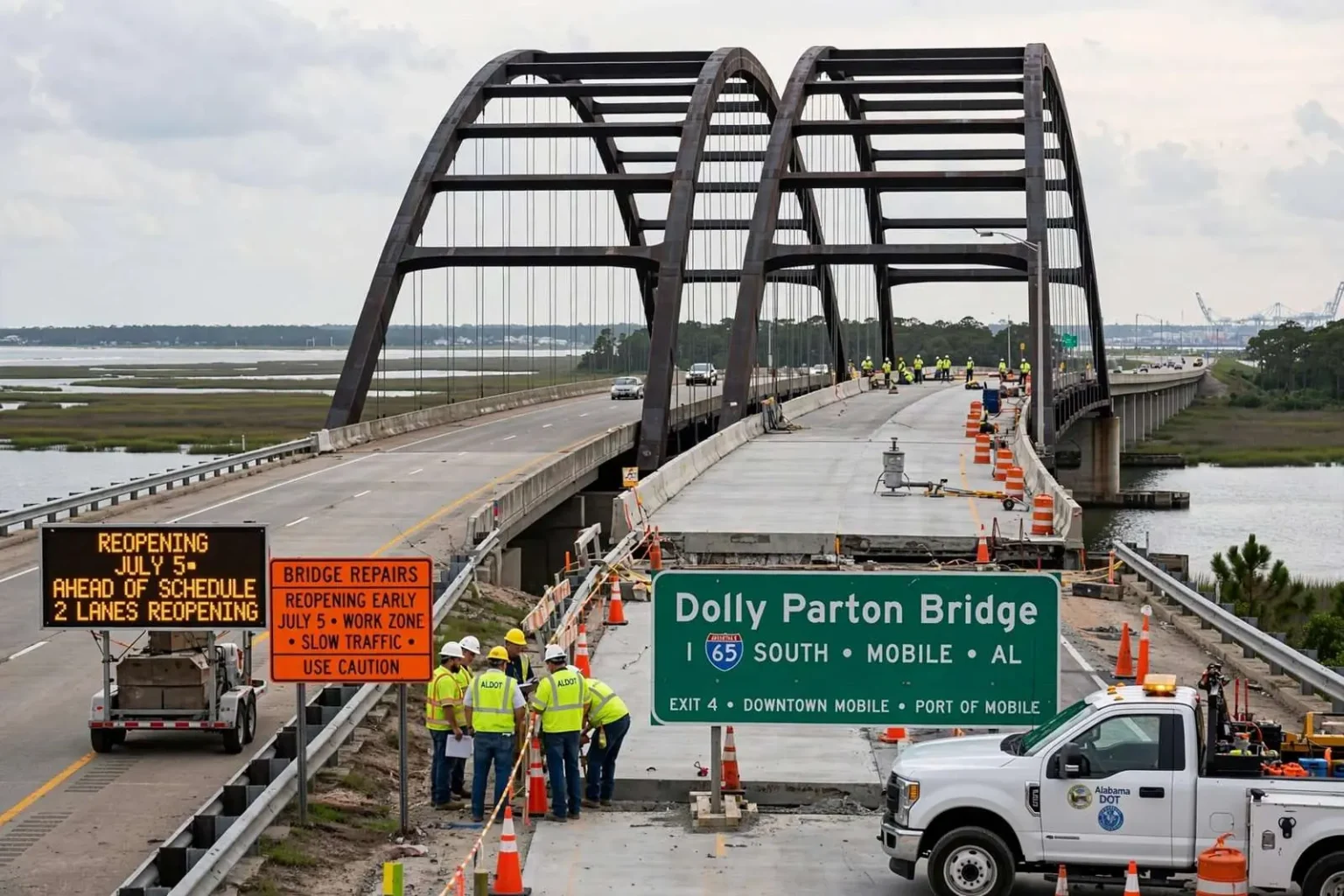
Crews repairing a damaged span of Interstate 65 near Mobile are running well ahead of schedule, according to state transportation officials, with the bridge now expected to reopen days earlier than originally planned. The announcement brought relief to commuters and freight haulers who have endured nearly two weeks of single-lane traffic on one of the region’s most important highway links.
The bridge, known locally by its nickname referencing its distinctive twin-arch design, had been down to a single open lane for nearly two weeks after a serious traffic accident in late May left a man dead and damaged the structure. The crash forced engineers to close half the crossing while they assessed whether the span could safely carry the roughly 80,000 vehicles that use the corridor on a busy day, and drivers have been squeezing through the remaining lane ever since.
Alabama Department of Transportation officials announced that after 12 days of repair work, the bridge should be fully complete and reopened on or before July 5, well ahead of a previously announced July 15 target. A department spokesperson credited around-the-clock work by the repair contractor, along with unusually cooperative weather, for helping push the timeline up by 10 days. Summer thunderstorms, which routinely interrupt outdoor construction schedules along the Gulf Coast, largely stayed away during the repair window.
The final concrete pour on the structure was scheduled for the evening the announcement was made, with plans to reopen the roadway as soon as the concrete reached the necessary strength to safely carry traffic. Engineers test concrete strength as it cures, and crews planned to monitor the new deck until it hit the threshold required for full traffic loads rather than waiting out a fixed calendar window.
A contract built for speed
The state’s response began almost immediately after the crash. Inspectors spent the first days evaluating the structural damage while crews set up the traffic control that kept the remaining lane open, and department officials used that assessment period to draft the emergency repair solicitation. Bidding was handled on an accelerated basis so that a contractor could be selected and mobilized without the lengthy procurement cycle a standard project would have required, and the winning firm started work just weeks after the accident occurred.
Repair crews faced a scope of work that included replacing damaged structural elements, pouring new concrete decking and restoring the barrier systems and striping that guide traffic across the span. Working around the clock in two shifts, crews were able to compress tasks that would normally proceed sequentially, with concrete curing time representing the final constraint that dictated when traffic could return.
Once repairs are finished, both lanes of the bridge’s southbound side will reopen after crews remove a temporary traffic control barrier that has been separating work zones from moving traffic throughout the project. Barrier removal and striping are relatively quick tasks, which is why officials expressed confidence in the accelerated reopening date once the concrete work was complete.
The contractor was awarded the repair job for roughly $2.3 million in mid-June, under a 25-day contract that began June 21. The agreement includes a built-in incentive: for every day the contractor finishes ahead of the deadline, it earns an additional $50,000, an amount state officials say reflects the calculated cost to drivers of having the bridge only partially open. If the work is completed by July 5, as now expected, the contractor could earn as much as $500,000 in bonus payments.
Incentive clauses of that size are not typical for routine road projects, but transportation departments use them when the public cost of a closure outweighs the construction bill. Transportation planners estimated that a partially closed interstate crossing imposes real economic losses on the region every day, from lost commuter time to delayed commercial freight, and the bonus structure was designed to convert some of those avoided losses into contractor earnings.
Why the bridge matters to the region
The bridge is a critical connector for traffic flowing along the Interstate 65 corridor in and out of the Mobile area, and the accelerated repair timeline is expected to ease traffic bottlenecks heading into the busy summer travel season. The corridor carries local commuters, beach traffic headed toward the Gulf Shores area, and a heavy volume of commercial trucks moving goods between Montgomery, Mobile and the Port City’s terminals.
With half the crossing closed, delays rippled well beyond the bridge itself. Drivers detoured onto parallel routes, pushing heavier traffic onto city streets and state highways that were never designed to carry interstate volumes, and businesses near the affected interchanges reported slower customer traffic. Every day of the accelerated schedule therefore translated into measurable relief for communities on both sides of the crossing.
The accident that damaged the span underscored how vulnerable even major infrastructure can be to a single collision. When a vehicle crash involves fire or impact against structural elements, engineers must inspect for damage to beams, decks and supports before allowing traffic back over the structure, and repairs of that kind cannot be improvised. The state’s ability to bid the job quickly, lock in a contractor and start work within weeks of the damage reflected an emergency contracting process designed for exactly this kind of situation.
What drivers can expect next
Transportation officials urged drivers to remain cautious during the final days of the project, noting that work zones would still be active until the barrier came down. Once both southbound lanes reopen, traffic patterns along the corridor should return to normal just ahead of the July Fourth holiday period, one of the heaviest travel weeks of the year on Gulf Coast interstates.
Emergency contracting of this kind has become a familiar tool for state transportation departments facing sudden infrastructure damage, whether from collisions, storms or washouts. The approach trades some of the deliberateness of a normal bid process for speed, relying on incentive clauses and tight oversight to keep quality from suffering. On this project, department engineers inspected the repaired elements at each stage, and the concrete strength testing served as the final quality gate before the reopening.
The department also reminded motorists that the bridge’s distinctive twin-arch design has made it a recognizable landmark for travelers along the corridor, which is how the structure picked up its affectionate local nickname over the years. For now, the more meaningful sight for drivers will be an open roadway, two full lanes and the end of a repair saga that could have stretched much deeper into the summer.
State officials said they would continue monitoring the repaired section in the weeks after reopening, as is standard practice following structural repairs, and thanked drivers for their patience during the closure. The combination of a motivated contractor, cooperative weather and an incentive-laden contract turned a projected mid-July reopening into a late-June finish, and left the traveling public with a working bridge heading into the peak of the summer season.
For regional planners, the episode also fed into ongoing conversations about redundancy along the Gulf Coast highway network. A single crash on a major crossing can disrupt travel for weeks, and planners have long pointed to the value of parallel routes and resilient design when interstates carry as much traffic as I-65 does through the Mobile area. The quick repair did not resolve those broader questions, but it demonstrated how fast the state can respond when a critical link goes down.
Commercial interests paid particularly close attention to the repair timeline. Trucking companies routing freight between the Port of Mobile and inland markets had been building the single-lane delay into their schedules, and an early reopening meant those adjustments could be dropped days sooner. Retailers along the corridor, accustomed to summer tourist traffic passing their doors, likewise welcomed the return of normal traffic flow before the Independence Day weekend.
The repair contract’s structure may also serve as a template for future emergency work. Transportation officials noted that day-by-day incentives give contractors a clear financial reason to mobilize extra crews and equipment, and the 10-day improvement achieved on this project offered concrete evidence that the approach pays for itself when measured against the cost of a prolonged closure.
Safety officials used the reopening as an occasion to remind drivers about work zone awareness generally. The late May crash that started the whole episode happened in traffic, not in a construction zone, but the weeks of repair that followed put workers within feet of live traffic every day. State statistics consistently show that work zone crashes rise when drivers speed or drift through narrow lanes, and officials asked motorists to carry the same caution they showed during this closure into every active work zone they encounter.
As the barrier came down and both lanes returned to service, the episode closed with the region’s busiest interstate crossing back at full capacity ahead of the holiday rush, a contractor collecting a substantial early-finish bonus, and a transportation department with a fresh demonstration that aggressive scheduling and financial incentives can compress repair timelines that once would have stretched across an entire summer.