‘Dolly Parton Bridge’ Repairs on I-65 Tracking Toward July 15 Finish
Repairs to the I-65 Gen. W.K. Wilson Jr. Bridge, known locally as the Dolly Parton Bridge, remain on pace for July 15.
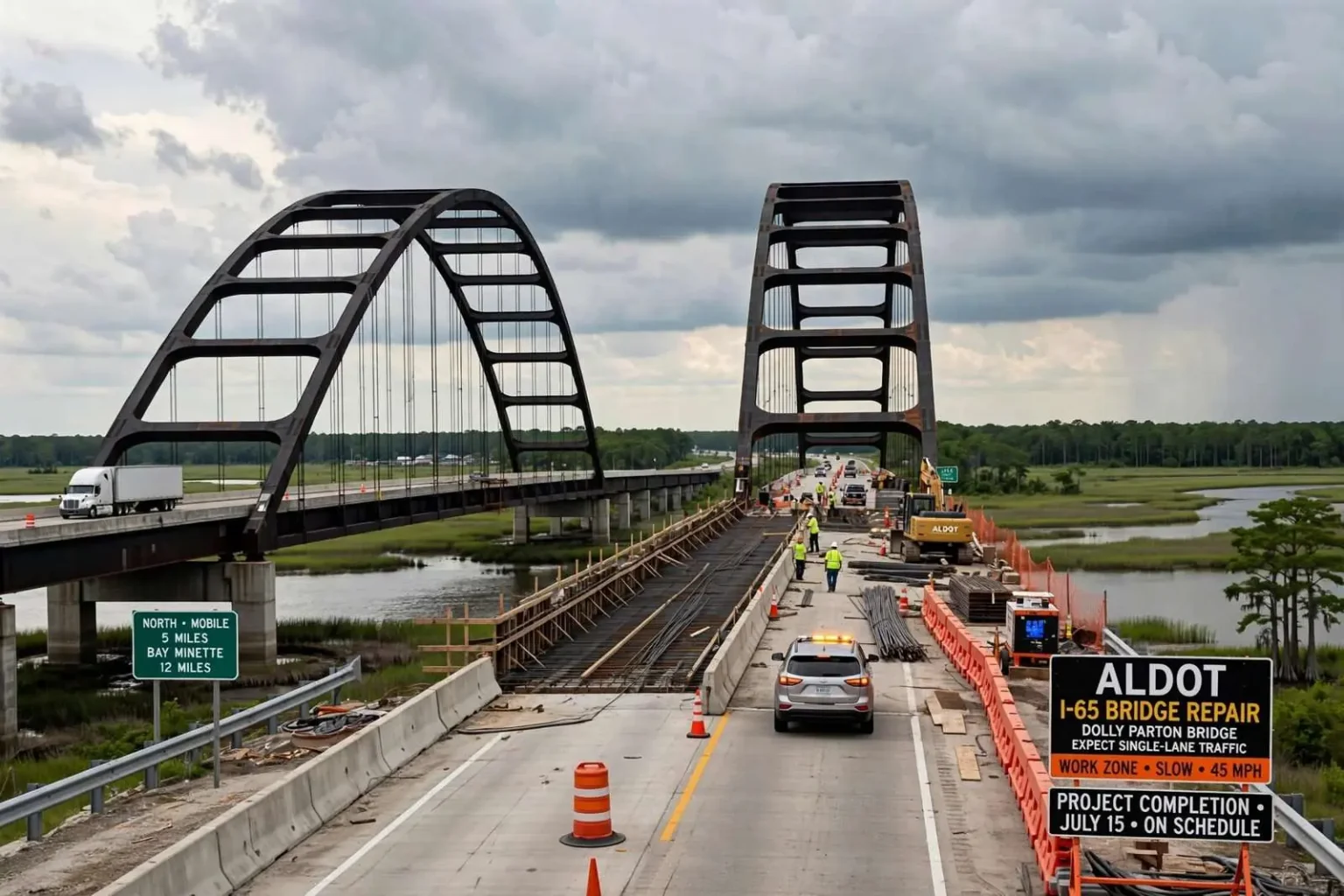
MOBILE, Alabama — A week into repair work on the Interstate 65 Gen. W.K. Wilson Jr. Bridge, Alabama Department of Transportation officials say the project remains on schedule for a July 15 completion. The timeline matters to thousands of drivers who cross the span daily, because the bridge is the primary interstate link between Mobile and the fast-growing communities of the northern corridor, and even single-lane conditions ripple through commute times on both ends.
Demolition and steel work finished
ALDOT construction engineer Brian Aaron said crews had completed all necessary demolition on the span, along with heat straightening work finished the night before his update. With that phase behind them, the contractor has moved on to placing forms and installing reinforcing steel ahead of pouring a new concrete bridge deck. The sequence is standard for this kind of repair: once damaged sections are removed and bent steel is straightened, the formwork and rebar create the skeleton into which new concrete is poured, tying the repaired sections back into the original structure. Heat straightening, in particular, is a controlled technique that uses repeated application of heat to gently coax bent steel members back into alignment without replacing them, saving both time and material on a compressed schedule.
Aaron said crews have had to work around summer rain showers nearly every evening but still expected to pour concrete over the coming weekend. Gulf Coast summers make weather management a constant variable on road projects of this kind, with afternoon and evening thunderstorms capable of halting concrete pours on short notice. Pouring concrete on a bridge deck requires a dry window from start to finish, so contractors build schedules around forecast gaps and work quickly when one opens. Holding the schedule despite the daily storms is a signal that the contractor has built enough float into the plan to absorb routine weather delays, and it suggests the remaining milestones — the pour itself, curing, and finishing work — are being sequenced with the same discipline.
A bridge known for its silhouette
The span, officially named for Gen. W.K. Wilson Jr., carries the popular nickname the Dolly Parton Bridge among locals, a reference to the shape of its twin support towers as drivers approach from a distance along the interstate corridor linking Mobile and Baldwin counties across the Mobile-Tensaw Delta. The nickname has circulated for decades and appears on T-shirts and roadside conversation alike, even though the official dedication honors the Mobile native and decorated Army general who rose to command American forces during World War II. The twin towers rising out of the delta wetlands make the bridge one of the most recognizable structures on the Gulf Coast, and for many travelers it marks the traditional gateway between the port city and the beaches and growing suburbs to the northeast.
The bridge crosses one of the most ecologically significant landscapes in the country. The Mobile-Tensaw Delta is a vast network of rivers, bayous, bottomland hardwoods and marshland through which the Alabama and Tombigbee rivers flow together on their way to Mobile Bay, and it supports an extraordinary range of fish, birds and other wildlife. Building and maintaining a highway crossing over that environment carries engineering constraints that ordinary overland projects never face — deep foundations driven far below the waterline, corrosion from brackish air and water, constant exposure to wind and storms coming off the Gulf — which is one reason repairs to the span draw attention well beyond the immediate traffic impacts. The structure must endure a delta climate that is punishing on steel and concrete alike, and periodic repair work is part of the cost of keeping such a crossing in service.
Repairs followed a fatal accident
The repair project followed a May 22 traffic accident on the bridge that left a man dead, prompting the transportation department to move quickly on the fix. The crash damaged enough of the structure that engineers ordered repairs before normal traffic could safely resume across both spans, a decision that reflects the priority ALDOT places on structural integrity over convenience on its highest-volume routes. When a bridge deck or its supporting steel takes impact damage, engineers evaluate the affected members immediately, because hidden stress in steel or compromised concrete can worsen under the repetitive loading of thousands of vehicles a day.
McInnis Construction LLC was awarded the $2.3 million repair contract on June 13. A week later, on June 20, ALDOT shifted all interstate traffic onto the southbound span, creating a single lane of travel in each direction while work proceeded. The 25-day contract officially began the next day, June 21, putting the mid-July completion date within reach if the pace holds. The compressed schedule is aggressive for bridge deck work of this scale, and it reflects both the urgency of restoring full capacity to the corridor and the contractor’s confidence in the phased approach — demolition and steel repair first, then forming and rebar, then the concrete pour that ties everything together. Each phase hands off directly to the next, and slipping on any one of them would push the completion date past the contract window.
Running two-way traffic on a single span is a familiar arrangement on Alabama interstate projects, but it changes the driving experience significantly. Head-to-head lanes with narrow shoulders demand more attention from drivers, and law enforcement agencies typically increase patrols through work zones during such phases to discourage speeding. The state’s move-fast approach after the accident also illustrates how a single severe crash on a structure like the Wilson Bridge can reshape travel patterns for weeks, with commuters, freight haulers and beach-bound summer traffic all funneling through the same narrowed bottleneck.
What drivers can expect
Motorists traveling the heavily used I-65 corridor between Mobile and points north have continued to experience single-lane traffic in each direction during the repair window. ALDOT has not indicated any additional delays beyond the original schedule, and the coming concrete pour represents one of the final major steps before the bridge deck work is wrapped up. After the pour, crews will need time for the concrete to cure to sufficient strength before traffic loads shift back onto the repaired surface, and final striping, barrier adjustments and inspections typically follow before all lanes reopen. Those finishing steps are quick compared with the structural work, but they are essential to handing the span back to the public in better condition than before the crash.
For now, drivers are advised to build extra time into trips through the corridor, particularly during morning and evening peaks when volume is heaviest. Freight traffic between the Port of Mobile and points north, daily commuters between the city and communities along the interstate, and summer travelers heading toward Baldwin County’s beaches all converge on this stretch, so even modest slowdowns compound quickly. ALDOT encourages drivers to check updated project information before traveling and to use caution through the work zone — reduced speeds, mandated lane discipline and heightened enforcement are all standard while crews work just feet away from live traffic, and worker safety depends as much on driver behavior as on the barriers between them.
If the schedule holds, the July 15 completion will restore full two-span traffic flow to the corridor and close out a repair effort that moved from fatal crash to contract award to near-completion in under two months. For a structure as heavily used and as visible as the Dolly Parton Bridge, that pace is a reminder of how quickly the state can mobilize on critical infrastructure when conditions demand it — and of how much the region depends on the delta crossing staying open, whether drivers know it by its official name or the nickname everyone uses anyway.
The speed of the response is worth noting for residents who follow infrastructure issues along the Gulf Coast. From the accident in late May to a contract award in mid-June to traffic shifts and phased demolition within days of that award, the project has moved at a pace that is uncommon for public construction work of any kind. Emergency repair contracts like this one are structured differently from routine projects: instead of a lengthy design-and-bid cycle, the state prequalifies contractors capable of mobilizing immediately and negotiates terms that let crews begin work while planning for later phases continues in parallel. The tradeoff is typically a premium on flexibility, but in return the corridor gets its capacity back weeks or months sooner than a conventional process would allow.
The Wilson Bridge itself has been a fixture of the corridor since it opened as part of the interstate system that reshaped travel across the Southeast. Rising over the delta north of Mobile, it carries the traffic of an entire region: port-bound freight heading to and from the busiest container terminal on the Gulf, commuters linking Baldwin County’s growth centers with jobs in the city, and seasonal travelers streaming toward the beach communities that anchor the coastal economy. Any disruption to the span is felt well beyond the bridge itself, on alternate routes that lack the capacity to absorb the overflow and on the local roads that connect to them.
That is why ALDOT’s running updates during the repair window have drawn attention from drivers on both sides of the delta. Knowing that demolition is finished and steel work is straightened tells commuters the end of the bottleneck is approaching; knowing the concrete pour is imminent tells them the most visible phase is nearly complete. Transportation officials have generally found that regular, specific communication about work zone progress reduces driver frustration and improves compliance with reduced speeds, both of which matter in a work zone where crews are exposed to live traffic.
Once the project wraps, the corridor returns to normal, but the episode leaves behind a familiar lesson for the region: the delta crossing is both indispensable and vulnerable, a single point of failure for a metropolitan area that keeps growing around it. Keeping it safe is continuous work, and the crews who spent their summer evenings dodging rainstorms over the Mobile-Tensaw Delta have, by all accounts so far, delivered it on time.