Crews Finish Rapid Repairs to Mobile’s ‘Dolly Parton Bridge’ Ahead of Schedule
Contractors finished repairing storm-damaged decking on Mobile's I-65 Wilson Bridge in about two weeks, potentially earning a hefty completion bonus.
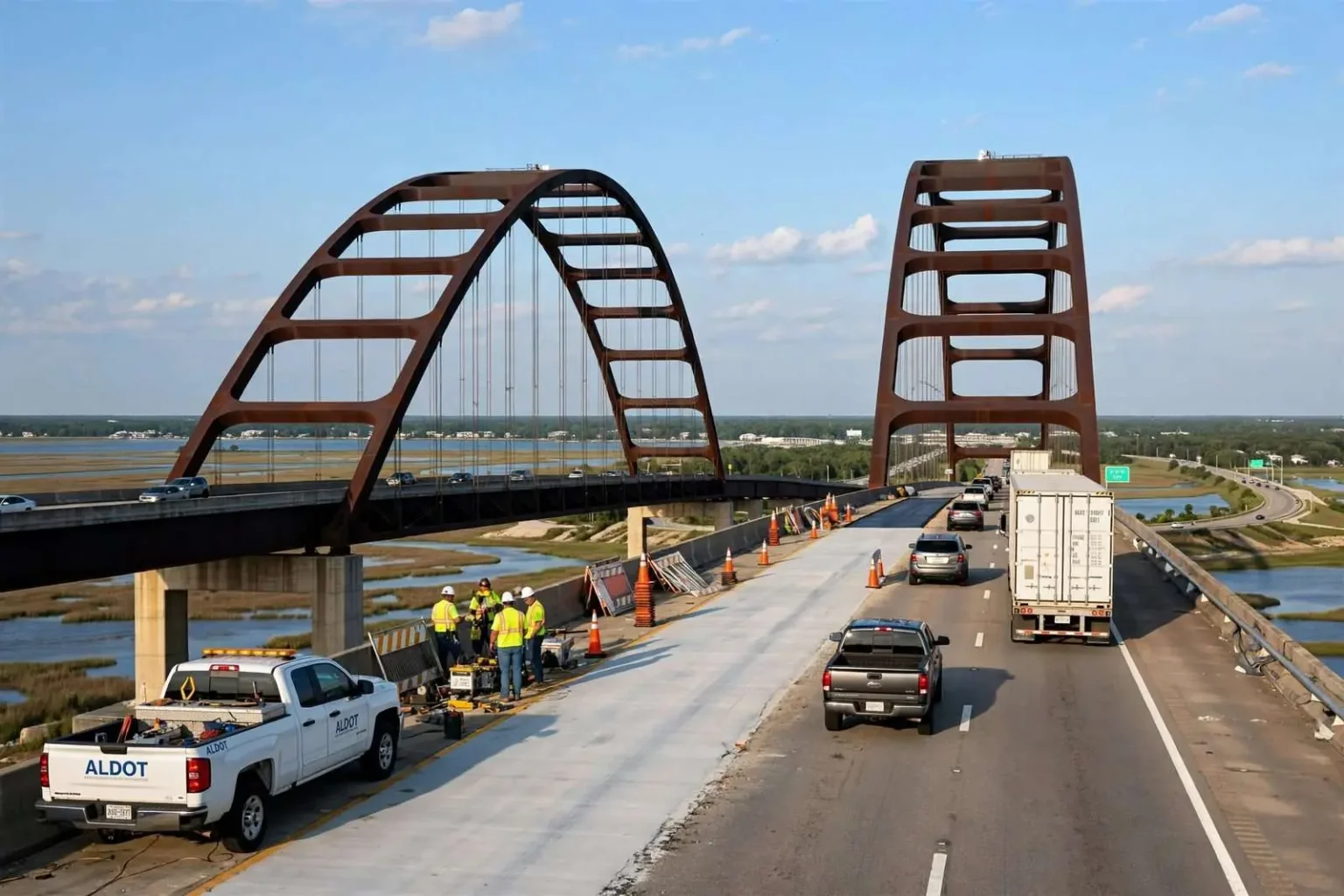
A bridge that originally took two years to build was patched up in a fraction of that time this summer, after crews raced to repair storm and crash damage on one of Mobile’s busiest highway crossings. The Gen. W.K. Wilson Jr. Bridge, better known locally as the Dolly Parton Bridge for its distinctive twin-peaked profile, carries Interstate 65 traffic across the Mobile River and has been in service since 1980. The crossing is a lifeline for the region’s freight network — the most direct route between Mobile and Montgomery for the trucks that move the Port of Mobile’s cargo — and any extended closure there ripples through the supply chains of the entire central Gulf Coast.
The Damage That Started the Clock
The bridge suffered significant damage in May, when a tractor-trailer slammed into the back of another 18-wheeler that had already stopped for a separate crash, damaging roughly 250 feet of the bridge deck. The chain-reaction wreck underscored the vulnerability of the span’s traffic flow: with limited maneuvering room and heavy truck volumes, a single incident on the bridge can quickly become a multi-vehicle event, and this one left engineers with a stretch of deck too damaged to trust under daily traffic.
Given that an estimated 30,000 vehicles cross the span each day, Alabama Department of Transportation officials moved quickly to get repairs underway. Montgomery-based McInnis Construction was awarded a $2.3 million contract to complete the repairs within 25 days, with work formally beginning June 21. The 25-day window was an aggressive one for bridge deck work, and ALDOT knew it — which is why the department structured the contract the way it did.
To speed things along, ALDOT structured the deal as an incentive and disincentive contract, meaning the contractor stood to earn significant bonus money for finishing ahead of schedule, calculated based on the cost to the public of prolonged lane closures. The approach has become standard practice for high-impact highway projects: rather than accepting a low bid on a slow timeline, the state pays a premium for speed and recovers the cost in reduced traffic delay. Every day the Dolly Parton Bridge ran at reduced capacity, the region paid in lost time, detoured freight and fuel — and the contract put a dollar figure on exactly that.
The Incentive Math
According to an ALDOT project manager, the incentive was set at $50,000 for every day the work finished early, meaning a contractor completing the job by the target date of July 5 could earn as much as an additional $500,000 on top of the base contract. Officials said the final bonus amount would depend on when the new concrete cured and the roadway was certified ready for traffic. The structure cut both ways: the disincentive clause meant the contractor also faced penalties for running late, keeping the financial pressure pointed firmly at a fast, clean finish.
An ALDOT construction engineer said the project moved faster than officials had initially anticipated, allowing the bridge to reopen to full traffic ahead of the original projection and minimizing disruption for commuters and freight haulers who rely on the corridor daily. For a crossing that carries everything from port-bound container trucks to Birmingham-bound families on summer trips, a reopened span a day early was worth every dollar of the incentive — and the rapid completion meant the repair was measured in weeks, not the months a traditional contract might have consumed.
How the Work Unfolded
The repair process unfolded in stages to keep some traffic moving throughout construction. In mid-June, crews narrowed the southbound side of the span, shifting traffic into fewer lanes while demolition and deck replacement began on the damaged section. The staged approach is the standard playbook for repairs on a bridge with no practical detour: closing it entirely would push 30,000 vehicles a day onto alternate routes that were never built to absorb that volume, so the contractor worked around live traffic instead.
Bridge deck repair of this kind is demanding, exacting work. Crews sawed out the damaged concrete down to the reinforcing steel, replaced corroded rebar where the impact had compromised it, and poured new deck panels in sections — each of which then needed time to cure before it could carry the weight of fully loaded trucks. The July heat that makes Gulf Coast summers miserable for people is actually a help to concrete crews, accelerating cure times, which worked in the project’s favor as the July 5 target approached.
The demolition and replacement sequence also required constant coordination with traffic control. Lane shifts on a bridge deck leave no margin for error, and ALDOT kept crews, inspectors and law enforcement coordinated through the entire window to protect both the workers and the passing traffic. Speed was the goal, but the deck still had to meet the same load-rating standards as any new construction before the full span could reopen.
A Bridge With a Story
The Wilson Bridge has carried a nickname almost as long as it has carried traffic. Locals christened it the Dolly Parton Bridge years ago for the pair of arched peaks that rise over the Mobile River, a silhouette visible for miles across the delta. The formal name honors Gen. W.K. Wilson Jr., a Mobile native and decorated Army engineer, and the crossing itself — twin arches spanning the water just north of the Cochrane-Africatown USA Bridge corridor — has become one of the most recognizable landmarks on the drive between Mobile and the rest of Alabama.
The nickname has outlived repeated attempts to use the formal name, and it is now a genuine piece of Gulf Coast folk geography. Radio traffic reporters use it, truckers use it on the CB, and out-of-state drivers arriving from the north know they are almost to Mobile when the twin peaks rise out of the delta. The bridge’s profile also makes it a periodic photography subject, particularly at sunset, when the arches frame the sky over the river bottoms. For all its fame, though, the span is first and foremost working infrastructure — a piece of the interstate system that has carried five decades of Alabama traffic and, after this summer’s repair, is positioned to carry decades more.
Contractors who specialize in emergency bridge work are a small and specialized community, and McInnis Construction’s performance on the 25-day contract will follow it. The state awards emergency and incentive contracts only to firms it believes can deliver under that kind of pressure, and an ahead-of-schedule finish on a signature crossing is the strongest credential a contractor in this field can earn.
Why This Crossing Matters So Much
Interstate 65 is the backbone of north-south freight movement through Alabama, and the Mobile River crossing is one of its most critical links. Trucks hauling containers from the Port of Mobile, timber products from the piney woods, and chemicals from the industrial corridor all funnel across the span, as do the commuter flows between Mobile and the growing communities to the north. When the bridge is restricted, the detours are punishing: traffic diverts through downtown interchanges or onto U.S. highways that add time and cost to every trip.
The swift repair was also a morale marker for the region. Motorists who remember the crash-damaged closures of past decades know that bridge work on this scale can drag on, and watching crews finish a $2.3 million deck repair in roughly the time it takes to plan it sent a clear message about how the state handles critical infrastructure. The incentive-disincentive model, once novel, has proven itself repeatedly on Gulf Coast projects — and the Dolly Parton Bridge repair is the kind of case study transportation officials cite when defending the approach.
What Drivers Should Take From It
For daily commuters and truckers, the episode is a reminder of both the bridge’s importance and its fragility. A single crash can damage hundreds of feet of deck and constrain a corridor used by tens of thousands of people, and there is no quick detour around the Mobile River on I-65. Safe following distances on the span — especially in the sudden Gulf Coast downpours that reduce visibility and stretch stopping distances — are the cheapest insurance the traveling public can buy.
When the barriers came down and the full bridge reopened ahead of schedule, traffic on Interstate 65 returned to its normal rhythm, and one of the Gulf Coast’s busiest crossings went back to doing silently what it has done since 1980: carrying the region’s commerce and commuters across the Mobile River, two distinctive arches at a time. The two years it took to build the bridge had become a piece of local lore; the few weeks it took to save it became, for ALDOT, proof of what happens when money and motivation point the same way.
Officials with the state transportation department have noted that the incentive-disincentive structure is not a giveaway but a trade: the maximum $500,000 bonus, if earned, is far smaller than the economic cost of even a few extra days of restricted traffic on a corridor carrying 30,000 vehicles a day. That calculus — measured in freight hours, fuel and commuter time — is what makes speed worth paying for on a crossing of this importance, and it is why the department has leaned on the model repeatedly for Gulf Coast projects where every closure day carries a real public price.